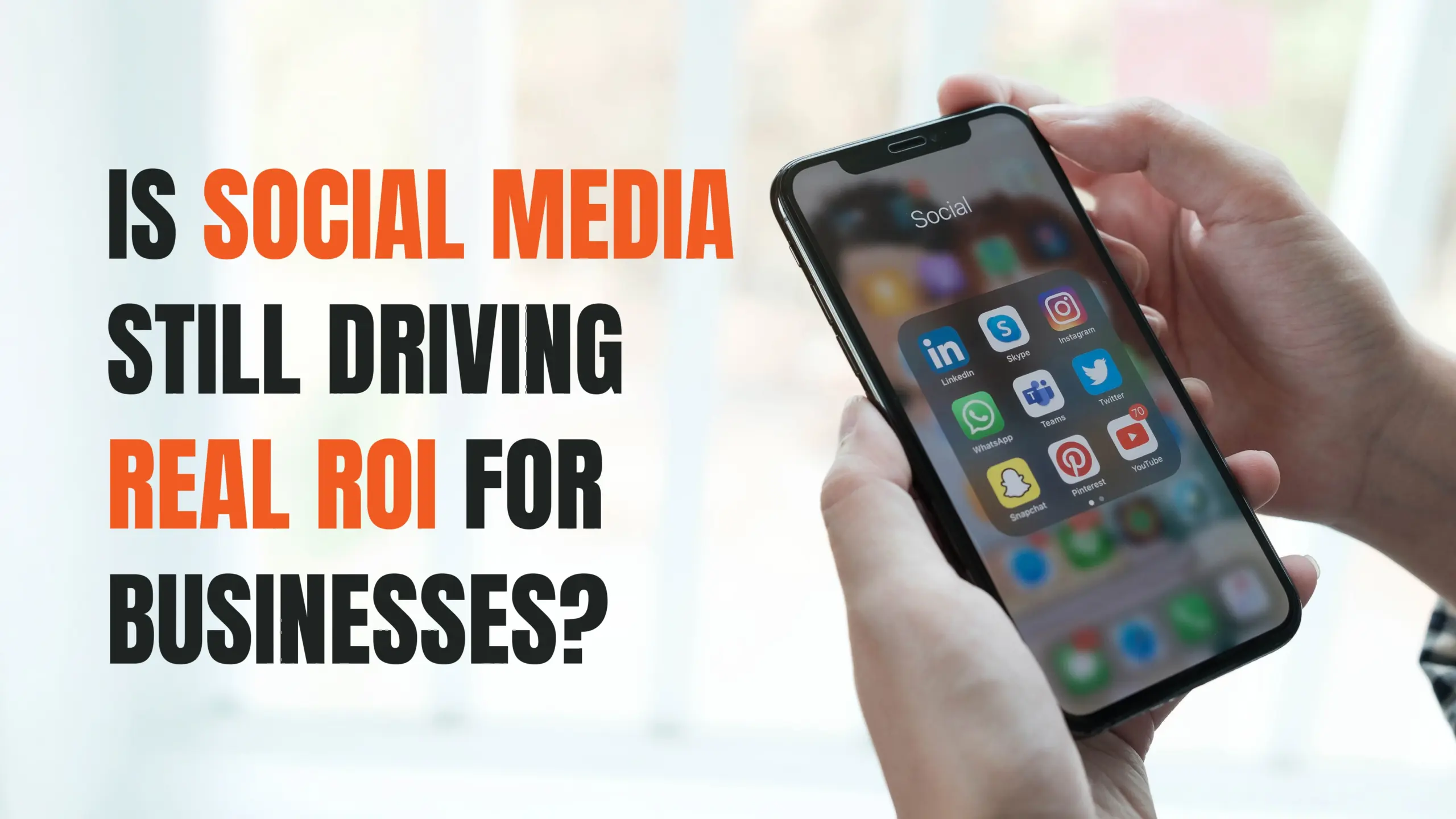
Is Social Media Still Driving Real ROI for Businesses?
Do you ever think..
You post consistently.
You try the latest trends.
You might even run ads.
But when you look at your bottom line, one painful question remains: Is any of this actually making money?
If you’ve ever questioned whether social media for business still delivers results, you’re not alone.
The market has moved well beyond the old “post-and-pray” approach. According to Forrester’s 2026 insights, social media has become the most influential publishing channel for B2B brands, shaping how buyers research, engage, validate, and ultimately make confident purchase decisions.
But here’s the reality check: Social media isn’t dead. The playbook is dead.
What worked in 2023 no longer works in 2026. Platforms have evolved, audience behavior has changed, and measuring success requires more than counting likes.
This isn’t another fluffy article about “engagement.” This is a straight-talking guide that will:
- Show you the 2026 social media trends that actually matter.
- Diagnose exactly why your social media is not generating leads or sales.
- Give you a clear, step-by-step method to track and measure social media ROI.
- Provide an actionable framework to turn your social channels into real profit centers.
Let’s cut through the noise and find out if social media can still drive real business value.
Table of Contents
Social Media Trends 2026: What Actually Matters for ROI
According to Hootsuite’s 2026 Social Trends Report, the key shifts are:
1. AI-Powered Personalization at Scale: Platforms are using AI to show content to hyper-specific niches. For businesses, broad content no longer delivers results. Success requires creating content tailored to specific customer pain points and stages in their journey.
2. The Rise of “Search-and-Solve” Behavior: Young users are not using Google much anymore.
They search on TikTok and Instagram to find answers and reviews. If your business isn’t creating real-time and problem-solving content, you will lose out somewhere.
3. Social Commerce Maturation: The path from discovery to purchase is shorter than ever. Features like Instagram Shops, TikTok Shop, and Pinterest Product Pins are no longer tests; they are essential sales channels. Your social media strategy must seamlessly connect inspiration to transaction.
4. Authenticity Over Production Value: Highly polished, corporate-style ads see lower engagement. Raw, authentic, behind-the-scenes, and user-generated content (UGC) builds more trust and drives higher conversion rates.
The takeaway? Social media advertising ROI in 2026 hinges on being helpful, shoppable, and human, not just being present.
Why Your Social Media is NOT Generating ROI?
You’re posting every day, but the leads aren’t coming in.
If you’re wondering, “Why isn’t social media bringing me clients?” one of these five issues is likely the problem.:
1. You’re Talking to Everyone (And Therefore, No One): Posting generic industry news or random company updates doesn’t attract buyers. You’re creating “awareness content” without a social media for business funnel to convert that awareness. An effective social media campaign ROI starts with a defined target audience and a specific offer for them.
2. The “Black Hole” of No Tracking: You get a few website clicks from LinkedIn, but what happened after that? If you can’t connect a social media click to a lead form submission, demo booking, or sale, you will never know your true social media ROI. This is the most critical failure point for businesses.
3. Platform Misalignment: You’re pouring effort into creating Instagram reels for a B2B service whose decision-makers primarily network on LinkedIn. Or you’re writing long-form articles on Facebook where the algorithm favors short video. Your platform choice must match where your ideal customers actively seek solutions.
4. Content-Offer Disconnect: You post a great infographic (engagement!), but the next post is a hard-sell product link (ignored!). There’s no bridge. Engaging content must naturally lead to a relevant, valuable offer (e.g., a checklist, webinar, or free audit) that captures lead information.
5. Expecting Organic to Do the Heavy Lifting: The golden age of free organic reach is over, especially for businesses. Relying solely on organic social media for direct sales is like expecting a billboard on a side street to drive a million in revenue. In 2026, a paid amplification strategy is non-negotiable for consistent social media advertising roi.
Platforms That Still Deliver Strong Business ROI in 2026
Not all platforms are created equal for ROI. Your choice depends entirely on your social media for business model: B2B, B2C, service, or e-commerce. Here’s the 2026 platform-by-platform reality check:
| Platform | Core Strength & Best For | Primary ROI Focus & Tactics | Key 2026 Statistic & Insight |
|---|---|---|---|
| B2B Lead Generation. Unmatched for reaching professionals and decision-makers. | High-quality leads. Use targeted Sponsored Content, Message Ads, and authority-building articles to generate qualified leads and drive conversions. | Used by 42% of marketers, a significant 11% increase from 2024, highlighting its growing value for professional audiences. | |
| Meta (Instagram & Facebook) | Broad Reach & Social Commerce. Instagram excels for visually-driven D2C brands; Facebook for community and retargeting. | Direct sales & retargeting. Leverage Instagram Shops for sales, Reels for discovery, and Facebook’s powerful ads for retargeting website visitors. | Instagram is the most-cited platform for ROI, and 43% of marketers rank Facebook as a top ROI driver, proving their combined power. |
| TikTok | Top-of-Funnel Discovery & Brand Awareness. Ideal for reaching new, younger audiences with engaging content. | Awareness to consideration. Focus on entertaining, problem-solving short-form videos to attract cold audiences and funnel them to your website or other platforms. | 32% of marketers say TikTok consistently offers the highest ROI, and it’s the platform most plan to use in 2026, as reported by HubSpot. |
| Top-of-Funnel Discovery & Brand Awareness. Ideal for planned purchases and niche audiences. | Sustainable traffic & sales. Create inspirational, keyword-rich pins that drive traffic and sales over months. Ideal for lifestyle, home, and fashion. | 22% of marketers now use Pinterest (a 6% year-over-year increase), indicating its resurgence for planned purchases and niche audiences. |
Key Question: Does social media marketing work for small businesses? Absolutely. The secret is to dominate ONE platform where your customers are, rather than stretching thin across four.
Organic vs Paid Social Media: What Actually Works Now?
Let’s settle this debate with a clear analogy.
Organic Social Media is your brand’s voice and community hub. It’s for building trust, providing customer service, sharing culture, and nurturing existing followers. Its ROI is indirect—brand loyalty, customer retention, and content that fuels paid ads.
Paid Social Media is your targeted sales and lead generation engine. It’s for putting your solution directly in front of people actively looking for it (or who match your ideal customer profile). Its ROI should be direct and measurable.
The Verdict: You need both, but with the right expectations. Use organic to build the relationship and paid to drive the scalable business result. In 2026, trying to grow a business using only organic social is an uphill battle against powerful algorithms designed to prioritize paid content.
Content That Drives Measurable Results
Forget “viral” content. Aim for valuable content that moves the needle. Here are the high-ROI content types for 2026:
1. Problem-Solution Demonstrations: Short videos that clearly show how your product/service fixes a common issue. (e.g., “Here’s how our software automates this 30-minute report in 2 clicks”).
2. Expert Insight & Data: Share a surprising statistic from your industry and explain what it means for your audience. This builds authority and attracts serious prospects.
3. Customer Success Stories & UGC: A video testimonial or a user’s post featuring your product is 10x more persuasive than your own ad. It provides social proof, which is a key social media ROI metric for trust.
4. Lead Magnet Teasers: Don’t just post your free guide. Create a 30-second video highlighting the one big tip inside it. The content is the ad for your offer.
How to Track and Measure Social Media ROI Properly
This is the most important section. Proving social media ROI is impossible without proper tracking. Here is your straightforward system:
Step 1: Define a $ Goal.
Stop with “more engagement.” Set goals like:
- Generate 20 qualified leads per month.
- Drive $5,000 in online sales.
- Book 15 discovery calls.
Step 2: Use UTM Parameters & Pixels.
This is non-negotiable. Use Google’s Campaign URL Builder to create trackable links for every post and ad. Install the Meta Pixel, LinkedIn Insight Tag, etc., on your website to track user actions.
Step 3: Calculate Using the Core Formula.
- SOCIAL MEDIA ROI (%) = [(Revenue Attributable to Social – Total Social Spend) / Total Social Spend] x 100
- Revenue: Tracked via your CRM (e.g., a lead source tagged “LinkedIn Ad Q4” that closed into a $10,000 deal).
- Total Social Spend: Ad budget + software costs + a fair estimate of employee/agency time.
Example: You spent $1,500 on ads and tools in a month. Tracked sales from those efforts totaled $9,000.
ROI = [($9,000 – $1,500) / $1,500] x 100 = 500% ROI
Step 4: Monitor Key Performance Indicators (KPIs)
For Leads: Cost per Lead (CPL), Conversion Rate from click to lead.
For Sales: Return on Ad Spend (ROAS), Conversion Value per Click.
For Awareness: Reach, Video Completion Rate (for top-of-funnel campaigns).
Using a social media ROI calculator (many free ones exist online) can help structure this math.
When Social Media Delivers the Highest ROI
Social media isn’t always the right channel. Its ROI skyrockets in these scenarios:
1. Your Audience is Actively on Social Platforms: For visually-driven (e.g., fashion) or innovation-driven (e.g., tech SaaS) industries.
2. You Have a Clear, Trackable Funnel: From ad → landing page → lead capture → sale.
3. You Can Commit to Consistency: Both in content publishing and ad budget. Sporadic efforts fail.
4. You’re Selling Mid-to-High Ticket Value: The lifetime value of a customer justifies the cost of acquisition via social ads.
5. Actionable Framework: How to Improve Your Social Media ROI in 90 Days
Follow this 90-day plan:
Month 1: Audit & Align.
- Pause all random posting.
- Audit your last 3 months: Which post actually drove a website visit or lead?
- Set one primary revenue-focused goal.
- Ensure all tracking (pixels, UTMs) is flawless.
Month 2: Create & Target.
- Develop 4-6 pieces of core “hero” content around your key customer problems.
- Pair each with a clear offer (guide, consultation, demo).
- Launch a focused paid campaign ($15-20/day) to boost this content to a tightly defined audience.
- How to track social media leads to sales: Use a dedicated landing page and a tracked phone number/form for this campaign only.
Month 3: Measure, Optimize & Scale.
- After 30 days of data, check your social media ROI metrics.
- Which ad creative worked? Which audience segment converted? Double down on what worked. Kill what didn’t.
- Re-invest the initial profit back into scaling the winning campaign.
Final Verdict: Is Social Media Still Worth It?
Yes, social media can deliver exceptional ROI in 2026, but only with a strategic, trackable, and paid-amplified approach.
The era of easy organic wins is over. Today, social media for business is a powerful revenue channel when treated with the same discipline as your sales team: clear goals, measurable outcomes, and constant optimization. The businesses seeing real returns are those that have moved from “doing social media” to running a social media strategy that’s integrated into their sales funnel.
Need help building a measurable, ROI-positive social media strategy? Ingenious Netsoft’s digital marketing experts specialize in creating data-driven campaigns that connect social efforts directly to your revenue.
Request your free quote today!
FAQ’s
Q1. What will social media look like in 2026?
Social media in 2026 is highly personalized, intent-driven, and commerce-enabled. Users rely on platforms to research, compare, and validate brands before buying, not just to scroll or socialize.
Q2. What is the state of social media marketing in 2026?
Social media marketing in 2026 is performance-focused and data-led. Organic reach has declined, while paid amplification, AI targeting, and measurable conversions now define success.
Q3. What is the social media strategy in 2026?
A winning social media strategy in 2026 centers on fewer platforms, clear funnel goals, and strong tracking. Content is built to educate, build trust, and move users toward a defined action.
Q4. What are the content marketing trends in 2026?
Content marketing in 2026 favors short-form video, problem-solving content, and authentic storytelling. Value, relevance, and credibility matter more than high production or viral formats.
Q5. Is social media still effective for business growth?
Yes, social media remains effective when aligned with business goals. Brands that combine organic content with targeted paid campaigns consistently drive leads and sales.
Q6. Which social media platforms matter most for businesses?
LinkedIn works best for B2B, Meta platforms excel at retargeting and conversions, TikTok supports discovery, and Pinterest drives long-term traffic. Platform choice depends on audience behavior.
Q7. How do businesses measure social media ROI?
Businesses track social media ROI using UTM links, tracking pixels, and CRM data. Metrics like cost per lead, return on ad spend, and attributed revenue provide clear performance insights.
Q8. What mistakes are businesses making with social media?
Common mistakes include relying only on organic reach, posting without a funnel, and ignoring performance tracking. These issues prevent social efforts from translating into revenue.