
How to Get Your Shopify Store Recommended by AI Shopping Assistants
According to 2025 consumer research by Bloomreach, more than 60% of shoppers have already used conversational AI tools like ChatGPT and Gemini to assist them with online purchases.
The momentum is scaling rapidly in 2026. A recent report by Gartner predicts a massive 25% drop in traditional search engine volume as consumers abandon classic search bars in favor of AI-powered conversational answers.
This behavioral shift presents an immediate challenge for online merchants: if your website architecture isn’t engineered for machine consumption, your products simply do not exist to these AI engines. To protect your market share in the US, UK, and Australia, you must shift your digital blueprint toward Generative Engine Optimization for e-commerce.
The good news? You do not need to be a software engineer to fix this. This guide will show you how to structure your Shopify store to win conversational AI recommendations and capture high-intent buyers before they ever see a list of links.
TL;DR
- The New Retail Reality: Shoppers are asking AI engines for specific product recommendations instead of browsing standard search result pages.
- The Secret to AI Rankings: Academic studies show that AI assistants favor exact numbers, facts, and trusted reviews over marketing hype.
- Technical Fixes Made Simple: Winning an AI recommendation requires clean background tags, high-speed page loading, and open bot access permissions.
- The Bottom Line: Organizing your online store into a machine-readable data source is mandatory to stay discoverable in the modern e-commerce landscape.
Table of Contents
Why AI Shopping Assistants Are Changing E-commerce Search
Traditional search engines display a ranked list of websites, leaving shoppers to compare products on their own. AI shopping assistants work differently. Instead of presenting ten blue links, they analyze multiple trusted sources, summarize product information, and provide direct recommendations based on the shopper’s specific request.
For example, instead of searching for:
“best wireless headphones”
Today’s shopper is more likely to ask:
“Which wireless headphones under $200 have active noise cancellation, work well for travel, and can be delivered to New York within three days?”
AI systems understand these conversational requests by combining product specifications, reviews, structured data, merchant credibility, and technical website signals.
Major AI platforms are already influencing purchase decisions:
- ChatGPT: Search synthesizes trusted web content into conversational answers.
- Google Gemini: Combines Google’s search ecosystem with AI-generated responses.
- Perplexity AI: Emphasizes citations, authority, and trustworthy sources when generating recommendations.
- Microsoft Copilot: Integrates AI-powered shopping assistance with Bing’s search index.
- Claude: Increasingly relies on high-quality, factual web content to answer product-related questions.
This shift means traditional keyword optimization alone is no longer enough. Businesses must combine strong SEO with Generative Engine Optimization for e-commerce to improve how AI understands and recommends their products.
Effective Shopify AI SEO focuses on making product pages rich in factual information, structured data, and clear technical signals that AI systems can easily interpret.
The Famous Princeton AI Study
Many store owners assume that getting recommended by AI requires paid partnerships, proprietary tools, or complex optimization techniques. Research suggests otherwise.
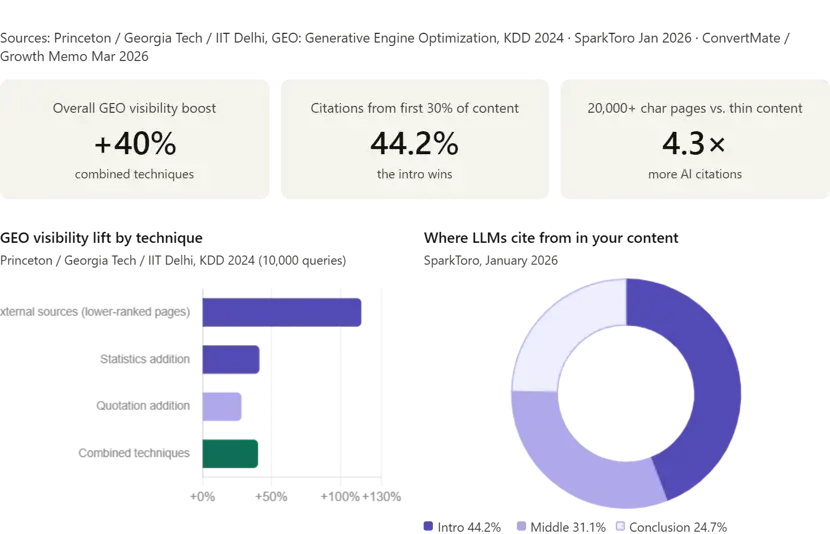
A landmark study conducted by researchers from Princeton University and Georgia Tech examined thousands of real-world queries across multiple AI search platforms to understand why some websites appeared in AI-generated answers while others were ignored.
The findings challenged many long-held SEO assumptions. Traditional tactics such as keyword stuffing or excessive promotional language produced little benefit. Instead, AI systems consistently favored content that was factual, specific, and easy to verify.
The researchers identified two major factors that significantly improved AI visibility:
Fact Density
AI models consistently preferred content containing measurable information such as dimensions, weights, pricing, materials, compatibility, specifications, and performance data. These details help language models confidently match products to highly specific shopping queries.
Verifiable Trust Signals
AI assistants prioritize information they can validate. Transparent customer reviews, warranty details, shipping policies, certifications, and clearly documented return policies all increase confidence in product recommendations.
The study reported visibility improvements of 30% to 40% when websites focused on factual, structured content instead of promotional copy. These findings reinforce why Generative Engine Optimization for e-commerce is becoming an essential strategy for online retailers.
If your goal is to optimize for ChatGPT search or improve performance against perplexity ranking factors ecommerce, your product pages must answer customer questions with precise, verifiable information rather than marketing claims.
Modern Shopify AI SEO is no longer about repeating keywords. It is about helping AI systems understand, verify, and confidently recommend your products through trustworthy, information-rich content.
Source: https://www.omnibound.ai/blog/generative-engine-optimization-statistics
3 Simple Steps to Make Your Store AI-Ready
Step 1: Ditch the Marketing Fluff—Give the AI Hard Facts
When humans write product descriptions, we tend to write like traditional marketers. We use emotional words to get people excited. Unfortunately, AI bots find emotional language completely useless and filter it out.
Look at the difference between what a traditional store writes versus what an AI-ready store writes:
- Traditional Copy (Ignored by AI): “Our gorgeous, high-quality leather backpack is absolute perfection! It is made from premium materials and is the best bag for your daily routine.”
- AI-Optimized Copy (Highly Recommended by AI): “An urban commuter backpack constructed from weather-resistant 500D nylon, weighing 1.4 lbs. Features a padded sleeve built for laptops up to 16 inches, and includes a 30-day money-back return policy.”
The second option gives the AI exact data points. When a customer tells ChatGPT they need a bag for a 16-inch laptop that resists rain, the AI matches those exact words to your store.
Step 2: Clear Out the “App Clutter” that Slows You Down
E-commerce owners love adding apps to their Shopify stores, pop-ups, spin-the-wheel discounts, review widgets, and chat boxes.
While these tools are fun, they load a massive amount of hidden background code (called JavaScript) onto your website. While a human shopper might wait a couple of seconds for your page to load, an AI search bot will not.
AI search indexers operate on tight time limits. If your page takes too long to open because of heavy background code, the bot simply leaves, making your product invisible.
To fix this, you need custom web development solutions to clean up your website’s theme.
Make sure your core details, like prices, sizes, and descriptions, load instantly on the server level before the page even opens.
If your most important details are hidden inside a layout that requires a customer to click a “Read More” tab to see them, the AI bot may never find them.
Step 3: Use the Free Shopify Tools Already Available to You
Shopify recognizes this massive shift in how people shop, which is why they have introduced direct tools to help you manage how AI sees your business.
You should install the free Shopify Knowledge Base App on your store. This tool acts like an open instruction manual for AI bots. It allows you to write clear, factual FAQs about your store policies, shipping rates, and return timelines.
Traditional Stores vs. AI-Citable Architecture
Making the transition to an AI-ready store requires changing a few common habits. Here is a simple cheat sheet breaking down what to change:
| What You Might Be Doing Now (Blocks AI) | The AI-Ready Upgrade (Earns Recommendations) |
| Writing emotional, hype-filled product text | Using strict, number-driven product specifications |
| Stacking heavy apps that slow down your pages | Using streamlined, clean code built for instant loading |
| Hiding text inside clickable drop-down tabs | Laying out text openly so bots can read it without clicking |
| Relying on old eCommerce website design architectures | Utilizing updated backend tags like JSON-LD product data |
Securing Your Business for the Future
The way the world shops has fundamentally changed. Optimizing your website for AI shopping assistants isn’t about rewriting your entire business code from scratch, it is simply about clarity, speed, and real information.
By transforming your store’s text from vague advertising copy into an organized, high-speed layout of clear facts, you ensure that AI engines will actively route customers to your checkout page.
Because technology updates happen every single week, keeping your storefront fully optimized requires consistent oversight. Many successful brands protect their visibility by setting up dedicated website maintenance plans to ensure their site structure never breaks when new AI search updates roll out.
Don’t let your business get left behind in the old search era. Take the time to audit your product pages today, and claim your spot in the future of online retail.
How Ingenious Netsoft Can Help
Transitioning into an AI-optimized store doesn’t have to be overwhelming. At Ingenious Netsoft, we build advanced eCommerce website design architectures tailored for both human buyers and next-generation AI crawlers across the US, UK, and Australia.
Our global technical team helps you win AI recommendations through:
- AI Speed Optimization: We deploy high-performance custom web development solutions that strip away code clutter, maximize page speed, and bypass JavaScript traps that block AI bots.
- Semantic Content Blueprinting:We upgrade your descriptions into data-dense copy focused on Information Gain using advanced, data-driven SEO services
- Continuous Infrastructure Support: We provide dedicated website maintenance plans to ensure your backend JSON-LD schema and configurations update automatically as AI search rules evolve.


