
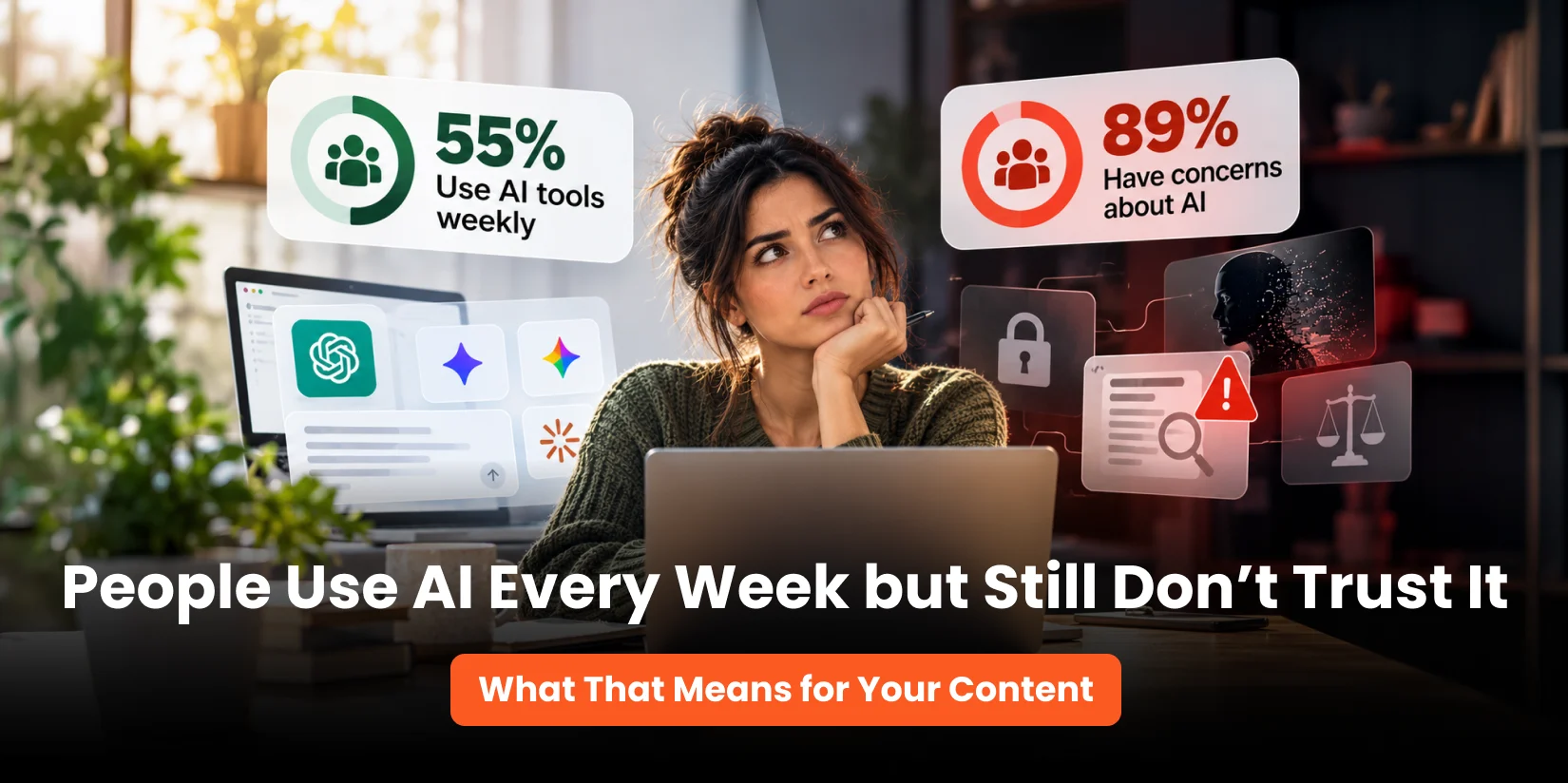
People Use AI Every Week but Still Don’t Trust It: What That Means for Your Content
Most marketers assume that if people use AI tools, they trust them. New survey data says otherwise. The distance between using AI and believing it is the AI trust gap, and a strong AI trust gap content strategy is how brands turn that gap into an advantage. Done well, it also improves your AI search visibility.
Table of Contents
- The Numbers Behind the AI Trust Gap
- What Worries Users Most
- Your Audience Is Not One Group
- 3 Ways to Build Content for the Trust Gap
- How to Optimize Content for AI Search
- How to Improve Brand Visibility in ChatGPT
- Build an AI Search Optimization Strategy
- How Ingenious Netsoft Can Help
- Frequently Asked Questions
The Numbers Behind the AI Trust Gap
A YouGov survey found that 89% of US adults have at least one concern about using AI, yet 55% use AI tools weekly. The surprise is that people with concerns use AI almost as often as people without any (55% versus 61%).
Pew Research Center’s June 2026 survey shows the same split. About 52% of Americans are more concerned than excited about AI in daily life, while 37% feel equally concerned and excited. Concern has held near 50% since 2023, so it isn’t fading.
The takeaway is that usage is not trust. Your customers may ask ChatGPT or Perplexity about your category every week and still doubt what comes back.
What Worries Users Most
YouGov’s respondents named specific concerns:
- Data privacy and security (63%)
- Over-reliance on AI (53%)
- Distrust of AI companies (48%)
- Accuracy and reliability of answers (46%)
A brand can speak to several of these directly, which makes them a content opportunity.
Your Audience Is Not One Group
Attitudes vary sharply with how often people use AI. Among weekly users, 52% say AI’s impact on society has been positive and 22% say negative. Among people who never use it, only 6% say positive and 75% say negative.
Treat this as a segmentation signal. A page written for a daily ChatGPT user will not persuade someone who has never tried it, so your AI content strategy should plan for different trust levels. The survey asked about AI’s impact on society, not whether people trust AI answers about your brand, so it supports segmentation rather than measuring brand trust.
3 Ways to Build Content for the Trust Gap
1. Publish Source-Backed Content
Anyone doubting AI answers will check claims for themselves. Source-backed content links to studies, names its data sources, and dates its statistics. It also supports how to get cited by AI search engines, because AI systems favour pages with verifiable support.
2. Practice AI Transparency in Content
AI transparency in content means stating your limits plainly. Say what your product or service does not do, who it is not for, and where results vary. If AI helped produce a piece, say how it was reviewed. Honest limits build AI content credibility, and clear, specific statements are easier for AI systems to quote accurately.
3. Answer the Worries Directly
Add sections on privacy, accuracy, and how your team reviews its work. These match the concerns people already have, and
How to Optimize Content for AI Search
To optimize content for AI search, write in clear, self-contained sections with direct answers, use descriptive headings, and back every claim with a named source. Keep facts consistent across your site and profiles, because conflicting information makes AI answers less reliable.
How to Improve Brand Visibility in ChatGPT
If you want to know how to improve brand visibility in ChatGPT, focus on being easy to verify. Earn mentions on credible third-party sites, publish original, well-sourced content, and keep your product details accurate and up to date. Then track whether your brand appears in category questions over time, separately from branded prompts.
Build an AI Search Optimization Strategy
An effective AI search optimization strategy combines three things: content people can trust, a regular check of how AI platforms describe you, and a plan for correcting mistakes quickly. Treat it as ongoing work, not a one-off project.
How Ingenious Netsoft Can Help
Closing the AI trust gap takes planning, not guesswork. Ingenious Netsoft offers AI SEO and ChatGPT SEO services that help businesses understand how AI platforms describe them, create source-backed content for different audience segments, and track AI search visibility with measurable reporting. If you want your brand recommended accurately in AI answers, contact Ingenious Netsoft to start with an AI search visibility review.


