
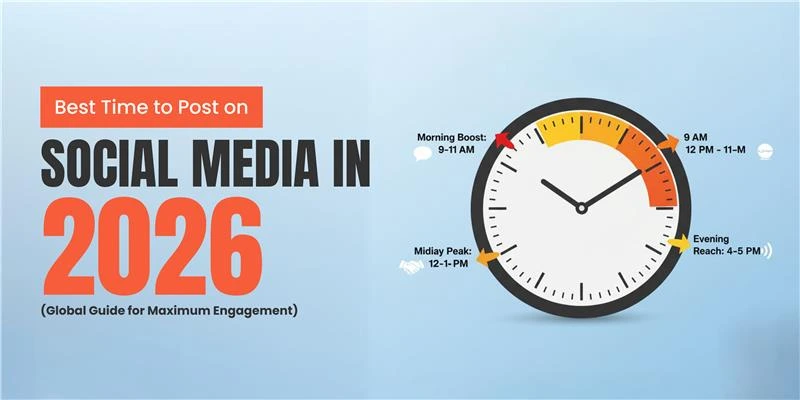
Best Time to Post on Social Media in 2026 (Global Guide for Maximum Engagement)
If you’ve ever wondered why some posts go viral while others barely get noticed, the answer isn’t just what you post – it’s also when you post.
But here’s the truth in 2026: There is no single “perfect time” that works for everyone.
With evolving algorithms on platforms like Instagram, LinkedIn, TikTok, and YouTube, timing has changed. It’s now more about audience behavior than fixed schedules.
In this guide, we’ll break down:
- The best posting times (globally)
- Platform-specific insights
- What actually works in 2026
- And how businesses can turn timing into real growth
There is no universal best time to post on social media in 2026 — only the best time for your audience.
Table of Contents
- Does Posting Time Still Matter in 2026?
- Best Time to Post on Social Media (Global Overview)
- Platform-Wise Best Times to Post on Social Media (2026)
- Best Time to Post on Social Media by Industry (2026)
- Best Time to Post on Social Media by Country (2026)
- Important Global Posting Tip
- What Actually Matters More Than Timing in 2026
- How to Find YOUR Best Time to Post (Data-Driven Approach)
- Common Mistakes Businesses Still Make
- Best Tools to Find the Perfect Posting Time
- Conclusion: Turn the Right Timing into Real Growth
- FAQs
Does Posting Time Still Matter in 2026?
Short answer: Yes — but not the way you think.
Earlier, marketers relied on generic timing charts. But today:
- Algorithms prioritize engagement signals
- Content is shown based on user activity patterns
- Consistency often beats perfect timing
This means:
The best time to post is when your audience is most active, not when a chart says so.
Best Time to Post on Social Media (Global Overview)
Across major markets like the USA, UK, Canada, and Australia, these trends are consistent:
- Morning: 7 AM – 9 AM (before work scroll)
- Midday: 12 PM – 2 PM (lunch break browsing)
- Evening: 6 PM – 9 PM (peak engagement window)
Weekdays (Tuesday–Thursday) generally perform best
Weekends work well for entertainment and lifestyle content
Platform-Wise Best Times to Post on Social Media (2026)
Here’s a quick breakdown of the best time to post on social media by platform in 2026:
| Platform | Best Time to Post | Best Days | Key Insight |
|---|---|---|---|
| 7–9 AM, 6–9 PM | Tue–Thu | Reels perform well at night; consistency matters more than timing | |
| 9 AM–12 PM, 6–8 PM | Mon–Fri | Strong for communities & local businesses; engagement peaks mid-morning | |
| 8–10 AM | Tue–Thu | Best for B2B; avoid weekends | |
| TikTok | 6–10 PM, 10 PM–1 AM | Wed–Sun | Watch time drives reach more than posting time |
| YouTube | 3–6 PM | Fri–Sun | Upload before peak hours for better push |
| X | 8–11 AM, 5–7 PM | Mon–Fri | Works best with real-time and trending content |
| 8–11 PM | Sat–Sun | Acts like a search engine; timing less critical |
Best Time to Post on Social Media by Industry (2026)
| Industry | Best Time to Post | Best Days | Key Insight |
|---|---|---|---|
| E-commerce & Retail | 12–2 PM, 7–9 PM | Wed–Sat | Lunch break & evening shopping hours drive conversions |
| B2B Services | 8–10 AM | Tue–Thu | Professionals engage during work hours |
| Healthcare & Wellness | 7–9 AM, 6–8 PM | Mon–Fri | Users check health content before/after work |
| Education & Coaching | 3–6 PM | Mon–Thu | Students & learners are active after classes |
| Real Estate | 6–9 PM | Wed–Sun | Evening browsing for property research |
| Restaurants & Food | 11 AM–1 PM, 6–9 PM | Fri–Sun | Meal times = highest engagement |
| Fitness & Gym | 6–8 AM, 6–8 PM | Mon–Fri | Before & after workout hours |
| Travel & Hospitality | 8–11 PM | Thu–Sun | Users plan trips during leisure time |
| Tech & SaaS | 9–11 AM | Tue–Thu | Decision-makers active during work hours |
| Entertainment & Media | 7–11 PM | Fri–Sun | Peak leisure & binge time |
Best Time to Post on Social Media by Country (2026)
If your audience is spread across different regions, posting at the right local time zone becomes critical. Here’s a country-wise breakdown based on user behavior trends:
United States
| Time Slot | Best Time |
|---|---|
| Morning | 7–9 AM |
| Midday | 12–2 PM |
| Evening | 6–9 PM |
Best Days: Tuesday to Thursday
High engagement during commute, lunch breaks, and after work hours
United Kingdom
| Time Slot | Best Time |
|---|---|
| Morning | 7–9 AM |
| Midday | 12–1 PM |
| Evening | 5–7 PM |
Best Days: Monday to Wednesday
Slightly earlier evening engagement compared to the US
Canada
| Time Slot | Best Time |
|---|---|
| Morning | 7–9 AM |
| Midday | 12–2 PM |
| Evening | 6–9 PM |
Best Days: Tuesday to Thursday
Similar behavior patterns to the US market
Australia
| Time Slot | Best Time |
|---|---|
| Morning | 6–8 AM |
| Midday | 12–2 PM |
| Evening | 5–7 PM |
Best Days: Wednesday to Friday
Earlier mornings and evenings due to lifestyle patterns
Important Global Posting Tip
If you’re targeting multiple countries at once:
- Schedule posts based on your primary audience location
- Or repost content at different time zones
- Use scheduling tools to maintain consistency
What Actually Matters More Than Timing in 2026
While knowing the best time to post on social media gives you a strong starting point, it’s no longer the ultimate growth factor.
In 2026, platforms like Instagram and TikTok prioritize:
- Content relevance
- Audience interaction
- Watch time and retention
- Early engagement signals
This means that even a perfectly timed post can fail if the content doesn’t connect with your audience.
If you want to truly measure how well your content performs, understanding engagement metrics is crucial. That’s where our detailed guide on Engagement Rate Benchmarks and Formulas: 2026 Update can help you break down performance and improve results.
How to Find YOUR Best Time to Post (Data-Driven Approach)
Instead of relying only on global averages, businesses today are using data-backed strategies to identify their ideal posting time.
Here’s how you can do it:
- Analyze platform insights (audience active hours)
- Test different time slots over 2–4 weeks
- Track engagement trends (likes, shares, saves)
- Adjust based on audience location (especially for global targeting)
For example, if your audience is mainly in the USA or UK, posting according to IST may not deliver optimal results.
To take this further, you should build a complete optimization strategy instead of focusing only on timing. Our blog on Social Media Optimization in 13 Easy Steps walks you through a step-by-step process to improve your overall social media performance.
Common Mistakes Businesses Still Make
Even in 2026, many brands struggle because they rely on outdated practices
❌ Copying generic posting schedules
❌ Ignoring audience time zones
❌ Posting without a clear strategy
❌ Focusing only on timing instead of engagement
The reality is simple:
Timing supports growth, but strategy drives it.
Best Tools to Find the Perfect Posting Time
Even with all the insights and general data available, relying on guesswork isn’t enough in 2026. To truly maximize your results, you need to use the right tools that provide real-time audience behavior and performance data.
Here are some of the most effective tools you can use:
- Native analytics from Instagram Insights and Facebook Insights help you understand when your audience is most active
- LinkedIn Analytics provides detailed performance data for professional content
- Social media management platforms like Hootsuite and Buffer allow you to schedule and optimize posts based on engagement trends
These tools enable you to:
- Monitor audience activity in real time
- Identify peak engagement windows
- Experiment with different posting schedules
- Maintain consistency through automation
Using the right tools eliminates guesswork and helps you build a data-driven social media strategy that delivers measurable results.
Conclusion: Turn the Right Timing into Real Growth
Finding the best time to post on social media in 2026 is no longer about following generic schedules—it’s about understanding your audience, analyzing data, and staying consistent.
While timing can improve visibility, it’s only one part of the bigger picture. Real growth comes from combining the right timing with:
- High-quality content
- Audience-focused strategies
- Consistent posting
- Performance tracking
If you’re still struggling with low engagement, poor reach, or inconsistent results, it’s a sign that you need more than just timing—you need a complete strategy.
This is where professional social media optimization services make a difference.
With the right approach, you can:
- Increase engagement and visibility
- Reach the right audience at the right time
- Build a strong and consistent brand presence
- Turn your social media into a growth engine for your business
If you’re looking to scale faster, working with a social media marketing agency or hiring experts for social media optimization services for business growth can help you achieve better and faster results.
At Ingenious Netsoft Pvt. Ltd., we specialize in:
- Data-driven social media optimization
- Audience-focused content strategies
- Performance-based social media marketing
- End-to-end social media management services
Ready to boost your engagement and grow your brand? Get expert social media optimization services and let professionals handle your growth.
Want to go deeper? Take a course related to this topic.


