Why Does My Store Only Rank for My Brand and Nothing Else?
Search your brand name on Google.
Now search for the products you sell.
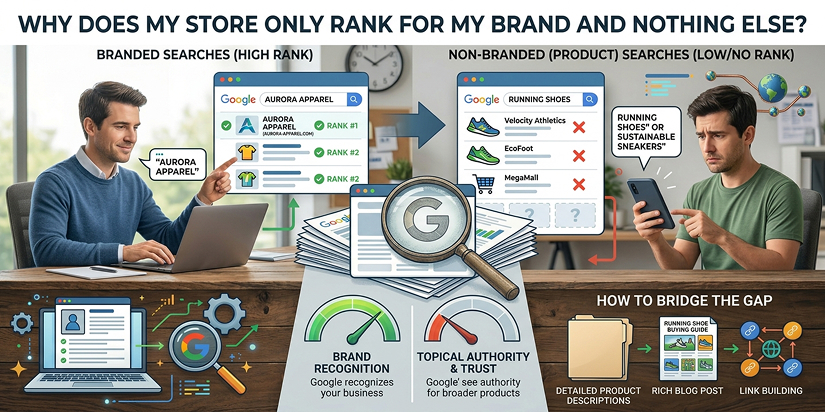
If your store disappears the moment your brand name is removed from the query, Google is sending an important signal: it recognizes your business, but it doesn’t yet see your website as an authority for the broader topics and products you want to rank for.
This gap between branded visibility and non-branded visibility is one of the biggest obstacles in seo in ecommerce. Understanding why it happens is the first step toward attracting customers who have never heard of your brand before.
Table of Contents
- What Does It Mean to Rank Only for Your Brand?
- How Google Decides Whether to Rank an Ecommerce Store
- Seven Reasons Google Only Shows Your Store for Branded Searches
- How AI Search Is Making This Problem Worse
- How to Move Beyond Branded Rankings
- Ingenious Netsoft: Driving Smarter Ecommerce SEO Growth
- Frequently Asked Questions
In this blog, we will explore why this ranking gap exists, how Google evaluates e-commerce websites, and the practical steps you can take to improve your visibility for the searches that matter most.
TL;DR – Key Takeaways
Too busy to read the full guide? Here’s what you need to know:
- If your store only ranks for its brand name, Google recognizes your business but lacks enough authority to rank it for broader product or category searches. Improving seo in ecommerce, building topical authority, and using AI-driven keyword strategies helps unlock non-branded visibility and attract new customers.
What Does It Mean to Rank Only for Your Brand?
It means your store appears in search results only when users type your brand name, but not for product or category-related keywords. This shows limited visibility beyond existing brand awareness.
What is a Branded Search?
A branded search happens when someone already knows your business and types your store name, brand name, or website directly into Google.
In simple terms, the user is not discovering you, they are specifically looking for you.
Examples of Branded Searches:
- ABC Outdoor Store.
- ABC Outdoor Jackets.
- ABCOutdoor.com.
- ABC Outdoor hiking gear.
What It Means for Your Store:
- Google already recognizes your business name.
- Users already have awareness of your brand.
- Traffic comes from people who are already familiar with you.
- Competition is usually low because no other brand is competing for your exact name.
What is a Non-Branded Search?
A non-branded search happens when someone is looking for a product, service, or solution, but they have not decided which brand to buy from yet.
Here, the user is in discovery mode.
Examples of Non-Branded Searches:
- Waterproof hiking jackets.
- Lightweight camping gear.
- Winter hiking clothing.
- Best outdoor jackets for rain.
What It Means for Your Store:
- Google is trying to decide which websites are most relevant.
- Users are open to discovering new brands.
- Competition is much higher.
- Ranking depends on authority, content quality, and relevance.
How Google Decides Whether to Rank an Ecommerce Store
Google generally evaluates three important questions.
1. Does Google Know Your Store Exists?
This is the foundation.
If your site is indexed and appears for your brand name, Google has already answered yes.
Many store owners stop here because they assume visibility equals authority.
However, this only confirms that Google recognizes the brand.
2. Does Google Understand What Your Store Sells?
This is where many stores struggle.
A website may sell hundreds of products, but Google may not clearly understand:
- Main product categories.
- Industry specialization.
- Product relationships.
- Buying intent.
This is why category optimization remains a critical component of seo in ecommerce.
Without strong category pages, Google has fewer signals about the subjects your business specializes in.
3. Does Google Trust Your Store More Than Competitors?
Trust is often the deciding factor.
Google compares your website with competitors targeting the same keywords.
Factors influencing trust include:
- Quality backlinks.
- Industry mentions.
- Product expertise.
- Comprehensive content.
- User engagement signals.
Many businesses hire ecommerce seo services or an experienced ecommerce seo agency specifically to strengthen these trust signals.
Seven Reasons Google Only Shows Your Store for Branded Searches
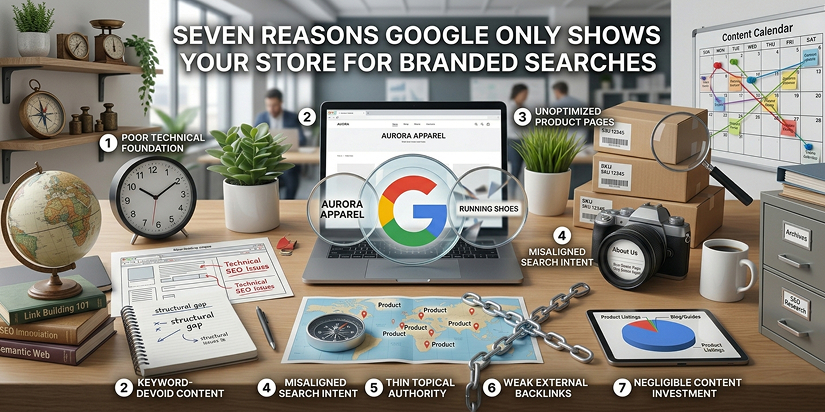
When a store only appears for its own brand name, it usually reflects a structural gap in how Google understands the website beyond identity-level recognition. In seo in ecommerce, this is a common pattern where visibility exists, but discovery is limited.
1. Google Understands Your Brand but Not Your Products
One of the most common issues in seo in ecommerce is that Google can identify the brand but cannot confidently map it to product relevance.
This Happens When:
- Thin category pages reduce contextual clarity.
- Weak product descriptions fail to explain use cases.
- Missing topical signals prevent Google from understanding niche focus.
As a result, Google associates the website with the brand name, but not with search queries related to products or categories. Many businesses try to fix this through e commerce seo services, but the root issue is often content depth and structure.
2. Your Category Pages Have No Ranking Power
In effective seo in ecommerce,category pages should act as primary ranking assets. However, many ecommerce websites treat them as simple product listings.
Common Scenario:
- A category page contains only product grids.
- No supporting explanation or context.
- No targeting of search intent.
Google often prefers well-structured category pages for commercial keywords because they better match user intent than isolated product pages.
Why Category Pages Matter:
- They target high-intent commercial searches.
- They define topical relevance for the entire site.
- They act as authority hubs for product groups.
Common ecommerce Mistake:
Many businesses ignore category optimization and rely only on product pages. This weakens overall seo in ecommerce performance and limits visibility to branded queries only.
An experienced ecommerce seo agency usually prioritizes rebuilding category structure as a foundation step.
3. Your Store Has No Topical Authority
Topical authority is a critical ranking factor in modern seo in ecommerce. It refers to how deeply a website covers a subject area.
If your store only has product pages, Google sees:
What you sell
But not your expertise in the niche
Missing Elements Include:
- Buying guides.
- Product comparisons.
- Educational resources.
- Category explanations.
Without these, Google has no strong evidence that your store deserves visibility for informational or commercial queries.
This is where structurede commerce seo services help build content ecosystems instead of isolated pages.
4. Competitors Have Built More Trust
Even if your store is relevant, competitors may outrank you due to stronger trust signals.
In seo in ecommerce, trust is built through:
- High-quality backlinks.
- Brand mentions across the web.
- User engagement signals.
- Established authority in the niche.
Google compares your store with competitors before deciding who appears for non-branded searches. If competitors have stronger trust signals, your visibility remains limited to branded searches only.
5. Your Store Is Stuck in Google’s “Known Brand” Bucket
A deeper issue in seo in ecommerce is that Google may categorize your website primarily as a “known entity” rather than a “search solution provider.”
The Two Visibility Layers Framework
To understand this clearly:
Layer 1: Identity Visibility
- Ranking for your brand name.
- Users already know your business.
- Low competition, easy visibility.
Layer 2: Discovery Visibility
- Ranking for product searches.
- Ranking for problem-based queries.
- Ranking for solution-driven keywords.
Most stores remain stuck in Layer 1, meaning they are visible only when users already know the brand.
Moving into Layer 2 requires structured optimization using ai non-brand keyword strategy, which focuses on discovery-based search behavior instead of brand dependence.
6. Google Doesn’t See Strong Entity Signals
Modern seo in ecommerce is heavily influenced by entity-based understanding. Google does not just read keywords, it understands relationships between entities.
Key Entities Include:
- Brand entity (your store identity).
- Product entity (what you sell).
- Category entity (your niche structure).
If these entities are not clearly connected through structured content, Google cannot confidently rank your store beyond branded queries.
This is especially important in AI-driven search, where systems rely heavily on entity mapping to generate results.
A strong ai ecommerce keyword research process ensures that these entities are properly identified and structured across the website.
7. Search Intent Mismatch
One of the most overlooked problems in seo in ecommerce is intent mismatch between what users search and what the website provides.
Google’s Intent Expectations:
- Google wants: Category pages.
- But store offers: Product pages.
- Google wants: Buying guides.
- But store offers: Product listings.
When this mismatch exists, Google struggles to match your pages with non-branded search intent.
This results in your store appearing only when users search your brand directly, while competitors capture broader discovery traffic.
Fixing this requires aligning content structure with intent-driven ai non-brand keyword strategy, ensuring that each search type has a matching page format.
How AI Search Is Making This Problem Worse
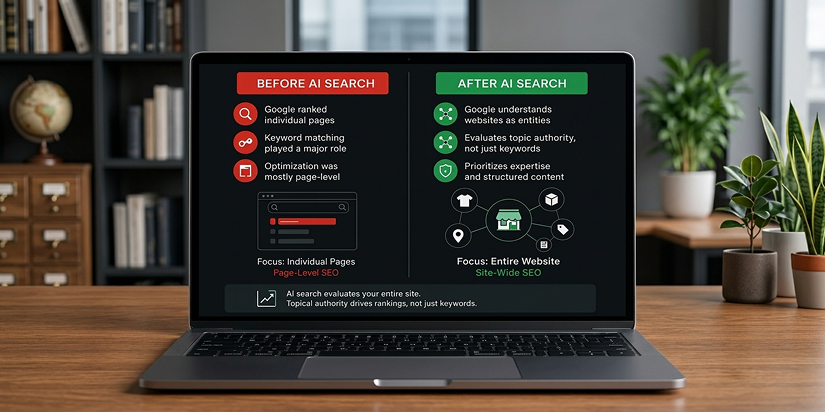
AI-driven search has changed how seo in ecommerce works. Earlier, Google mainly ranked individual pages based on keywords and backlinks. If a page matched a search term well, it had a chance to rank even with limited site-wide structure.
Now, search systems work differently.
Modern AI Search Focuses On:
- Understanding entities (brand, products, categories).
- Understanding relationships between pages and topics.
- Evaluating overall expertise across the website.
In this system, seo in ecommerce is no longer page-based—it is site-wide.
What Changed After AI Search
Before AI Search:
- Google ranked individual pages.
- Keyword matching played a major role.
- Optimization was mostly page-level.
After AI Search:
- Google understands entire websites as entities.
- It evaluates topic authority, not just keywords.
- It prioritizes expertise and structured content.
Why This Makes the Problem Worse
If your store has weak topical structure, AI systems cannot clearly understand your niche. As a result:
- Your store is seen mainly as a brand, not a topic authority.
- Non-branded visibility drops.
- Discovery traffic becomes limited.
This is why modern ai ecommerce keyword research and ai non-brand keyword strategy are now essential parts of seo in ecommerce.
Without them, stores often remain visible only for branded searches, even if they are properly indexed.
How to Move Beyond Branded Rankings
Moving beyond branded visibility requires a structured approach to seo services in ecommerce that helps Google understand your store as a category authority, not just a brand name.
1. Build Strong Category Pages
Category pages should be the foundation of your seo services in ecommerce strategy. Instead of acting as simple product grids, they should clearly explain:
- What the category is.
- Who it is for.
- Key product differences.
- Use cases and buying intent.
Strong category pages help search engines connect your store with non-branded search terms. Many e commerce seo services prioritize rebuilding category pages because they directly impact discovery visibility.
2. Create Topic Clusters Around Products
Topic clusters improve how Google understands your niche. In modern seo in ecommerce, each product category should be supported by related content such as:
- Guides.
- Comparisons.
- Use-case articles.
This structure signals depth and relevance. A well-planned cluster strategy is often developed by an experienced ecommerce seo agency to improve non-branded rankings.
3. Publish Buying Guides
Buying guides help bridge the gap between product listings and search intent. They play a key role in seo services in ecommerce by targeting users who are still in the research phase.
Examples Include:
- “Best hiking jackets for winter”.
- “How to choose camping gear”.
These pages help implement an effective ai non-brand keyword strategy, which focuses on capturing discovery-based searches rather than branded traffic.
4. Improve Internal Linking
In seo in ecommerce, internal linking helps distribute authority across your website. It ensures that:
- Category pages support product pages.
- Blog content supports commercial pages.
- Authority flows between related topics.
Without strong internal linking, even well-written content may remain isolated and fail to rank beyond branded searches.
5. Strengthen Entity Signals
Modern search systems rely heavily on entities to understand websites. In seo in ecommerce, entity signals include:
- Brand identity clarity.
- Product categorization.
- Consistent topical structure.
Strong entity signals help Google understand not just what you sell, but what your store represents in the market. This is also a core focus of ai ecommerce keyword research, which aligns content with how AI interprets meaning.
6. Earn Industry Mentions
External mentions remain a critical trust factor in seo in ecommerce. When other websites reference your brand, products, or content, it strengthens your authority.
This Includes:
- Backlinks from relevant websites.
- Brand mentions in articles.
- Industry citations.
Many businesses use e commerce seo services or a specialized ecommerce seo agency to build these authority signals at scale.
Ingenious Netsoft: Driving Smarter Ecommerce SEO Growth
The Problem
Most ecommerce stores only rank for their brand name and fail to appear for non-branded searches. This limits new customer discovery due to weak category structure, low authority, and poor seo ecommerce strategy.
Our Approach
We improve visibility beyond branded searches using structured seo in ecommerce, focused on search intent, category optimization, and an effective ai non-brand keyword strategy to drive discovery traffic.
What We Can Do
We provide end-to-end seo in e-commerce solutions designed for modern search systems, including:
- ai ecommerce keyword research for intent-driven targeting.
- Content structure optimization for category and product pages.
- Development of topic clusters and buying guides.
- Technical SEO improvements for better indexing and visibility.
- Authority building through strategic e-commerce services.
We also operate as a performance-focused ecommerce seo agency, helping brands move from branded-only rankings to consistent non-branded organic growth.