Tried Two SEO Agencies: My Store Still Does Not Rank
If your store is not ranking, even after investing in the best ecommerce SEO services, the problem is not just SEO, it is a fundamental failure to adapt to the March 2026 Google Core Update and the new world of Generative Engine Optimization (GEO).
In 2026, ranking #1 on a list of links is no longer enough; you need to be the cited source in the AI Overview box at the top of the page.
This blog breaks down simple, research-backed strategies to help you improve your rankings in both traditional search results and AI-driven search.
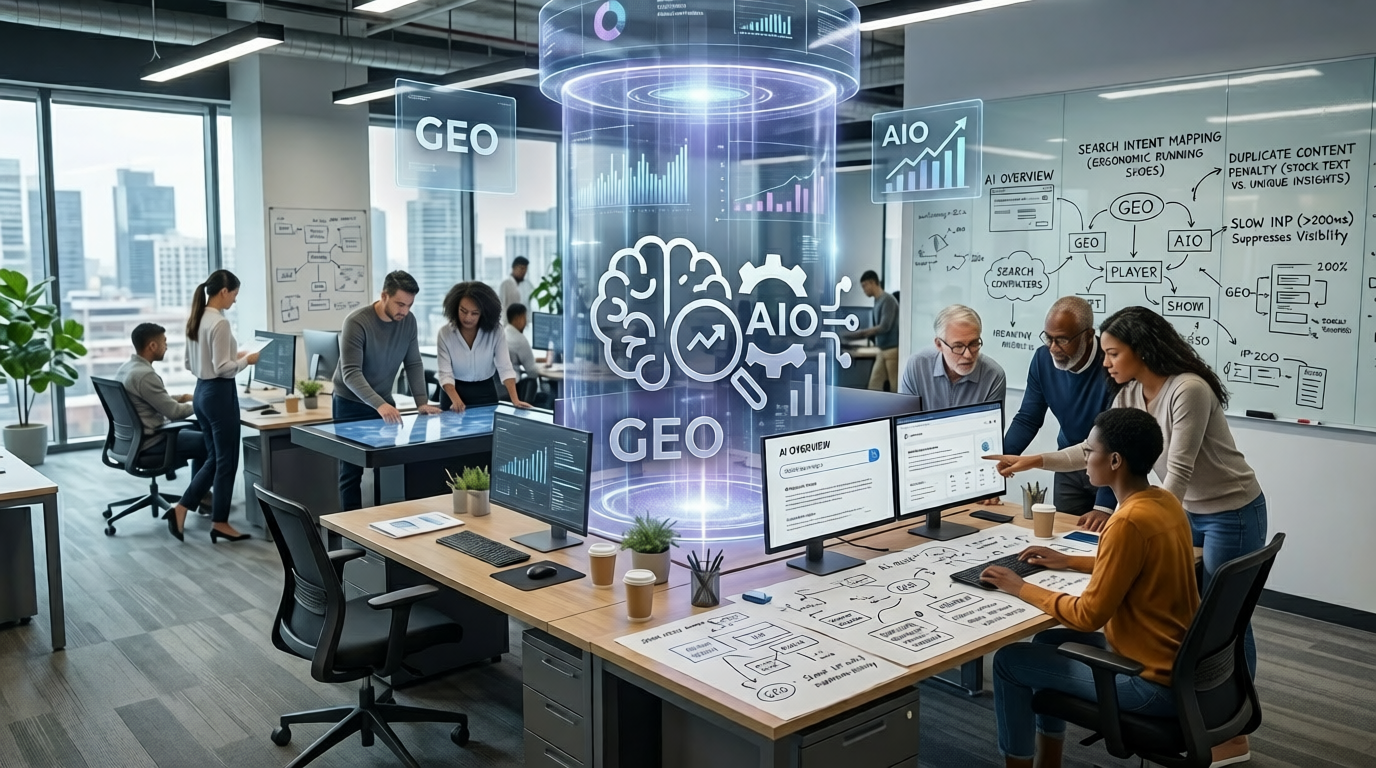
Table of Contents
Reasons Why SEO Agencies Fail
According to data from Numinix (April 2026), over 65% of ecommerce sites saw a ranking shift following the recent algorithm updates. Even the best ecommerce SEO companies fail because they treat SEO as a checklist rather than an ecosystem.
1. Lack of Original Value in Content
Google now aggressively penalizes thin content. If your agency simply used manufacturer-provided descriptions, your site is duplicate in Google’s eyes.
Numinix reports that sites with 100% unique, insight-driven descriptions saw a 40% higher retention in rankings compared to those using stock text.
Source: Numinix – March 2026 Core Update Impact
2. Slow Website Interactions
In 2026, Core Web Vitals have evolved. It is no longer just about how fast a page loads, but how fast it responds when a user clicks a button.
If your site’s INP is above 200ms, Google suppresses your visibility.
Many agencies focus on PageSpeed Insights but ignore the actual responsiveness of your Shopify or Magento filters.
3. Missing the AI Overview (AIO) Window
Google’s AI Overviews now capture approximately 61% of informational clicks.
If your store is not structured to be scraped by AI, you are not just losing rank, you are losing existence in the modern search interface.
4. Poor Search Intent Mapping
Agencies often chase high-volume broad keywords like “shoes” instead of high-intent long-tail terms like “best ergonomic running shoes for flat feet.”
Without AI ecommerce ranking fix strategies that align content with specific user problems, your bounce rate stays high, signaling to Google that your site is not helpful.
5. Lack of Entity Authority
Google now views brands as Entities.
If your brand, founder, and products are not linked via Advanced Schema (JSON-LD) to trusted social profiles and industry citations, you lack the trust required to rank for competitive terms.
Data Comparison: Traditional vs. AI-Native SEO
| Feature | Legacy SEO (Pre-2026) | AI-Native SEO (Post-March 2026) |
|---|---|---|
| Primary Goal | Rank in 10 Blue Links | Citation in AI Overviews (AIO) |
| Content Focus | Keyword Density | Information Gain & E-E-A-T |
| Technical Priority | LCP (Load Speed) | INP (Interaction Speed) |
| Product Data | Standard HTML Tables | Semantic Schema (JSON-LD) |
| Visuals | Compressed Stock Photos | Authentic, High-Quality Visuals |
| Strategy Name | Search Engine Optimization | Generative Engine Optimization (GEO) |
The AI SEO Recovery Plan: A Practical Roadmap
If your store is stagnant after hiring two agencies, it is likely because they were chasing clicks while the search world moved toward citations.
To reclaim your visibility, you do not need more SEO, you need an AI SEO Recovery Plan.
Here is the simplified 4-step roadmap to recovery.
Step 1: The Technical Deep Clean
Before hiring a new team, fix the foundation. If your site is messy, Google’s AI will ignore it.
- Fix Filter Overload: Product filters like size, color, and price often create thousands of junk URLs. Clean these up so Google only sees your most important pages.
- Clean the Code: Delete old and bulky apps you do not use. They slow down your site’s INP (Response Speed), which is a major ranking factor in 2026.
Step 2: Use Generative Engine Optimization (GEO)
To appear in the AI Answer Box at the top of Google, your site must be easy for a machine to read.
- The 40-Word Answer: Start every page with a 40–60 word summary explaining exactly what the product is and who it helps.
- Comparison Tables: Create Product A vs. Product B charts. Tables are highly extractable data that AI shopping assistants love to quote.
Step 3: Optimize for Visual Search
With the rise of Google Lens, your images are now as important as your text.
- Authenticity Wins: Transition to a dark premium look with high-contrast and professional photography.
- Avoid AI-Fake Looks: Google’s 2026 AI filters out cartoonish or animated graphics. Real-world and authentic photos are required to rank in visual search results.
Step 4: Partner with the Right Experts
Look for best ecommerce SEO companies that specifically offer AI Citation Tracking.
- Why It Matters: Experts monitor how often AI models like Gemini and ChatGPT mention your products and ensure those mentions lead back to a clickable link on your store.
- Entity Mapping: They connect your brand, reviews, and founder expertise into a Knowledge Graph that proves you are a trustworthy authority.
Real-World Recovery: What 2026 Success Looks Like
If you are skeptical about whether a Recovery Plan works, you only need to look at the brands that leaned into Generative Engine Optimization (GEO) early this year.
The data shows that the gap between the winners and losers of the March 2026 update comes down to one thing: AI Visibility.
Case Study: Bloom & Wild’s 2026 AI Shift
Bloom & Wild, a leading online florist, provides the perfect blueprint for an AI SEO recovery.
While their competitors were fighting over broad keywords like “order flowers online,” Bloom & Wild shifted their strategy to answer the intent behind the purchase.
The Problem
Their traditional product pages were seeing a 35% drop in organic traffic after the update because they lacked Information Gain.
The Solution
They implemented Answer-First architecture.
They added FAQ blocks and detailed Occasion Guides such as “What flowers are best for a 50th Anniversary?”
This strategy directly fed Google’s AI Overviews.
The Result
Bloom & Wild achieved a 90% increase in organic search visibility and a 122% increase in conversions.
By becoming the cited source for gifting advice, they captured shoppers before they even looked at a product grid.
Source: Bloom & Wild SEO Case Study
Final Thoughts
SEO in 2026 is no longer just about visibility, it is about earning relevance, building structure, and establishing trust in a rapidly evolving search landscape.
As search engines become more intelligent, simply ranking is not enough; your content must demonstrate real value and clarity.
That is why moving beyond outdated tactics is essential. By focusing on information depth, technical performance, and AI compatibility, your store does not just recover, it becomes more resilient and competitive.
The goal is clear: build enough authority so that search engines do not just list your brand, they recommend it as the definitive answer.
Elevate your brand with Ingenious Netsoft, where cutting-edge AI strategy meets elite digital marketing to dominate the 2026 search landscape.