
How SEO Helps Eye Care Clinics Attract More Patients
Here is a question worth sitting with for a moment.
Right now, somewhere in your city, a person is typing “optometrist near me” into Google. Or they are asking ChatGPT “which eye clinic should I go to in [your city]?” They need an appointment. They are ready to book. They just need to find the right clinic.
Is that clinic yours?
If you are not sure — or if the honest answer is no — you are not alone. But you are losing patients every single day to competitors who have invested in making sure they show up at that exact moment.
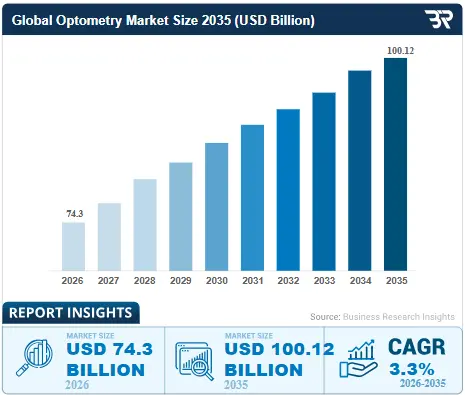
The eye care industry in the United States, United Kingdom, Canada, and Australia is growing.The global optometry market is valued at $74.3 billion in 2026 and is on track to reach $100.12 billion by 2035. In the US alone, the industry is worth $21.5 billion(IBISWorld, 2026). Demand for eye care is consistent, driven by aging populations, rising screen use, and growing awareness of vision health.
But a growing market does not automatically mean a full appointment book. It means more competition for the same patients.
The clinics winning in 2026 are not always the biggest. They are not always the ones with the most advanced equipment. They are the ones that show up — on Google, on Google Maps, and increasingly inside AI-generated answers — at the precise moment a patient is looking for help.
This guide explains exactly how they do it, and what your clinic needs to do right now to compete.
TL;DR – Key Takeaways
- 70%+ of patientssearch online before booking an eye care appointment.
- 67% of patients now consult AI platforms like ChatGPT before even opening Google.
- SEO gets your clinic found in Google search results for terms like “optometrist near me.
- Local SEO + Google Business Profile puts your clinic in the Google Map Pack — where most appointment calls come from.
- GEO (Generative Engine Optimization) makes your clinic visible inside AI-generated answers on ChatGPT, Gemini, and Perplexity.
- AEO (Answer Engine Optimization) positions your clinic as the trusted answer when patients ask AI health questions.
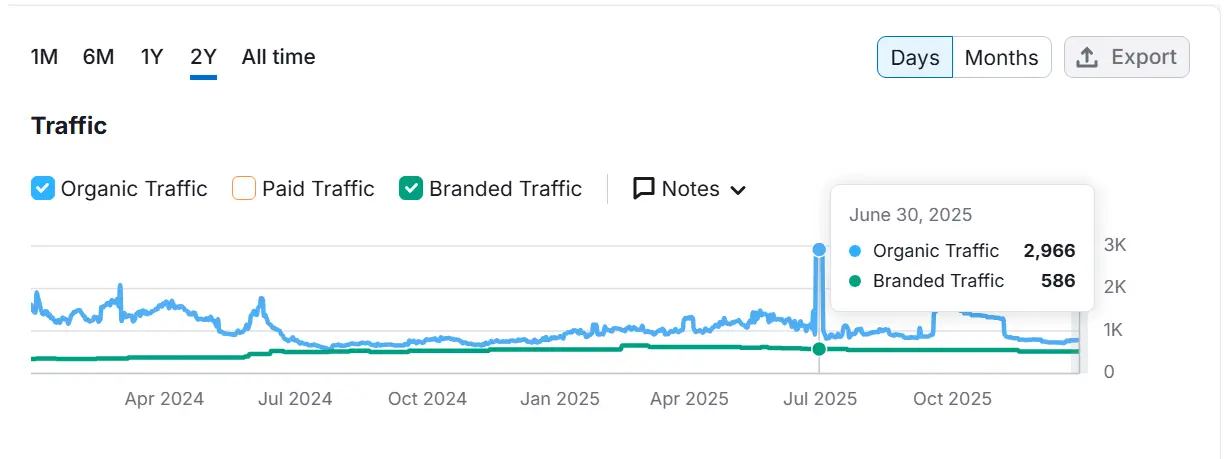
- Real proof: Ingenious Netsoft grew Eyes on Brickell from 632 to 2,966 monthly visitors, built 37,856 backlinks, and generated 8,500+ monthly Google Maps searches.
- Ingenious Netsoft offers all these services for eye care clinics in USA, UK, Canada & Australia — with a free consultation to get started..
Table of Contents
- The Way Patients Find Eye Care Has Fundamentally Changed
- What Is SEO and Why Does It Matter for Eye Care Clinics?
- Local SEO and Google Business Profile: The Most Important Channel for Eye Clinics
- GEO: The New Frontier That Most Eye Care Clinics Are Completely Ignoring
- AEO: Appearing in AI Answers Before Patients Even Choose a Clinic
- Real Results: What We Achieved for Eyes on Brickell
- The Window Is Open — But Not Forever
- Ready to Get More Patients for Your Eye Care Clinic?
- Frequently Asked Questions
The Way Patients Find Eye Care Has Fundamentally Changed
Not long ago, word of mouth and a listing in a local directory were enough to keep an eye clinic busy. That world no longer exists.
Today, over 70% of patients search online before booking a healthcare appointment (RankingGeek, 2026). They Google symptoms. They compare clinics. They read reviews. They check whether a practice appears on Google Maps. And increasingly in 2026, they are asking AI assistants — ChatGPT, Google Gemini, Perplexity — to recommend the best eye clinic in their area.
Consider what the data tells us about how patients search for eye care:
- 77% of patients search online before booking an eye exam.
- 46% of all Google searches have local intent — meaning patients are looking for services near them.
- 93% of all healthcare discovery starts with Google search
- 77% of local eye care searches happen on Google Maps mobile
- 67% of patients now consult AI platforms like ChatGPT before running a conventional Google search.
- 40 million people globally ask ChatGPT health-related questions every single day.
What this means practically: the patient journey now begins online, long before anyone picks up the phone or walks through your door. If your clinic is not visible at that first moment of search — whether on Google, on Google Maps, or inside an AI-generated answer — the patient will find a competitor who is.
This shift in behaviour is not slowing down. It is accelerating. And it creates an urgent question for every eye care clinic owner: what are you doing to make sure patients find you first?
What Is SEO and Why Does It Matter for Eye Care Clinics?
Search Engine Optimization (SEO) is the process of making your clinic’s website appear higher in Google’s search results when patients search for eye care services in your area.
When someone types “eye doctor [city],” “optometrist near me,” or “LASIK consultation [suburb]” into Google, the clinics that appear on the first page — and especially in the top three results — receive the overwhelming majority of clicks. The second page of Google might as well not exist.
According to healthcare marketing benchmarks, SEO-optimised healthcare websites receive 5 to 10 times more organic traffic than those that do not invest in it (Marketing LTB, 2026).
For eye care clinics, SEO is not optional. It is the foundation of every other digital marketing effort.
What Does SEO for Eye Care Clinics Actually Involve?
Effective SEO for an eye care clinic covers several interconnected areas:
Technical SEO ensures your website is fast, mobile-friendly, secure, and structured so Google can crawl and understand it properly. A slow, broken, or poorly structured website will not rank — no matter how good the content is.
On-page optimisation means making sure each page of your website is built around the specific terms your patients are searching for. Service pages for “eye exams,” “contact lens fittings,” “dry eye treatment,” “LASIK consultations,” and “pediatric eye care” need to be keyword-targeted, clearly written, and structured to convert visitors into bookings.
Content marketing means creating educational content that answers the questions your patients are already asking — “how often should I get an eye exam?”, “what are the signs of glaucoma?”, “is LASIK right for me?” This content builds authority, captures patients earlier in the decision journey, and compounds in value over time.
Link building means earning backlinks from reputable, relevant websites — healthcare directories, local publications, medical associations — that signal to Google your clinic is a trustworthy, authoritative source of eye care information.
E-E-A-T signals — Experience, Expertise, Authoritativeness, and Trustworthiness — are particularly important for healthcare websites. Google scrutinises healthcare content more carefully than almost any other category. Your website must clearly demonstrate that qualified, experienced professionals stand behind your services and your content.
When these elements work together consistently over time, the result is a steady, growing stream of organic patients finding your clinic through search — without paying for every click.
Local SEO and Google Business Profile: The Most Important Channel for Eye Clinics
If SEO is the foundation, Local SEO is the single highest-impact channel for most eye care clinics.
Here is why: when patients look for an optometrist or eye doctor, they are not searching nationally. They are searching locally. They want a clinic near their home, their workplace, or their child’s school. Searches like “eye doctor near me,” “optometrist [suburb],” and “eye exam today” are what drive appointment bookings.
Google responds to these searches by showing a Local Pack — the map with three local clinic listings that appears at the top of the results page. The clinics in those top three positions receive the majority of clicks and calls from patients ready to book.
Nearly 46% of all Google searches have local intent (iMatrix, 2026). For eye care specifically, Local Pack listings consistently outperform organic blue-link results for appointment-intent queries (Authority Specialist, 2026). If your clinic is not in the top three local results, most patients in your area simply never see you.
Google Business Profile: Your Most Valuable Digital Asset
Your Google Business Profile (GBP) — the listing that appears in Google Maps and the Local Pack — is often the first thing a potential patient sees when searching for eye care. It is, in many cases, more important than your website.
A fully optimised GBP for an eye care clinic includes:
- Verified and accurate clinic name, address, and phone number (NAP)
- Correct primary category (Optometrist, Ophthalmologist, or Eye Care Center)
- All relevant secondary categories and service listings
- Up-to-date hours including holiday and special hours
- High-quality photos of the clinic, staff, and equipment — updated regularly
- A consistent flow of genuine patient reviews with professional responses
- Regular posts, updates, and service announcements
- Appointment booking links and accepted insurance information
Practices with fully optimised Google Business Profiles and 50 or more recent reviews convert local search impressions at measurably higher rates than those with incomplete profiles (Authority Specialist, 2026).
Reviews deserve special attention. Practices below 4.0 stars lose over 40% of potential patients before they even visit the website (Marketing LTB, 2026). Systematic, ethical review acquisition is not optional — it is a direct driver of patient volume.
Beyond the GBP: Local Citation Building
Local SEO also requires consistent information across the broader web — Yelp, Healthgrades, Zocdoc, local directories, and industry-specific listings. Every inconsistency in your Name, Address, and Phone number across platforms weakens your local ranking signals.
Building and maintaining a clean, consistent local citation profile is foundational work that most eye care clinics have never fully addressed — and it represents a real competitive opportunity for practices willing to invest in getting it right.
GEO: The New Frontier That Most Eye Care Clinics Are Completely Ignoring
Here is what is changing right now in 2026 that most clinics — and most marketing agencies — have not yet caught up with.
Patients are no longer just using Google. They are asking AI assistants direct questions: “What is the best eye clinic in Toronto?” or “I need a contact lens fitting in Birmingham — what would you recommend?” These questions are being asked of ChatGPT, Google’s AI Overviews, Gemini, Perplexity, and Claude — millions of times every day across the USA, UK, Canada, and Australia.
The practices that appear in those AI-generated answers are gaining a significant competitive advantage. The ones that do not are completely invisible in a channel that is growing fast.
This is Generative Engine Optimization — GEO.
The numbers make the opportunity clear:
- 40 million people globally ask ChatGPT health-related questions daily (OpenAI, 2026)
- 67% of patients consult AI platforms before using traditional Google search (RankingGeek, 2026)
- Nearly two-thirds of online health searchers now see AI-generated responses at the top of their results (Annenberg Public Policy Center, 2025)
- GEO optimisation can increase a clinic’s visibility by up to 40% in AI-generated responses (Digital Limelight Media)
- 13 million adults in the United States already use generative AI as their primary search tool (Digital Limelight Media, 2026)
GEO is the practice of optimising your clinic’s digital content so that AI systems — which work very differently from traditional search engines — recognise your clinic as authoritative, trust it as a source, and actively recommend it when patients ask relevant questions.
How GEO Differs from Traditional SEO
Traditional SEO targets keywords. GEO targets conversational intent and entity authority.
When someone asks ChatGPT “which optometrist in Melbourne should I visit?”, the AI does not return a list of keyword-matched pages. It synthesises information from multiple trusted sources and generates a response. The clinics and sources it draws on are those that have demonstrated clear expertise, consistent online authority, and structured content that AI can extract and verify.
GEO techniques for eye care clinics include:
- Structuring content with direct, extractable answers — short, clear responses to common patient questions that AI can easily cite
- FAQ pages built around conversational queries — matching exactly how patients phrase questions to AI assistants
- Strengthening E-E-A-T signals so AI systems categorise your clinic as a trustworthy healthcare authority
- Entity clarity — ensuring every platform where your clinic appears communicates the same consistent, accurate information about what you do, where you are, and why you are the right choice
- Schema markup — structured data that helps AI systems understand your clinic’s services, location, and credentials without ambiguity
The early-mover advantage in GEO is real and it is closing. The clinics investing in GEO optimisation now will establish AI visibility before their competitors — and that visibility will be significantly harder to displace once it is built.
AEO: Appearing in AI Answers Before Patients Even Choose a Clinic
Answer Engine Optimization (AEO) works alongside GEO to ensure your clinic’s content is what AI systems cite when patients ask health-related questions.
The distinction matters: GEO focuses on being recommended as a clinic. AEO focuses on being cited as a source of trustworthy information. Both drive patient acquisition, but through slightly different mechanisms.
When a patient in your city asks “what should I expect at my first comprehensive eye exam?” or “how do I know if I need prescription glasses?”, AEO determines whether your clinic’s website is what appears in the answer. This positions your practice as the trusted authority — and the natural next step when the patient is ready to book.
AEO requires:
- Structured FAQ content built around the exact questions patients ask
- Schema markup — specifically FAQ schema and healthcare provider schema
- Direct, confident answers written in plain language at the top of each relevant page
- Consistent content updates to signal that your information is current and accurate
- E-E-A-T reinforcement— author credentials, citations, review dates, and evidence-based claims
In 2025 and 2026, structured FAQ content does double duty: Google pulls it for Featured Snippets, and AI Overviews source answers from the same well-structured, credible content (iMatrix, 2026). A single well-built FAQ page can earn your clinic visibility in both traditional search results and AI-generated responses simultaneously.
The combination of SEO + Local SEO + GEO + AEO creates a complete digital presence that captures patients at every touchpoint in the modern patient journey — wherever they search, however they search, at whatever stage of decision-making they are in.
Real Results: What We Achieved for Eyes on Brickell
Everything in this article is grounded in what actually works — and we have the data to prove it.
Eyes on Brickell is a top-rated eye care clinic in the heart of Miami, Florida. When they first partnered with Ingenious Netsoft, their digital presence told a familiar story: strong clinical reputation, but almost no online visibility to match it.
Where They Started
| Metric | Starting Point |
| Monthly organic traffic | 632 visitors |
| Keywords ranking in Google | 871 terms |
| Referring domains (backlinks) | 1 |
| Google Maps visibility | Minimal |
| AI Overview presence | None |
Competition from larger optical chains was strong. Technical SEO issues were dragging performance down. Content was not structured to rank or convert. The Google Business Profile was underoptimised. The clinic was invisible at the moments that matter most.
What We Did
We implemented a focused, six-part strategy built specifically for the eye care industry:
Keyword and competitor research — mapping the Miami eye care search landscape to identify the highest-value opportunities for local patient acquisition.
Technical SEO — resolving crawlability issues, improving page speed, implementing healthcare schema markup, and ensuring Google could fully index the site.
Content creation — building service pages and educational content optimised for the specific terms Miami patients search for, structured to meet Google’s E-E-A-T standards for healthcare.
Strategic link building — growing the backlink profile from virtually zero to a peak of 37,856 backlinks and 1,930 referring domains through relevant, authoritative sources.
Google Business Profile optimisation — complete rebuild and ongoing management to drive Map Pack visibility and local patient searches.
Local SEO and citation building — NAP consistency, local directory listings, and location-specific signals across the web.
The Results
| Metric | Before | After |
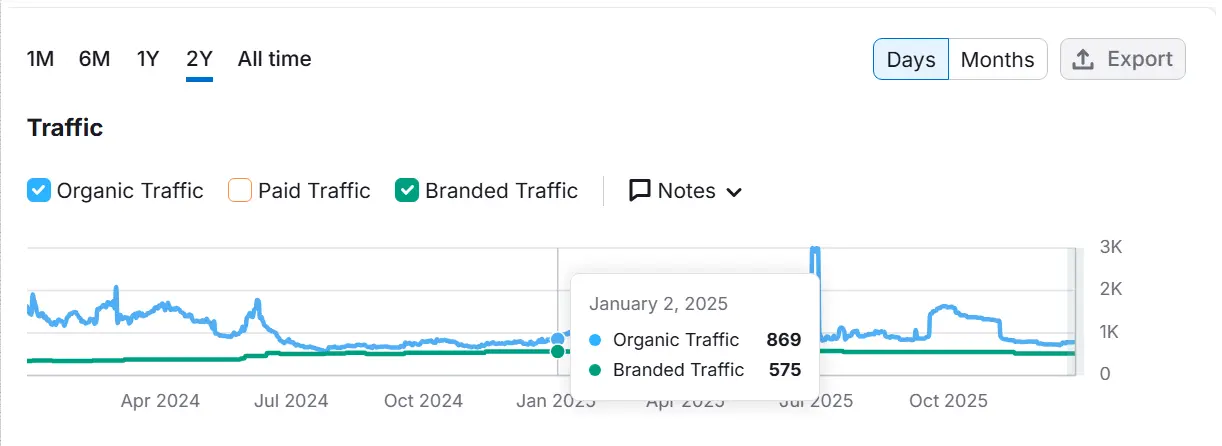
| Monthly organic traffic | 632 | 2,966(peak) |
| Keywords ranking | 871 | 3,956 |
| Backlinks | 1 | 37,856 (peak) |
| Referring domains | 1980 | 1,930 (peak) |
| Monthly GBP searches | Minimal | 8,572+ |
| AI Overview visibility | None | ✅ Appearing |
Before & After Performance Insights:
Before Organic Traffic:
After Organic Traffic:
Before Referring Domain: 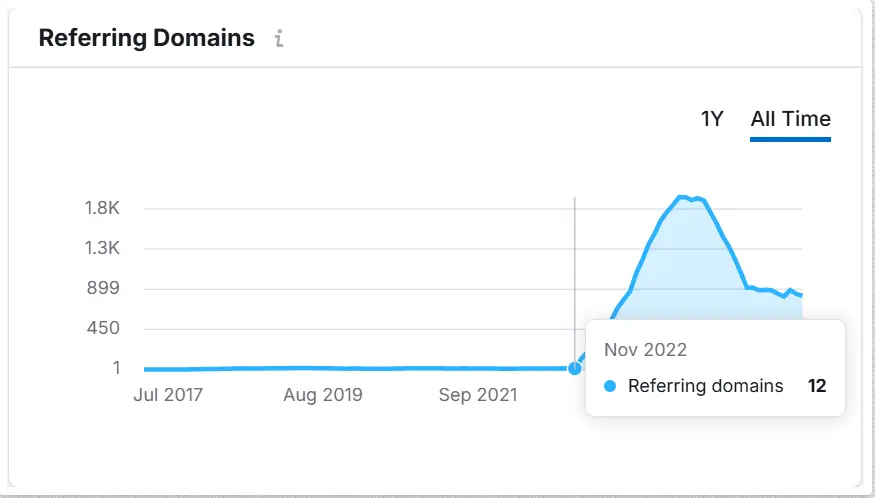
After Referring Domain:
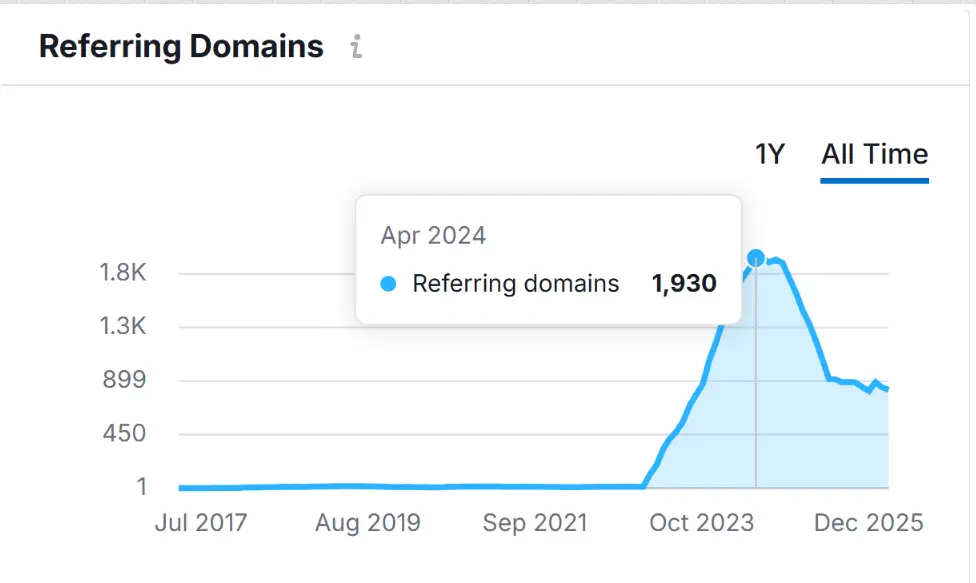
GMB:
GMB Performance Overview: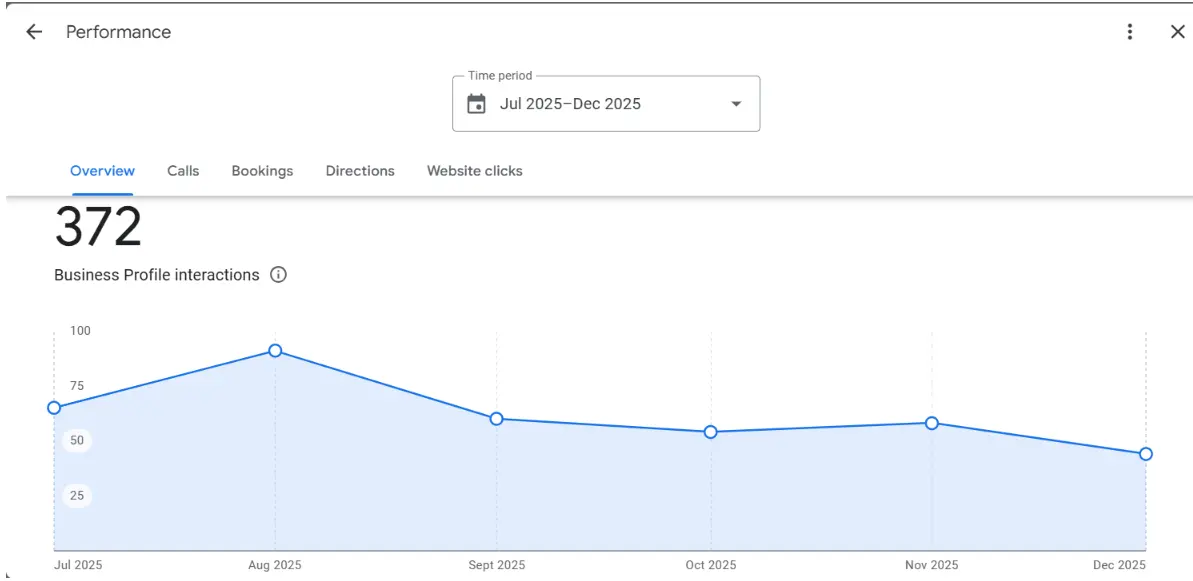
GMB Search Performance Overview:
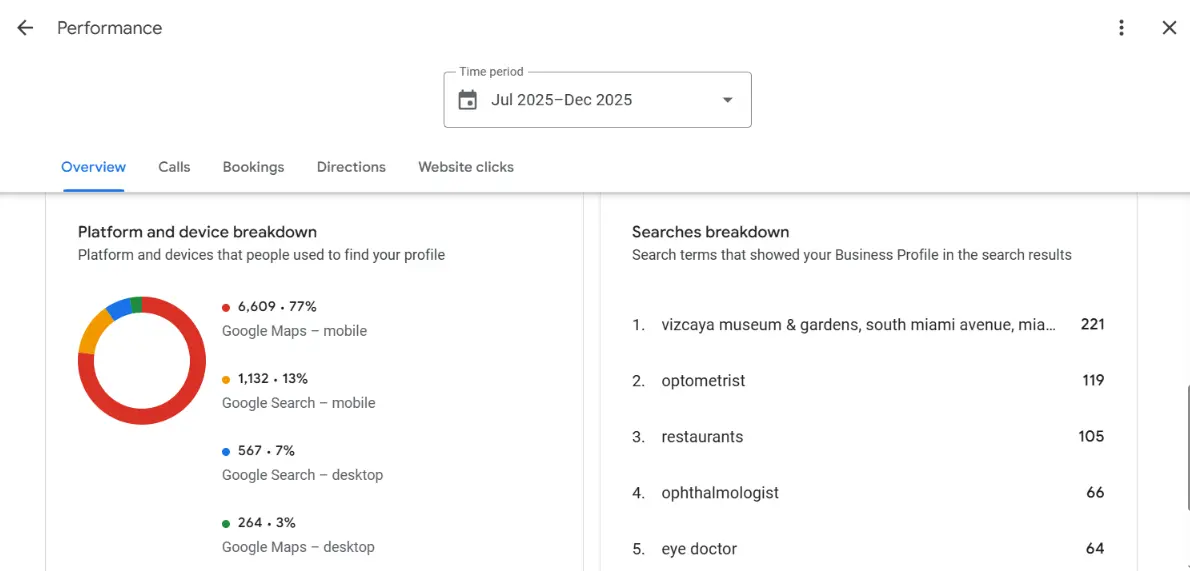
In the second half of 2025 alone, the Google Business Profile generated over 8,500 monthly patient searches — with 77% coming from Google Maps mobile, precisely the high-intent local search moment where appointment decisions are made.
Most primary and secondary keywords moved into the top 10 search results. Organic traffic grew by 369%. And the clinic now appears in Google’s AI Overviews — positioned for the next generation of patient discovery as AI search continues to grow.
These are not projections. They are documented outcomes from a real eye care clinic in a competitive US market, delivered through the same focused approach we bring to every client we work with.
The Window Is Open — But Not Forever
The eye care market in the USA, UK, Canada, and Australia is competitive and growing. Patients are searching. AI assistants are fielding health questions by the millions every day. The clinics that invest in their digital visibility now — in SEO, local SEO, GEO, and AEO — will be the ones patients find first, trust most, and book immediately.
The early-mover advantage in AI search is real. It exists right now in a way it will not in 12 months’ time. The practices that act in 2026 will be significantly harder to displace than those who wait until the landscape is saturated.
At Ingenious Netsoft, we specialise in digital marketing for eye care clinics and healthcare providers. We combine technical SEO expertise, local search strategy, high-quality content creation, and cutting-edge GEO and AEO services to help clinics across the USA, UK, Canada, and Australia attract more patients, dominate local search, and build online visibility that compounds over time.
We do not offer cookie-cutter marketing packages. We build strategies around your clinic, your market, and your growth goals — backed by real data and documented results.
Ready to Get More Patients for Your Eye Care Clinic?
If you run an eye care clinic and you want to know exactly how your online presence is performing — and what a realistic path to growth looks like — we would like to talk.
Contact Ingenious Netsoft for a completely free, no-obligation consultation.
In your free session, we will:
- Audit your current SEO and local search performance
- Check your Google Business Profile for missed opportunities
- Assess your readiness for GEO and AEO in AI-driven search
- Give you an honest, clear growth roadmap — no fluff, no pressure
The patients are searching right now. Make sure they find your clinic.
Book Your Free Eye Clinic Digital Marketing Consultation


