

Airbnb-Like Website Development Cost: A Complete Breakdown
The short-term rental industry is no longer a side hustle. It is a global market worth $153 billion in 2026, and it is growing at 10.41% annually, projected to hit $371 billion by 2035. Airbnb alone generated $12.2 billion in revenue in 2025, with over 533 million nights booked, an 8% increase year on year.
But here is the problem nobody talks about openly: Airbnb takes up to 15.5% of every booking you earn. On a property generating $5,000 a month, that is $775 gone before you pay a single bill. At $180,000 annual revenue, one host calculated her Airbnb fees totalled $27,900 in a single year.
And beyond the fees, there is a deeper vulnerability. Airbnb’s algorithm is a black box. Hosts regularly report sudden drops in visibility after algorithm updates, with no warning and no explanation.
The answer for thousands of property owners and entrepreneurs across the UK, USA, Canada, and Australia is to build their own vacation rental website. A branded, direct booking platform that puts them in control. But not all short-term rental platforms are built equal. And ever since, entrepreneurs around the world have been asking the same question: “How much does it actually cost to build something like that?”
The honest answer: it depends. And most guides online either give you a number so low it is laughable, or so high it is terrifying. Neither is accurate. Neither is helpful.
In this blog, we give you the real numbers, based on actual marketplace website development data in 2026, broken down by approach, feature set, timeline, and team location. Whether you are a startup founder, a property entrepreneur, or a business looking to build a rental marketplace development platform, this guide tells you exactly what you are buying at every budget level.
Table of Contents
- How Much Does It Cost to Build a Website Like Airbnb in 2026?
- 3 Approaches to Build an Airbnb-Like Website
- Detailed Cost Breakdown of Building an Airbnb-Like Platform
- The 5 Biggest Factors That Drive Your Final Cost Up or Down
- The Question Nobody Asks, But Which Determines Whether You Succeed
- What This Means for Your Business in 2026
- Ready to Build Your Rental Marketplace? Let’s Talk.
TL;DR – Key Takeaways
The short-term rental market is worth $153 billion in 2026 and growing, so the opportunity is real. But the cost to build a platform like Airbnb depends entirely on how you build it.
There are three routes:
- No-code builder:
$100–$500/month. Fast and cheap. Good for testing an idea. Hits a ceiling quickly. - Clone script:
$5,000–$20,000. Looks cheap upfront. Hidden costs make it the most expensive option long-term. - Custom development:
the only serious option. MVP starts at $50,000–$120,000 and takes 3–5 months. A full platform with app, AI features, and multi-currency payments runs $250,000–$400,000+.
The biggest cost drivers are your team’s location (US agencies charge $100–$200/hour vs $25–$35/hour for experienced India-based teams), feature complexity, and how many third-party integrations you need.
But here is the part nobody tells you: the technology is the easy part. The real challenge is the chicken-and-egg problem, getting hosts to list when there are no guests, and guests to book when there are no listings. No developer can solve that for you. Start with a clear niche, validate with an MVP, then invest in custom development once you have real users.
How Much Does It Cost to Build a Website Like Airbnb in 2026?
Before any cost conversation, let’s establish why this idea makes commercial sense right now.
The global short-term rental market is valued at $153 billion in 2026 and is projected to reach $371 billion by 2035, growing at 10.41% annually.
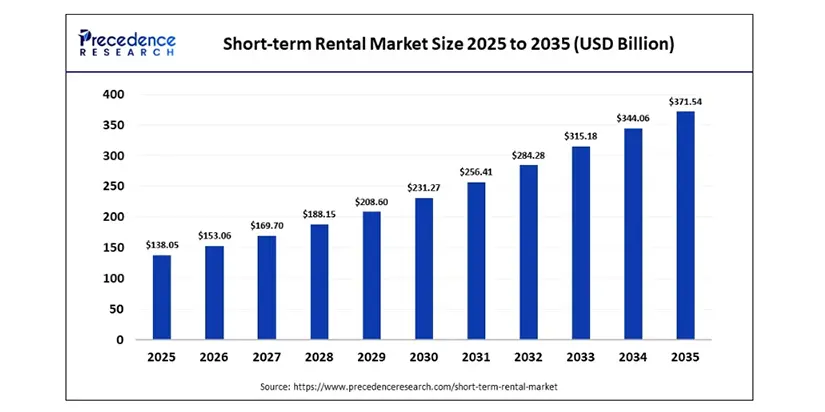
Source: Precedence Research — Short-Term Rental Market 2026
Airbnb alone generated $12.2 billion in revenue in 2025, a 9.9% year-on-year increase. Over 533 million nights were booked in 2025.
Source: Business of Apps — Airbnb Statistics 2026
By end of 2026, Airbnb is expected to have over 275 million active users worldwide.
Source: Techugo — Airbnb Clone App Guide 2026
The market is enormous, and Airbnb does not own every niche within it. Entrepreneurs are successfully building Airbnb clone development platforms for luxury villas, boat rentals, RV parks, co-living spaces, LGBTQ-friendly stays, pet-friendly accommodations, and dozens of other verticals that Airbnb serves poorly or not at all.
The opportunity is real. The question is what it costs to seize it.
The Three Ways to Build a Website Like Airbnb, And What Each Costs
There is no single answer to “how much does it cost to build a website like Airbnb” because there are three fundamentally different approaches, each with completely different price points, timelines, and outcomes.
Approach 1: No-Code Marketplace Builder
Platforms like Sharetribe, Cocorico, and Kreezalid allow you to launch a working rental marketplace development platform without writing a single line of code. You get core marketplace functionality: listings, bookings, payments, and reviews in days, not months.
- No-Code Builder: $100–$500/month subscription
- Timeline: Days to weeks
- Best for: Founders validating an idea on a tight budget
This approach is fast and cheap, but it hits a ceiling quickly. When your concept outgrows the template, you face a full rebuild. It is the right choice for testing whether your marketplace idea attracts real users. It is the wrong choice if you are building for serious scale from day one.
Best for: Early-stage founders who want to validate the concept before committing to custom web development.
Approach 2: Airbnb Clone Script
An Airbnb clone script is a pre-built codebase that replicates Airbnb’s core features out of the box. You purchase it, install it on a server, and — in theory — have a working rental marketplace without building anything from scratch.
- Clone Script: $5,000–$20,000 upfront
- Timeline: Weeks to months
- Best for: Budget-conscious founders with development resources
In practice, clone scripts come with serious drawbacks. They are built to look like Airbnb — not to fit your specific niche or business model. Customising them requires a developer who understands someone else’s codebase, which is often messier and more expensive than building from scratch. They also come with poor documentation, minimal support, and security vulnerabilities.
The Three Ways to Build a Website Like Airbnb — And What Each Costs
There is no single answer to “how much does it cost to build a website like Airbnb” because there are three fundamentally different approaches — each with completely different price points, timelines, and outcomes.
Approach 1: No-Code Marketplace Builder
Platforms like Sharetribe, Cocorico, and Kreezalid allow you to launch a working rental marketplace development platform without writing a single line of code. You get core marketplace functionality — listings, bookings, payments, reviews — in days, not months.
No-Code Builder: $100–$500/month subscription
- Timeline: Days to weeks
- Best for: Founders validating an idea on a tight budget
This approach is fast and cheap — but it hits a ceiling quickly. When your concept outgrows the template, you face a full rebuild. It is the right choice for testing whether your marketplace idea attracts real users. It is the wrong choice if you are building for serious scale from day one.
Best for: Early-stage founders who want to validate the concept before committing to custom web development.
Approach 2: Airbnb Clone Script
An airbnb clone script is a pre-built codebase that replicates Airbnb’s core features out of the box. You purchase it, install it on a server, and — in theory — have a working rental marketplace without building anything from scratch.
Clone Script: $5,000–$20,000 upfront
- Timeline: Weeks to months
- Best for: Budget-conscious founders with development resource
In practice, clone scripts come with serious drawbacks. They are built to look like Airbnb — not to fit your specific niche or business model. Customising them requires a developer who understands someone else’s codebase, which is often messier and more expensive than building from scratch. They also come with poor documentation, minimal support, and security vulnerabilities.
“If you’ve seen clone scripts advertised at low one-time prices, factor in the developer time you’ll need to make them usable. The total cost tends to exceed that of a no-code solution quickly, and you end up with something harder to maintain and scale.” — Sharetribe, 2026
Best for: Rarely the right choice. The hidden costs typically make this the most expensive option in the long run.
Approach 3: Custom Web Development
This is custom website development from the ground up — a bespoke platform built to your exact specifications by a professional development team. It is the most expensive approach and the most powerful.
MVP (Custom): $50,000–$120,000
- Timeline: 3–5 months
- Best for: Funded startups and serious entrepreneurs
Full Platform (Custom): $120,000–$350,000+
- Timeline: 6–12+ months
- Best for: Established businesses scaling a proven model
Custom development gives you complete control over architecture, design, features, and scalability. It is the only approach that produces a platform capable of competing seriously in a mature market — and the only approach a reputable website development company like Ingenious Netsoft would recommend for anything beyond initial concept validation.
The Real Cost Breakdown – What You Are Actually Paying For?
When a marketplace website development agency quotes you a number, here is what that number actually covers. Understanding this breakdown helps you evaluate any quote intelligently — and avoid being overcharged or underserved.
- UI/UX Design ($8,000–$25,000)
Design is not just how it looks. It is how it works. A well-designed build website like airbnb platform guides users from search to booking in as few steps as possible — reducing friction and increasing conversion rate. Poor UX design is the single biggest reason rental marketplaces fail to retain users after launch.
- Guest-facing search, filters, property listing pages, booking flow
- Host-facing dashboard, listing creation, calendar management
- Admin panel for platform management, payments, and user moderation
- Mobile-responsive design across all screen sizes
Custom animations, branded design systems, and accessibility compliance add 20–30% to base design costs, but pay for themselves in lower bounce rates and higher booking conversion.
2. Frontend Development ($15,000–$40,000)
The frontend is everything users see and interact with. For a platform like Airbnb, frontend complexity is significant: interactive maps, real-time availability calendars, image galleries, search with dynamic filters, and responsive layouts across every device.
75% of all travel bookings are now made on mobile devices. A platform that performs poorly on mobile will lose the majority of its potential bookings before they happen.
Source: Prostay — Hotel Booking Statistics 2026
3. Backend Development ($20,000–$60,000)
The backend is the engine nobody sees but everyone depends on. For a rental marketplace development platform, the backend handles:
- User authentication and profile management for hosts and guests
- Property listing logic creation, editing, approval, and geo-search
- Booking engine availability logic, conflict prevention, instant vs request booking
- Payment processing and escrow, holding funds until after stay completion
- Messaging system, real-time communication between hosts and guests
- Review and rating system, two-sided, verified reviews
- Admin panel, user management, listing moderation, and financial reporting
Airbnb originally ran on a single Ruby on Rails monolith. Today, it operates on microservices, independent services handling bookings, reviews, and payments separately. For a new platform, a modular monolith is the recommended starting architecture: a single codebase divided into logical modules, allowing the team to develop features in parallel without the complexity of full microservices from day one.
4. Payment Gateway Integration ($4,000–$25,000)
Payments are not optional, they are the business model. A marketplace app development cost estimate that skips payment complexity is missing a significant line item.
- Stripe integration (most developer-friendly): $4,000–$7,000
- Multiple gateway support for different regions/currencies: $12,000–$25,000
- Escrow logic — holding guest funds until after check-in: additional complexity
- Host payout system — automated, scheduled payouts to property owners
GDPR compliance for European users costs $8,000–$15,000 to implement properly. PCI-DSS compliance for payment data adds $5,000–$12,000. In regulated markets like Germany or France, local rental law compliance adds another $10,000–$30,000.
Source: HireFullStackDeveloperIndia — Airbnb Cost Guide 2026
5. Third-Party API Integrations ($5,000–$20,000)
No rental marketplace is built in isolation. The integrations that make a platform genuinely useful — and genuinely competitive — add meaningful cost:
- Google Maps API: location search, property mapping, neighbourhood exploration
- SMS provider (Twilio): booking confirmations, security codes, guest notifications
- Email service (SendGrid): automated messaging at scale
- ID verification (Onfido, Persona): host and guest identity verification
- Dynamic pricing engine (PriceLabs, Wheelhouse): automated rate optimisation
- Analytics (Mixpanel, Amplitude): user behaviour tracking for product improvement
6. AI Features ($20,000–$45,000) (Optional but Increasingly Expected)
In 2026, AI features are no longer optional extras on a competitive web application development cost estimate; they are becoming table stakes for user retention and investor credibility.
- Behavioural recommendation engine: Surfaces properties based on search history and past bookings: $20,000–$45,000
- AI-powered guest messaging: Automated responses with natural language understanding: $10,000–$25,000
- Smart pricing suggestions: AI-driven pricing recommendations for hosts: $15,000–$30,000
- Virtual property tours: 360-degree photo walkthroughs to reduce cancellations
7. Mobile App Development – Optional for MVP ($35,000–$140,000)
Most successful rental platforms launched web-first before investing in native mobile apps. However, if your target audience is primarily mobile, which in travel is almost universal, a mobile app becomes a competitive necessity quickly.
- Single platform (iOS or Android) native app: $35,000–$70,000
- Cross-platform (Flutter/React Native — iOS and Android): $45,000–$85,000
- Both native iOS and Android: $70,000–$140,000+
The cost to build a mobile app like Airbnb ranges from $150,000 to $400,000 for a full-featured native application, and takes 6 months or more to build.
- QA Testing and Security ($8,000–$20,000)
A marketplace platform handles real money, real identity data, and real bookings. Security is not a checkbox; it is a commercial necessity. A single data breach or payment vulnerability can destroy trust and kill a marketplace overnight.
- Penetration testing and vulnerability assessment
- Load testing: Can the platform handle peak demand without breaking?
- Cross-browser and cross-device QA
- Payment security audit
9. Ongoing Maintenance ($1,500–$8,000/month)
The cost of custom website development does not end at launch. A rental marketplace requires ongoing investment:
- Bug fixes and security patches
- Server infrastructure and scaling costs
- Feature development as the platform grows
- Platform updates and API maintenance as third-party services evolve
The 5 Biggest Factors That Drive Your Final Cost Up or Down
Two businesses can ask for the same platform and receive quotes that differ by $100,000 or more. Here is why:
1. Development Team Location
This is the single biggest cost variable in any marketplace website development project.
- US/UK-based agencies: $100–$200 per hour
- Eastern Europe/Latin America agencies: $40–$80 per hour
- India-based agencies with comparable experience: $25–$35 per hour
An India-based agency like Ingenious Netsoft serving UK, USA, Canada, and Australian clients, offers the quality of Western development at a fraction of the cost. This is not a compromise on quality. It is a commercial advantage that allows clients to build more for less.
2. Feature Complexity
Every advanced feature adds weeks to the timeline and thousands to the budget. A dynamic pricing engine alone takes 3–4 weeks to build correctly. AI recommendations can add $20,000–$45,000. The discipline of deciding what your MVP genuinely needs, versus what would be nice to have, is one of the most valuable things an experienced website development company brings to any project.
3. Design Approach
A straightforward, minimalist interface costs less than a fully custom design system. For an MVP, a clean, functional design that converts well is more valuable than an award-winning visual experience. Invest in design quality, but calibrate the level of design investment to the stage your business is at.
4. Number of Integrations
Each third-party API, maps, payments, ID verification, messaging, and analytics adds integration cost, licensing cost, and ongoing maintenance. Every integration also adds a dependency: if Google Maps changes its pricing (which it has), your costs change. Plan integrations deliberately and prioritise the ones that directly impact booking conversion.
5. Niche and Regulatory Complexity
A general property rental platform costs less than a boat rental platform with insurance verification and delivery coordination. A platform targeting the UK market costs less than one handling multi-currency, multi-language, GDPR compliance, and international tax reporting. Define your niche clearly before development begins; scope creep is the most expensive thing that can happen to a custom web development project.
The Question Nobody Asks, But Which Determines Whether You Succeed
Here is the most important thing about building a website like Airbnb that almost every cost guide skips entirely.
The technology is the easy part.
The hard part is the chicken-and-egg problem: how do you attract hosts to list on your platform when there are no guests, and how do you attract guests when there are no listings?
Airbnb solved this in its earliest days by manually photographing listings in New York and creating demand before supply existed at scale. Every successful marketplace since has had to solve the same fundamental problem, and technology cannot solve it for you.
Before you commission airbnb clone development, you need honest answers to these questions:
- What is your niche? General property rental competes directly with Airbnb. A specific vertical — eco-stays, LGBTQ-friendly accommodation, pet-friendly rural retreats — gives you a defensible position.
- How will you acquire your first 50 hosts? Without supply, you have no marketplace.
- How will you acquire your first 500 guests? Without demand, hosts will leave.
- What is your geographic focus? Starting in one city or region allows you to build concentration before expanding.
- What is your commission model? And does it give hosts a genuine reason to choose you over listing on Airbnb?
The Right Approach: Start with a no-code MVP to validate the concept and prove demand. Once you have real users and real bookings, invest in custom development to build the platform your validated audience actually needs. This approach minimises risk and ensures you are building features based on evidence rather than assumptions.
What This Means for Your Business in 2026
Building a website like Airbnb is not a small undertaking, but it is not an impossible one either. The market is enormous, the tools are more accessible than ever, and the right development partner can help you build something genuinely competitive without overspending on features your first users do not need yet.
The businesses that win in rental marketplace development in 2026 are the ones that:
- Start with a clear niche, not a direct Airbnb clone, but a specific underserved vertical
- Build an MVP first, validate the concept before committing $200,000+ to a full platform
- Choose a development partner with actual marketplace experience, not just web development experience
- Invest in UX and conversion design from the start, a well-designed platform retains users; a poorly designed one loses them immediately
- Plan for ongoing development, a marketplace is never “done”; it evolves with its users
Ready to Build Your Rental Marketplace? Let’s Talk.
At Ingenious Netsoft, we are a global custom web development company with over a decade of experience building complex web applications and marketplace platforms for clients across the UK, USA, Canada, and Australia. We specialise in marketplace website development, from MVP builds that validate your concept quickly, to full-featured platforms built for scale.
Our development approach covers everything: business analysis, UI/UX design, frontend and backend development, payment integration, third-party API connections, security testing, and post-launch support. We have built platforms across travel, property, eCommerce, and professional services, and we understand how the architecture decisions you make in month one affect what you can build in year three.
Whether you need an MVP in three months or a full rental marketplace development platform with AI recommendations and dynamic pricing, we build to your specific roadmap, on time and within budget.
Get in touch with Ingenious Netsoft today for a free project consultation and honest cost estimate. No inflated numbers. No vague answers. Just a clear plan for what your platform needs and what it will realistically cost to build it.


