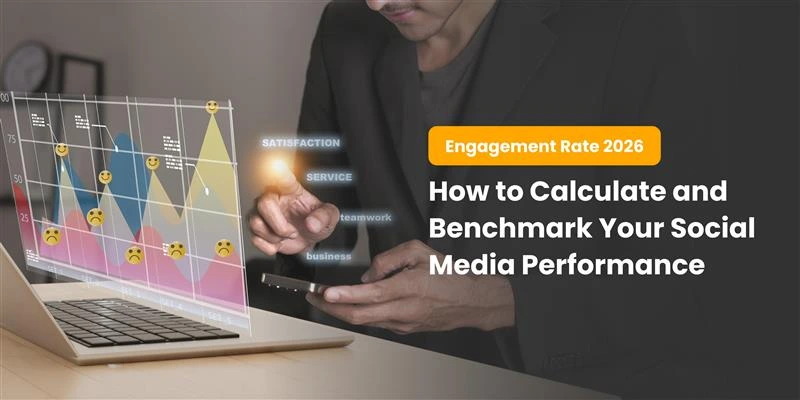
Engagement Rate 2026: How to Calculate and Benchmark Your Social Media Performance
Forget “post and pray.”In 2026, simply publishing content and hoping it goes viral is no longer a strategy, it’s a guaranteed way to get ignored.
If your social media feels like shouting into a void, the problem isn’t your effort—it’s your understanding of engagement rate in 2026.
While a million followers might look impressive, most brands today struggle with organic reach dropping below 1.5%. The rules have changed.
To win in 2026, you don’t need more content – you need better-calculated, data-driven content.\
Table of Contents
- What Does Engagement Rate Actually Mean?
- Why Does Engagement Rate Matter?
- Mathematical Formulas to Calculate Engagement Rate 2026
- Know How to Calculate Engagement Rate Automatically
- What is a Good Engagement Rate? (Benchmarks for 2026)
- 2026 Industry-Specific Engagement Benchmarks
- How to Use Engagement Rate to Create Your Strategy
- The Ingenious Netsoft Philosophy for Engagement Rate 2026
- Faq’s
What Does Engagement Rate Actually Mean?
Engagement Rate (ER) is a mathematical formula that measures the “stickiness” of your content. While a follower count tells you how many people subscribed to your channel, the engagement rate tells you how many of them actually care about what you have to say.
In simple terms:
It measures how many people actually care about what you post.
This includes:
- Likes
- Comments
- Shares
- Saves
Engagement Rate = (Total Engagement ÷ Total Audience or Reach) × 100
In 2026, where organic reach is a luxury! A high engagement rate is the only signal that tells social media platformsthat your content is worth promoting to a wider audience.
If you want to move beyond vanity metrics and actually understand your brand’s pulse, you need to stop looking at follower counts and start mastering your IG engagement.
Why Does Engagement Rate Matter?
If there’s one metric that actually tells you whether your content is working in 2026, its engagement rate. It represents the difference between a “dead” following and a thriving, profitable community.
Here is why it matters most for your social media marketing:
1. It is the Algorithm’s “Green Light”
Platforms are no longer chronological; they are interest-based. When you post, the algorithm “votes” to show it to more people only if the initial segment interacts.
2. It Filters Out “Ghost” Followers
Engagement rate exposes the truth, telling you exactly how many people are actually consuming your content versus inactive bots.
3. It Measures “Social Proof” and Trust
For a business, high engagement on instagram acts as a digital testimonial, creating immediate credibility for new leads.
4. It Predicts Conversion and ROI
There is a direct link between engagement and sales. High rates typically lead to lower Customer Acquisition Costs (CAC).
5. It Provides a Feedback Loop
By tracking which posts resonate, a social media content creatorcan stop guessing and refine the “Content-Market Fit.”
Mathematical Formulas to Calculate Engagement Rate 2026
To calculate your metrics accurately, you must choose the formula that matches your specific goal. Modern social media managementnow prioritizes “intent-based” actions like Saves and Shares over passive “Likes.”
1. Engagement Rate by Reach (ERR)
Best for: Measuring how compelling your content is to the people who actually saw it (both followers and non-followers).
Formula: (Engagement ÷ Reach) × 100
Why it matters: In 2026, “For You” feeds mean your content often reaches people who don’t follow you. ERR is the most accurate reflection of content quality.
Source: Hootsuite 2026 Social Trends Report
2. Engagement Rate by Post (ER Post)
Best for: Competitive benchmarking and tracking your “hardcore” audience’s loyalty.
Formula: (Engagement ÷ Followers) × 100
Why it matters: Since you cannot see a competitor’s reach data, this allows you to compare your performance against theirs using public follower counts.
Source: Socialinsider 2026 Benchmark Study
3. Engagement Rate by Views (ER Views)
Best for: Video-first platforms like TikTok, Reels, and YouTube Shorts.
Formula: (Total Engagement on videos/Total Video Views *100).
Why it matters: With short-form video accounting for 82% of internet traffic, this formula tells you if your video was “scroll-stopping” or just background noise.
4. Daily Engagement Rate (Daily ER)
Best for: Understanding your brand’s total “interaction velocity” over a 24-hour period.
Formula: (Total Engagement in 24 hours/Total Followers *100)
Why it matters: This helps you see how active your community is on a daily basis, regardless of how many individual posts you share.
Know How to Calculate Engagement Rate Automatically
To calculate engagement rates automatically in 2026, professional digital creators and agencies are moving away from manual spreadsheets in favor of API-driven analytics platforms. These tools pull real-time data directly from social media servers to provide instant insights.
We prefer automatic calculation through three primary methods:
1. Built-in Native Analytics
Every major platform now provides a professional dashboard that calculates engagement rates automatically.
- Instagram and Facebook: Use Meta Business Suite to automatically calculate your engagement rate per post and track trends over 7, 28, or 90 days.
- LinkedIn: The Analytics tab on your Company Page provides a breakdown of visitors and content, automatically displaying the engagement percentage for every update.
- TikTok: TikTok Analytics for business accounts features a specific engagement tab that aggregates likes, comments, and shares automatically.
2. Third-Party Social Media Management Tools
For brands managing multiple clients or running a high-growth smma, third-party tools are the industry standard for automated reporting. These platforms use formulas like ERR and ER Post to generate detailed reports in seconds.
- Hootsuite: Offers an Impact feature that automatically benchmarks your engagement against your specific industry.
- Sprout Social: Provides listening tools that calculate engagement for both your posts and your entire brand mention history across the web.
- Buffer: Ideal for clean, automated reports that determine your best time to post based on historical engagement data. Using a professional social media scheduler within these platforms ensures you never miss a peak interaction window.
3. Custom Google Looker Studio Dashboards
For high-level business analysis, we recommend connecting your social accounts to Google Looker Studio.
- How it works: You use a connector, such as Supermetrics or Windsor.ai, to feed live social data into a custom dashboard.
- The Benefit: It simplifies complex social media management by calculating your engagement rate across all platforms simultaneously, allowing you to view your omnichannel engagement in a single window.
2026 Industry-Specific Engagement Benchmarks
In 2026, a “good” engagement rate is no longer a single number. Because algorithms now prioritize shares and saves over passive likes, benchmarks vary wildly depending on your platform and industry. If you are struggling to hit these marks, a specialized social media agency can help you pivot your content strategy.
2026 Engagement Benchmarks by Platform
The following table represents the median engagement rates across all industries for 2026. If your brand is above these numbers, you are outperforming the market.
| Platform | Average Engagement Rate | “Good” Engagement Goal | Top Content Format |
|---|---|---|---|
| TikTok | 3.70% – 4.20% | 5.0% + | Short Video (7–15s) |
| 2.10% – 3.50% | 5.0% + | ||
| 0.50% – 0.98% | 2.5% + | Reels & Carousels | |
| 0.08% – 0.15% | 0.5% + | Photos & Group Posts | |
| X (Twitter) | 0.12% – 0.48% | 1.0% + | Text Threads & Polls |
The 2026 engagement data highlights a clear “Interest Graph” era where TikTok and LinkedIn lead the market with high-intent “Good” goals of 5.0%+. While TikTok dominates through hyper-short video virality (3.70%–4.20% average), LinkedIn has reinvented itself as a high-value educational hub via Document Carousels.
In contrast, legacy platforms like Facebook and X have transitioned into niche community spaces, requiring interactive formats like Polls and Threads to break through the noise.
Ultimately, the data proves that success in 2026 is mathematically tied to using platform-native formats moving away from static posts toward dynamic, “sticky” content that forces the algorithm to prioritize your brand.
2026 Industry-Specific Engagement Benchmarks
The following table displays the median engagement rate per post for major industries across the top three performance platforms.
| Industry Sector | TikTok | ||
|---|---|---|---|
| Higher Education | 2.45% | 7.36% | 3.90% |
| Sports Teams | 1.81% | 5.20% | 1.15% |
| Influencers | 1.38% | 4.80% | 2.50% |
| Nonprofits | 0.94% | 3.10% | 2.85% |
| Tech & Software | 0.72% | 2.45% | 3.10% |
| Healthcare | 0.61% | 3.70% | 1.95% |
| Retail & Fashion | 0.54% | 2.15% | 1.20% |
| Finance | 0.40% | 1.80% | 2.15% |
Why the Disparity?
The data identifies TikTok as the undisputed leader for engagement across almost all sectors, while LinkedIn has solidified its position as the high-performance engine for professional and B2B sectors.
Conversely, Instagram has transitioned into a “mid-tier” engagement platform, where success is highly dependent on specific visual niches like Higher Education and Sports.
The “Premium” Standard for 2026
If you are operating in a high-trust industry like Finance or Healthcare, your goal isn’t just a high number, it’s high-intent engagement.
For these sectors, we prioritize Saves and Shares over likes. A “save” on a financial tip post is worth significantly more to your ROI than a “like” on a generic office photo.
Source: Socialinsider 2026 Industry Benchmark Study
How to Use Engagement Rate to Create Your Own Social Media Strategy?
Engagement rate is the only metric that tells you if your content is actually “working.” In 2026, where algorithms prioritize interest over followers, your engagement data should be the primary architect of your social strategy.
You can use a four-step framework to turn these numbers into a high-performance growth engine.
1. Audit Your “Content Winners”
Don’t guess what your audience wants; let the data tell you.
- The 10-Post Rule: Look at your last 20 posts. Pick the top 10 with the highest engagement rate.
- Identify the Pattern: What do they have in common? Is it the format (Reels vs. Carousels), the tone (Educational vs. Humorous), or a specific topic?
- The Strategy: If 80% of your top posts are “How-To” Carousels, stop posting generic “Company News.” Double down on what is already winning.
2. Optimize Based on “Engagement Intent”
In 2026, not all interactions are equal. Use your strategy to drive the actions that matter most to your business goals.
- Goal: Awareness?
Focus on Shares. Create “relatable” or “controversial” content that people feel compelled to send to friends. - Goal: Trust/Authority?
Focus on Saves. Create high-value “Reference-Grade” content (like the formulas we discussed) that people want to keep for later. - Goal: Community?
Focus on Comments. End every post with a specific, easy-to-answer question to spark the algorithm’s “conversation” signal.
3. Identify Your “Peak Interaction Windows”
Posting when your audience is asleep is a wasted effort.
- The Strategy: Use your automated dashboards to find the exact hour when your engagement spikes.
- The 60-Minute Rule: In 2026, the first hour of a post is critical. Plan to be active and respond to every comment within that first hour to signal to the algorithm that the post is “trending.”
4. Competitive Benchmarking (The “Gap” Strategy)
Use your competitors’ engagement rates 2026 to find “White Space” topics they aren’t covering.
- The Strategy: Pick 3-5 competitors. If their engagement rate is high on a specific topic but low on others, it shows you where the audience’s hunger lies.
- The Execution: Create content that fills the gaps they are missing, using a more “premium” aesthetic and better text hierarchy to stand out.
| If your Engagement Rate is… | Your Strategy Shift should be… |
|---|---|
| High Reach / Low Engagement | Your “Hook” is good, but your content is boring. Improve value. |
| Low Reach / High Engagement | Your content is great, but the algorithm isn’t seeing it. Post more Reels/Video. |
| Low Reach / Low Engagement | You are posting for the wrong audience. Re-evaluate your Content Pillars. |
The Ingenious Netsoft Philosophy for Engagement Rate 2026
To master your social media marketing strategy in 2026, you must stop viewing likes as the finish line and start seeing Engagement Rate as your roadmap. The data is clear: whether you are a solo social media content creator or a global social media marketing agency, success now depends on mathematical precision and platform-native formats.
At Ingenious Netsoft, we believe that every digital interaction is a data point that should inform your next move. As a specialized social media management company, we don’t just help you post; we help you engineer “stickiness” that forces the interest-based algorithms of modern social media platforms to work in your favor
FAQs
1. Why is my engagement rate dropping while my follower count is growing?
This is a common “mathematical plateau.” As your audience expands, your content is shown to a broader, less-niche group, naturally lowering the percentage of people who interact. In 2026, a 2% rate for a 500k account is actually considered superior to a 5% rate for a 5k account in terms of absolute impact.
2. Which is a more important metric in 2026: Likes or Saves?
Saves are the “Golden Metric” of 2026. Algorithms now weight a Save significantly higher than a Like because it signals “High Utility.” While a Like is a passive 1-second interaction, a Save tells the platform your content is valuable enough to be revisited.
3. Does the “First Hour” of posting still determine a post’s success?
Yes! but with a twist. The 2026 “Distribution Waterfall” uses the first 60 minutes to test your content against a “Seed Group” of your most active followers. If they don’t engage, the algorithm restricts further reach to prevent the spread of low-value content.
4. What is the average engagement rate for a business on LinkedIn in 2026?
The 2026, Benchmark for a healthy LinkedIn Company Page sits between 2.10% and 3.50%. However, “Thought Leader” personal profiles typically see double that (5%–8%) because the algorithm prioritizes human-to-human interaction over corporate updates.
5. How does “Dark Social” affect my engagement calculations?
Dark Social refers to shares via private DMs, WhatsApp, or Slack. Since these are often invisible to standard public tools, your “True Engagement” is likely 20–30% higher than what is publicly visible. Tracking “Shares” in your private dashboard is the only way to measure this intent.