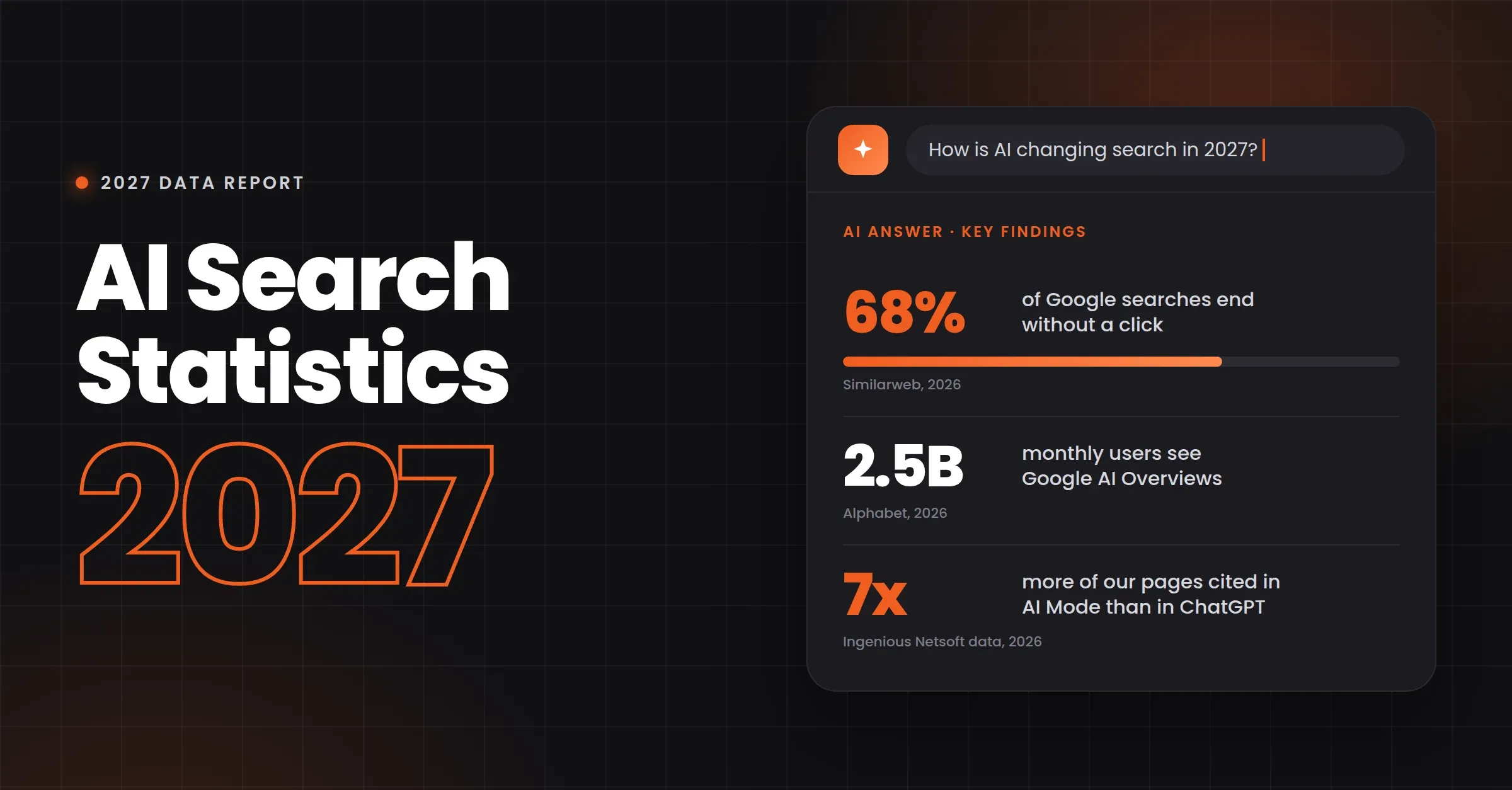
AI Search Statistics 2027: 60+ Data Points on ChatGPT, AI Overviews and GEO
AI search statistics tell a clear story going into 2027: people still search, but more of them get their answer from ChatGPT, Gemini or a Google AI Overview before they ever reach a website. For businesses in the UK, USA, Canada and Australia, that changes how you get found, how you measure traffic and where your marketing budget should go.
We’ve collected the most important AI search statistics, AI Overviews statistics and generative engine optimization (GEO) statistics, each linked to its original source. Every number is dated, and we update this page every quarter.
Key AI Search Statistics for 2027
-
- ChatGPT reached 900 million weekly active users in February 2026. (Wikipedia)
- Google AI Overviews reach 2.5 billion monthly users, according to Alphabet. (The Motley Fool)
- Google AI Mode passed 1 billion monthly active users in 2026. (TechCrunch)
- 49% of US adults now use AI chatbots, up from 33% in 2024. (Pew Research Center)
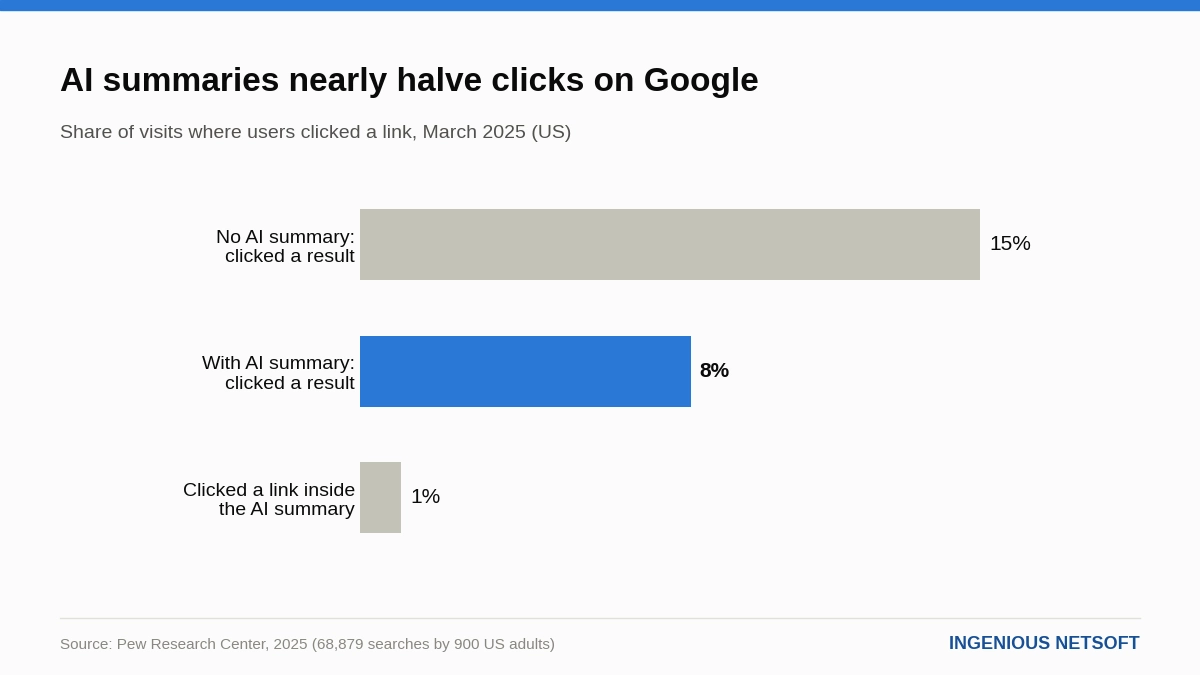
- Google users clicked a result on 8% of visits with an AI summary, versus 15% without one. (Pew Research Center)
- 68% of Google searches ended without a click in 2026. (Similarweb)
- AI traffic to US retail sites rose 393% year over year in Q1 2026, and converted 42% better than other traffic in March 2026. (TechCrunch, Adobe data)
- Branded web mentions are the strongest predictor of AI Overview visibility (0.664 correlation), three times stronger than backlinks. (Ahrefs)
- Marketers now put about 24% of search and content budgets into AI visibility. (Fractl via Relevant Audience)
- 58% of Australians aged 14+ use AI tools in an average four weeks. (Roy Morgan)
TL;DR
- AI search is now mainstream: billions of people see AI answers every month across Google, ChatGPT and Gemini.
- Clicks are shrinking: AI summaries roughly halve the chance someone clicks a regular result.
- But AI visitors are valuable: traffic from AI tools converts as well as or better than other traffic in several studies.
- Mentions beat links: being talked about across the web matters more for AI visibility than raw backlink counts.
- Budgets are moving: most marketers now fund AI visibility, but many still can’t measure it.
Is your brand showing up in AI answers?
We’ll check how ChatGPT, Google AI Overviews, AI Mode and Gemini describe your business, and send you a short report with three quick fixes. Free.
Table of Contents
- AI Search Usage Statistics
- Google AI Overviews and AI Mode Statistics
- Zero-Click Search Statistics
- AI Referral Traffic Statistics
- AI Citation and GEO Statistics
- Consumer Trust and Behaviour Statistics
- B2B Buyer AI Statistics
- AI Search Advertising Statistics
- Marketer Adoption and GEO Budget Statistics
- AI Search Statistics by Country: UK, US, Canada, Australia
- What These Statistics Mean for Your Business
- Methodology and How to Cite This Page
- FAQs
- Sources
AI Search Usage Statistics
AI tools have moved from novelty to everyday habit in just over three years.
- ChatGPT reached 900 million weekly active users in February 2026. (Wikipedia)
- ChatGPT reached 100 million monthly active users within two months of its November 2022 launch. (Wikipedia)
- The Gemini app reached 1 billion monthly active users in August 2026, announced by Sundar Pichai. (TechCrunch)
- Gemini had more than 950 million monthly users at Alphabet’s Q2 2026 earnings call, with daily active users tripling year over year. (TechCrunch)
- 63% of Gemini users use its voice feature. (TechCrunch)
- ChatGPT held about 79% of global generative AI web traffic in September 2025. (Similarweb)
- Gemini web visits grew 157% between April and September 2025, reaching 1.1 billion monthly visits. (Similarweb)
- Visits to AI platforms in the US grew 28.6% between January 2025 and January 2026. (Similarweb)
- 49% of US adults use AI chatbots, up from 33% in 2024. (Pew Research Center)
- 44% of US adults use ChatGPT, up from 18% in 2023. (Pew Research Center)
- About 24% of US adults use AI chatbots daily. (Pew Research Center)
- Searching for information is the most common use of AI chatbots in the US (42%). (Pew Research Center)
- US adults under 50 are about twice as likely to use ChatGPT as those 50 and over (57% vs 28%). (Pew Research Center)
Google AI Overviews and AI Mode Statistics
Google is still the biggest search engine, but more of its results now start with an AI answer.
Reach
- Google AI Overviews reach 2.5 billion monthly users, according to Alphabet CEO Sundar Pichai. (The Motley Fool)
- Google AI Mode has more than 1 billion monthly active users. (TechCrunch)
- AI Mode queries more than double every quarter, but AI Mode still accounts for about 0.34% of all Google searches. (Similarweb)
- About 18% of Google searches by a US panel produced an AI summary in March 2025. (Pew Research Center)
- AI Overviews appeared on 20% or more of searches in 2026. (Similarweb)
Which searches trigger AI Overviews
- 60% of question-format searches produced an AI summary. (Pew Research Center)
- 53% of searches with 10 or more words produced an AI summary. (Pew Research Center)
- 88% of AI summaries cited three or more sources. (Pew Research Center)
Click-through impact
- The #1 organic result gets 34.5% fewer clicks when an AI Overview is present (300,000 keywords, March 2024 vs March 2025). (Ahrefs via Search Engine Land)
- Across 700,000 keywords, CTR fell 15.49% on average when AI Overviews appeared. (Amsive via Search Engine Land)
- Branded keywords gained 18.68% CTR when an AI Overview appeared, while non-branded keywords lost 19.98%. (Amsive via Search Engine Land)
- Organic CTR on AI Overview queries fell from 1.41% to 0.64% year over year. (Seer Interactive via Evergreen Media)
- Paid search CTR on the same queries fell from 21.27% to 9.87%. (Seer Interactive via Evergreen Media)
Our takeaway: branded searches hold up, generic ones lose clicks. Building a brand people search for by name is now an SEO strategy.
Zero-Click Search Statistics
A “zero-click” search ends without the user visiting any website. AI answers are speeding up a trend that started years ago.
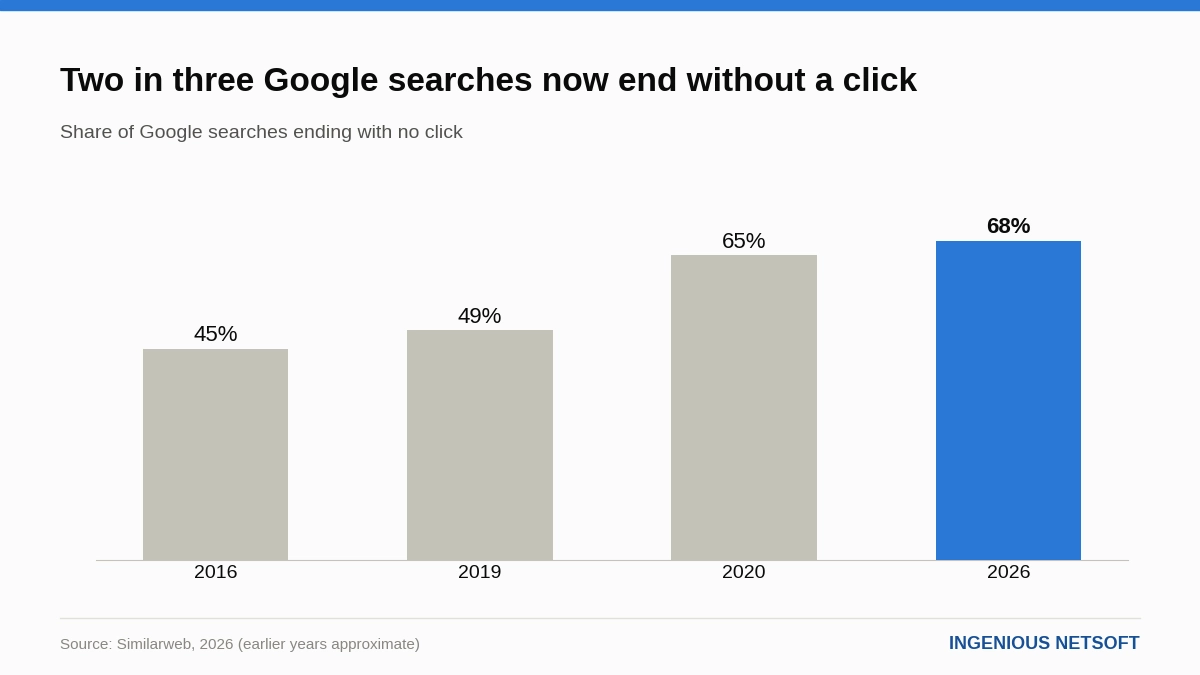
- 68.01% of Google searches ended without a click in 2026. (Similarweb)
- The zero-click rate was about 45% in 2016 and about 65% in 2020, a rise of 23 percentage points in a decade. (Similarweb)
- Google users clicked a traditional result on 8% of visits when an AI summary appeared, compared with 15% when it didn’t. (Pew Research Center)
- Users clicked a link inside the AI summary on just 1% of visits. (Pew Research Center)
- Users ended their browsing session on 26% of pages with an AI summary, versus 16% without one. (Pew Research Center)
- Google AI Mode sends a referral on only 1.6–2.5% of queries, compared with about 17–19% for traditional search. (Similarweb)
- Pew’s study covered 68,879 Google searches by 900 US adults. (Pew Research Center)
Our takeaway: traffic is no longer the only measure of search success. Track brand mentions in AI answers, branded search volume and enquiries, not just sessions.
AI Referral Traffic Statistics
AI tools send fewer visitors than Google, but the visitors they do send often behave better.
Growth
- AI traffic to US retail sites rose 393% year over year in Q1 2026. (TechCrunch, Adobe data)
- AI traffic to US retailers jumped 693% during the 2025 holiday season. (TechCrunch, Adobe data)
- Adobe’s analysis covered more than 1 trillion visits to US retail sites. (TechCrunch)
- Across the US, AI referral traffic stayed flat between January 2025 and January 2026, even as visits to AI platforms grew 28.6%. (Similarweb)
Quality
- AI traffic to US retailers converted 42% better than other traffic in March 2026. A year earlier it converted 38% worse. (TechCrunch, Adobe data)
- Revenue per visit from AI traffic was 37% higher than from non-AI sources in March 2026. (TechCrunch, Adobe data)
- AI visitors spent 48% longer on retail sites and viewed 13% more pages. (TechCrunch, Adobe data)
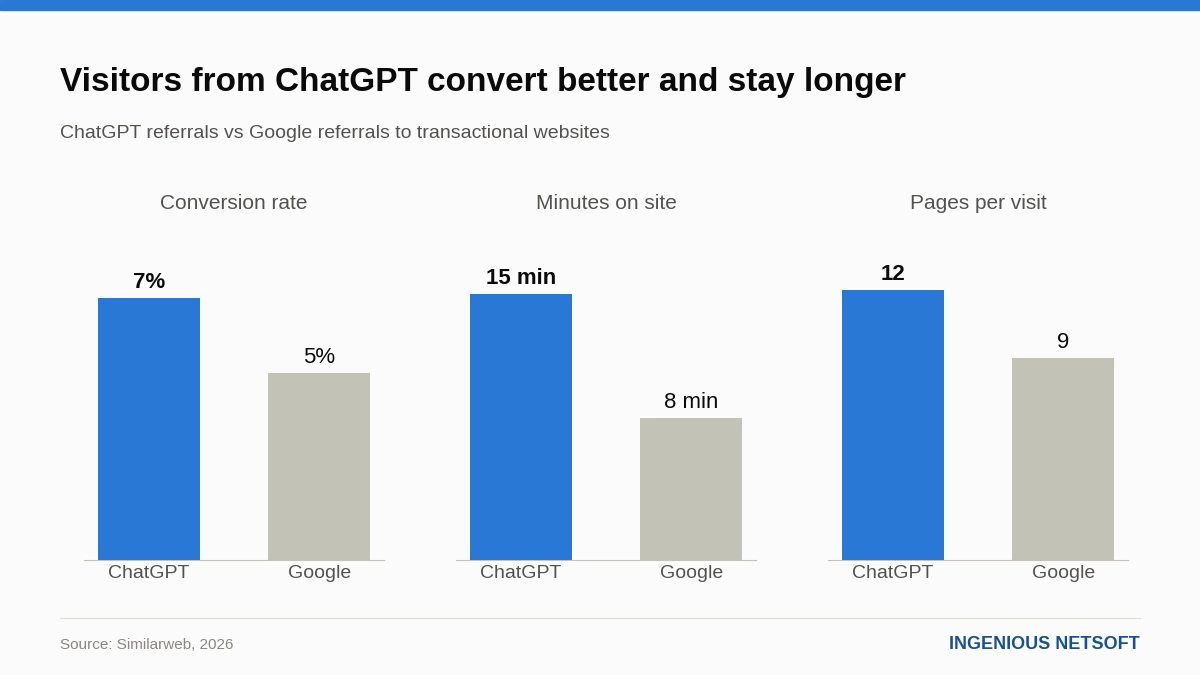
- ChatGPT referrals converted at 7% on transactional sites, compared with 5% from Google. (Similarweb)
- Visitors from ChatGPT spent about 15 minutes on site versus 8 minutes from Google, and viewed 12 pages versus 9. (Similarweb)
Shopping behaviour
- 39% of US consumers surveyed by Adobe used AI for online shopping, and 85% of them said it improved their experience. (TechCrunch, Adobe data)
- 35% of US consumers use AI at the product discovery stage, compared with 13.6% who use search. (Similarweb)
Our takeaway: don’t judge AI search by visit counts alone. Set up a separate AI referral channel in GA4 and compare its conversion rate with Google organic.
AI Citation and GEO Statistics
Generative engine optimization (GEO) is about getting your brand mentioned and cited inside AI answers. These numbers show what AI tools actually reward.
What predicts AI visibility
| Factor | Correlation with AI Overview brand mentions |
|---|---|
| Branded web mentions | 0.664 |
| Branded anchor text | 0.527 |
| Branded search volume | 0.392 |
| Domain Rating | 0.326 |
| Referring domains | 0.295 |
| Number of backlinks | 0.218 |
Source: Ahrefs, study of 75,000 brands, May 2025.
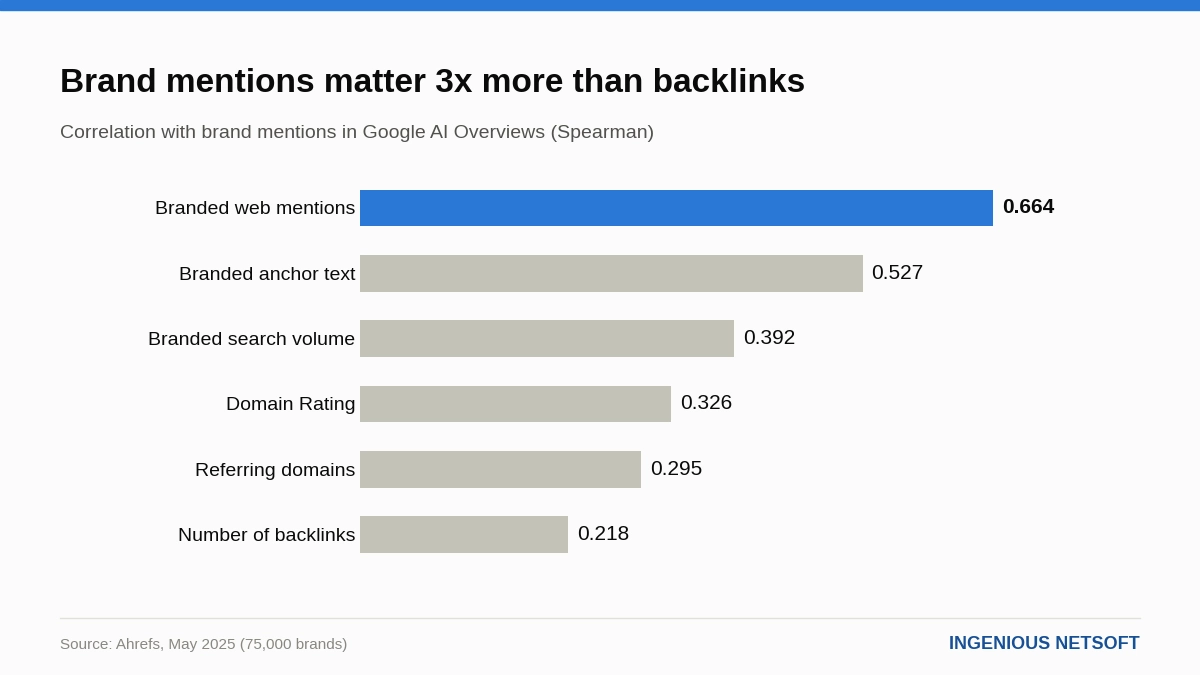
- Branded web mentions correlate three times more strongly with AI visibility than backlinks. (Ahrefs)
- Brands in the top 25% for web mentions averaged169 AI Overview mentions, about 10 times more than brands in the 50–75% band (14 mentions). (Ahrefs)
- About 26% of brands studied had zero AI Overview mentions. (Ahrefs)
Where citations come from
- Only 38% of pages cited in Google AI Overviews rank in the organic top 10, down from 76% in Ahrefs’ July 2025 study. Ahrefs notes better citation detection explains part of the change. (DesignRush, Ahrefs data)
- About 31% of AI Overview citations come from pages ranking beyond the top 100. (DesignRush, Ahrefs data)
- YouTube makes up nearly 6% of all AI Overview citations, and its share grew 34% in six months. (DesignRush, Ahrefs data)
- Wikipedia, YouTube and Reddit together made up 15% of sources cited in Google AI summaries. (Pew Research Center)
Our own data: AI citations differ hugely by platform
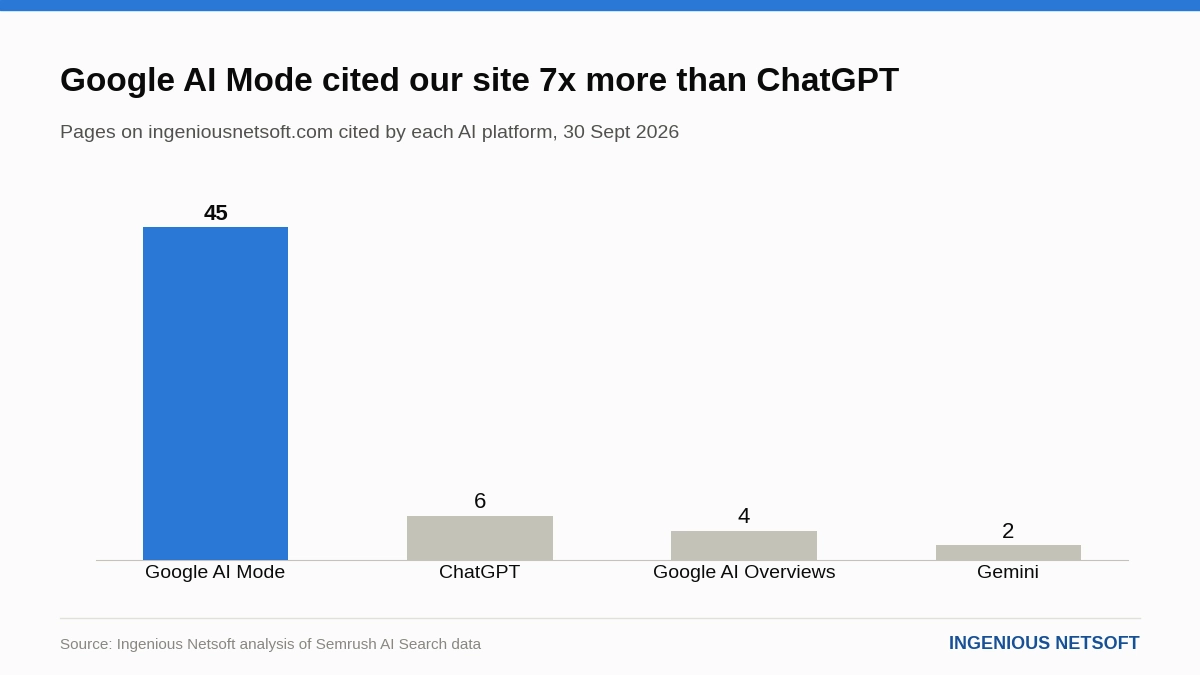
We checked our own website, ingeniousnetsoft.com, in Semrush’s AI Search report on 30 September 2026. Of 52 pages cited across AI platforms:
| Platform | Pages cited |
|---|---|
| Google AI Mode | 45 |
| ChatGPT | 6 |
| Google AI Overviews | 4 |
| Gemini | 2 |
The same website was cited more than seven times as often in Google AI Mode as in ChatGPT. One site is a small sample, but it shows why you should track each AI platform separately rather than treating “AI search” as one channel.
Consumer Trust and Behaviour Statistics
People use AI answers more every year, but they don’t fully trust them. That gap is an opportunity for brands that show real proof.
- 56% of UK adults say they would trust an AI-written news story less than one written by a person. (Ofcom via Broadband TV News)
- 63% of US adults believe AI is advancing too quickly. (Pew Research Center)
- 71% of US adults think AI will make personal information less secure. (Pew Research Center)
- 67% of US adults lack confidence in government regulation of AI. (Pew Research Center)
- 35% of US consumers use AI to discover products, and 32.9% use it to evaluate them, compared with 15% who use search at the evaluation stage. (Similarweb)
Our takeaway: AI often creates the shortlist, but people still check before they buy. Real reviews, case studies with numbers, and named experts are what close the deal.
B2B Buyer AI Statistics
Business buyers lean on AI for research, then turn to people to confirm what it told them.
- 45% of B2B buyers used AI during their most recent purchase. (Gartner)
- 67% of B2B buyers prefer a rep-free buying experience. (Gartner)
- 69% of B2B buyers turn to a sales rep specifically to validate insights generated by AI. (Gartner)
- 35.9% of Canadian workers used generative AI tools in their main job in the past 12 months, rising to 75.1% of managers. (Statistics Canada via Global News)
Our takeaway: for B2B, make sure AI tools describe your services, pricing model and proof accurately, because that description shapes the shortlist before a buyer ever contacts you.
AI Search Advertising Statistics
Ads are moving inside AI answers too, and the rules for paid search are changing with them.
- Ads in AI Overviews were live in 12 markets by December 2025, including the US, Canada and Australia. (PPC News Feed)
- Eligible formats are text and Shopping ads from existing Search, Shopping and Performance Max campaigns. (PPC News Feed)
- Ads inside Google AI Mode are served through AI Max and Performance Max campaigns, and were announced at Google Marketing Live 2026 as a test in the US. (DGTalents)
- Google says AI Max for Search can bring up to 14% more conversions at a similar CPA, and up to 27% for campaigns built mainly on exact and phrase match. (Search Engine Land)
- An independent review of 250+ AI Max campaigns found a 13% median revenue lift but a 16% median CPA increase. (PPC Live)
- CMOs allocate 15.3% of marketing budgets to AI, but only 30% say they’re ready to scale it. (Gartner)
Our takeaway: if you run Google Ads, AI Max and PMax are now the doorway to AI placements. Test them with clear guardrails rather than switching them on blindly. For a real example, see how we took an online motorcycle parts store to 18.9x ROAS with Google Ads, or learn more about our PPC management services.
Marketer Adoption and GEO Budget Statistics
Most marketers now spend on AI visibility. Far fewer can prove it’s working.
Budgets
- Marketers put about 24% of search and content budgets into AI visibility. (Fractl via Relevant Audience)
- 82% of marketers allocate at least some budget to AI visibility, and 43% spend more than 20% of their search and content budget on it. (Fractl via Relevant Audience)
- 69% of search professionals have a budget for AI search optimization, up from 38% in 2025. (SEOFOMO)
- 75% have a dedicated AI search strategy, up from 51%. (SEOFOMO)
- 98% of search professionals have been asked about AI search visibility by clients or bosses. (SEOFOMO)
Measurement and results
- 92% of search professionals track AI visibility and citations, up from 78%. (SEOFOMO)
- Yet 71% of marketers don’t track competitive share of voice in AI answers. (Scribewise via Relevant Audience)
- 56% report at least some positive business impact from AI search optimization, but only 5% call it significant. (SEOFOMO)
- 19% attribute more than 5% of site revenue to AI search, double the 8% in 2025. (SEOFOMO)
- The top challenge is reliably measuring AI search visibility (19%), followed by understanding what drives it (14%). (SEOFOMO)
- The most impactful tactics reported: expanding content coverage (18%), improving technical crawlability (17%) and restructuring content for easier extraction(16%). (SEOFOMO)
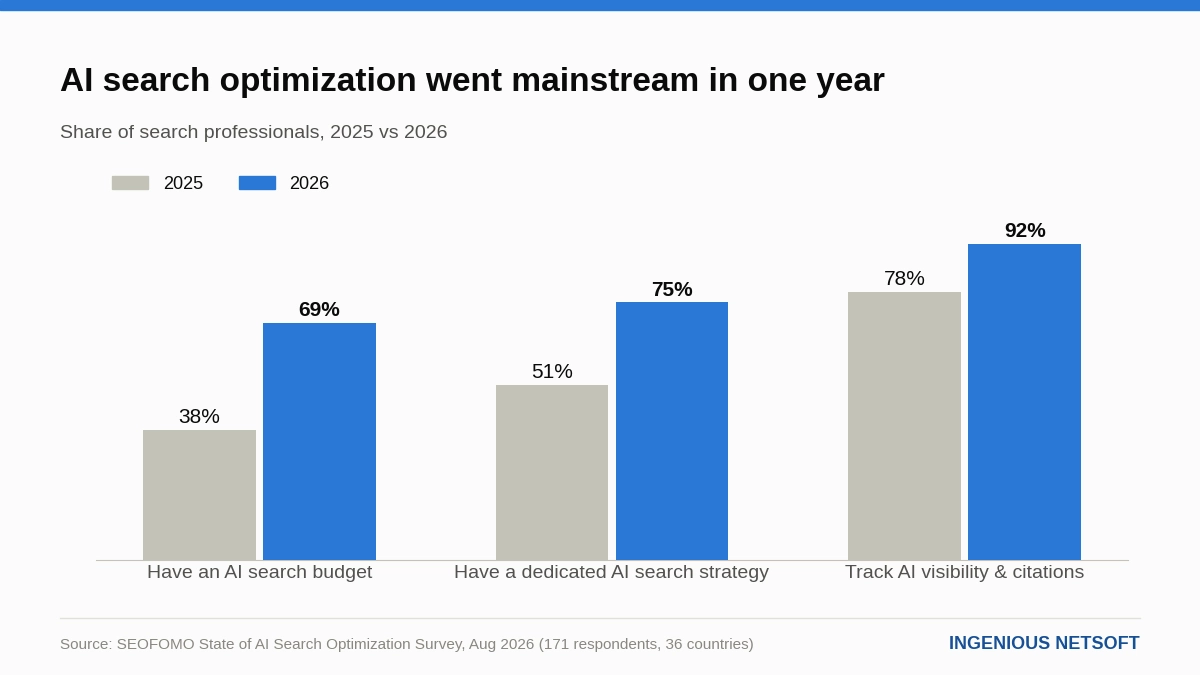
Note: the SEOFOMO survey covers 171 search professionals across 36 countries (August 2026), so treat it as a directional signal.
AI Search Statistics by Country: UK, US, Canada, Australia
Most AI search statistics are US-only. Here’s what we could verify for each of our four core markets. Each survey measures something slightly different, so compare with care.
| Country | Headline statistic | What it measures | Source |
|---|---|---|---|
| USA | 49% of adults use AI chatbots; 44% use ChatGPT | Adults, Feb 2026 (5,119 surveyed) | Pew Research Center |
| UK | 21% of adults used an AI app or service for news in the past month; ChatGPT most used at 13% | Adults, Ofcom News Report 2026 | Ofcom via Broadband TV News |
| Canada | 35.9% of workers used generative AI in their main job in the past year; 93.4% are aware of the tools | Workers, Labour Force Survey, March 2026 | Statistics Canada via Global News |
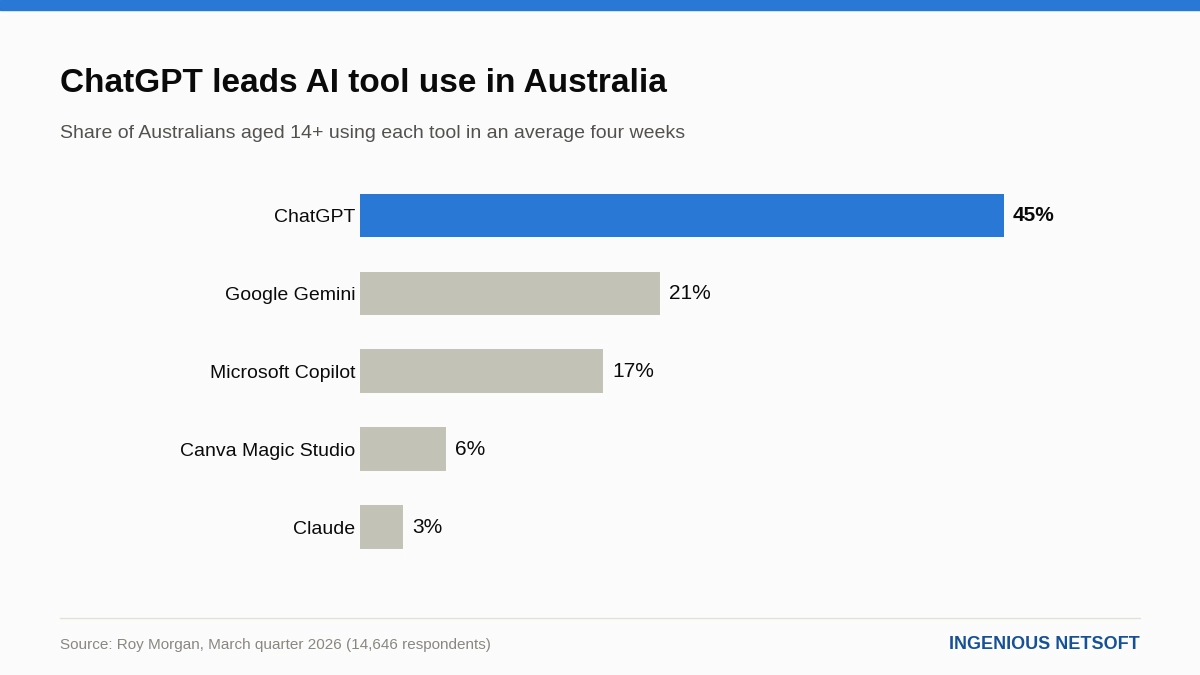
| Australia | 58% of people aged 14+ (13.6 million) use AI tools in an average four weeks | People 14+, March quarter 2026 (14,646 surveyed) | Roy Morgan |
Australia, by tool
(Roy Morgan):
- ChatGPT: 10.5 million users (45%)
- Google Gemini: 5 million (21%)
- Microsoft Copilot: 4 million (17%)
- Claude: 777,000 (3%)
- Usage peaks at 74% among 25–34-year-olds and drops to 31% among those 65+.
AI search ads by country: ads in Google AI Overviews were available in the US, Canada and Australia by December 2025. The UK was not on that list, so UK advertisers should check availability in their own account. (PPC News Feed)
What These Statistics Mean for Your Business
Six practical moves, each backed by the numbers above:
- Get talked about, not just linked to. Branded web mentions predict AI visibility three times better than backlinks. Earn mentions through PR, podcasts, reviews, industry lists and original data like this page.
- Build a brand people search for by name. Branded keywords gained CTR when AI Overviews appeared, while generic ones lost it. Brand demand is now SEO protection.
- Write for questions. 60% of question-style searches trigger an AI summary. Add clear, direct answers to the questions your buyers ask, in FAQs and service pages.
- Track each AI platform separately. Our own site was cited 45 times in AI Mode but only 6 times in ChatGPT. One “AI” number hides the real picture.
- Measure quality, not just visits. AI visitors convert well in several studies. Create an AI referral channel in GA4 and compare it with Google organic.
- Show proof. People use AI to shortlist but still verify. Case studies with real numbers, named experts and genuine reviews win the final decision.
Want to know where you stand?
Our free AI Visibility Check shows how ChatGPT, Google AI Overviews, AI Mode and Gemini describe your business, which competitors they mention instead, and three fixes to start with.
Get My Free AI Visibility Check →
Methodology and How to Cite This Page
How we built this page
- We only include statistics we could trace to the organisation that collected the data, or to a named report summarised by a reputable outlet. Where we used a summary, we name both (for example, “Adobe data via TechCrunch”).
- Every statistic shows its date or study period. Older figures are kept only where no newer data exists.
- Our own data comes from Semrush’s AI Search report for ingeniousnetsoft.com on 30 September 2026.
- Surveys measure different things (adults vs workers vs search professionals), so we note the audience next to each country figure.
- We review and update this page every quarter. Last updated: October 2026.
Spotted an outdated or incorrect number? Email us and we’ll correct it.
Cite this page
You’re welcome to use these statistics in your articles, reports and presentations. Please credit the original source of each statistic and link back to this page:
Ingenious Netsoft (2026). “AI Search Statistics 2027: 60+ Data Points on ChatGPT, AI Overviews and GEO.” https://ingeniousnetsoft.com/blog/ai-search-statistics/
Using one of our charts? Credit “Source: Ingenious Netsoft” with a link to this page.
FAQs
How many people use AI search in 2026?
ChatGPT reached 900 million weekly active users in February 2026, Google AI Overviews reach 2.5 billion monthly users, and Google AI Mode and the Gemini app each passed 1 billion monthly users.
What percentage of Google searches show an AI Overview?
About 18% of searches in Pew’s March 2025 US study produced an AI summary. Similarweb puts the share at 20% or more in 2026. Question-style and long searches trigger them most often.
Do AI Overviews reduce website traffic?
Yes, for most non-branded searches. Pew found users clicked a result on 8% of visits with an AI summary versus 15% without one, and Ahrefs found a 34.5% drop in clicks for the top-ranking result.
What percentage of Google searches are zero-click?
Similarweb found 68.01% of Google searches ended without a click in 2026, up from about 45% in 2016.
Does traffic from ChatGPT convert well?
In several studies, yes. Similarweb found ChatGPT referrals converted at 7% on transactional sites versus 5% from Google, and Adobe found AI traffic to US retailers converted 42% better than other traffic in March 2026.
What is generative engine optimization (GEO)?
GEO is the practice of making your brand easy for AI tools to find, understand and cite in their answers. It overlaps heavily with good SEO, but puts more weight on brand mentions, clear answers and structured content.
What helps a brand appear in AI Overviews?
In Ahrefs’ study of 75,000 brands, branded web mentions had the strongest link to AI Overview visibility (0.664 correlation), ahead of branded anchors, branded search volume and backlinks.
How much are marketers spending on AI search?
Fractl found marketers put about 24% of search and content budgets into AI visibility, and SEOFOMO found 69% of search professionals now have a dedicated AI search budget.
Can I use these statistics in my own content?
Yes. Please credit the original source of each statistic and link to this page. See “Cite this page” above.
Final Thoughts
The data points one way: AI answers are becoming the first stop for billions of searches, clicks are thinning out, and the brands that get mentioned are the ones that get chosen. The good news is that the visitors who do click through from AI tools are often the most ready to buy.
The businesses that win in 2027 will treat AI visibility like any other channel: measured, budgeted and backed by real proof.
See how AI search describes your business. Ingenious Netsoft has helped 450+ businesses across the UK, USA, Canada and Australia with SEO, AI search optimization, paid media and web development since 2010. Book a free 30-minute review and we’ll show you where you appear in AI answers, where your competitors do, and what to fix first.
Book My Free AI Search Review →
Sources
- Americans and AI 2026 – Pew Research Center
- Google users are less likely to click on links when an AI summary appears – Pew Research Center
- ChatGPT – Wikipedia
- Google’s Gemini app surges to 1 billion users – TechCrunch
- Alphabet’s AI products reach 2.5 billion monthly users through AI Overviews – The Motley Fool
- AI traffic to US retailers rose 393% in Q1 – TechCrunch
- AI Search Stats in 2026 – Similarweb
- Zero-Click Marketing: What the 2026 Data Means – Similarweb
- New data: Google AI Overviews are hurting click-through rates – Search Engine Land
- SEO Trends 2026 – Evergreen Media
- An Analysis of AI Overview Brand Visibility Factors – Ahrefs
- Only 38% of AI Overview Citations Come From Top 10 Pages – DesignRush
- Ofcom: One in five UK adults use AI for news – Broadband TV News
- 1 in 3 Canadian workers have used generative AI tools – Global News
- 13.6 million Australians now use AI tools – Roy Morgan
- Gartner: 67% of B2B buyers prefer a rep-free experience – Gartner
- Gartner: 69% of B2B buyers turn to sales reps to validate AI insights – Gartner
- Gartner 2026 CMO Spend Survey – Gartner
- Marketers put 24% of search budgets into AI visibility – Relevant Audience
- The State of AI Search Optimization Survey 2026 – SEOFOMO
- Ads in AI Overviews now live in 12 countries – PPC News Feed
- Google Ads in AI Mode – DGTalents
- Google Ads announces AI Max for Search – Search Engine Land
- Google’s AI Max for Search: What the data actually shows – PPC Live