
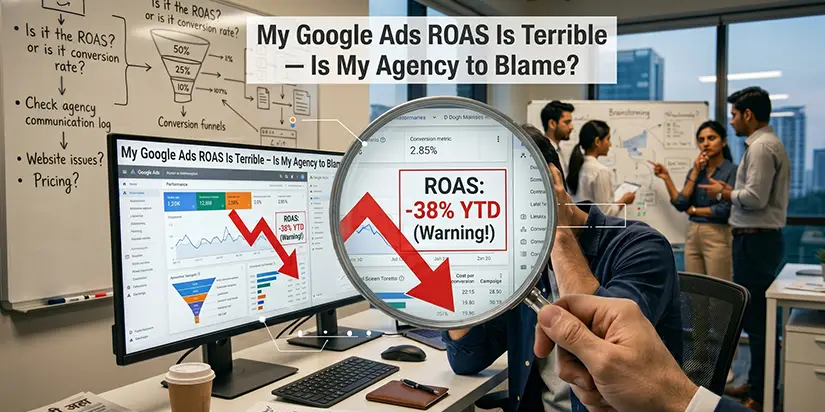
My Google Ads ROAS Is Terrible — Is My Agency to Blame?
Return on Ad Spend (ROAS) is the heartbeat of your digital marketing efforts. When it drops, panic sets in.
You see your budget disappearing with very little profit coming back in. Naturally, you look for someone to blame. Most business owners immediately look at their partner.
Is the problem your strategy, or is it the team running it?
Table of Contents
- The ROAS Equation: It Is More Than Just Ads
- When to Blame the Agency: Technical Red Flags
- When the Business Is to Blame: Operational Roadblocks
- Advanced Tech: AI ROAS Optimization
- The Role of Measurement and Tracking
- Market Factors: The Silent Killers
- Auditing with Precision
- Comparing PPC Advertising Companies
- Transitioning to a New PPC Digital Marketing Agency
- The Importance of Communication
- Final Checklist for ROAS Recovery
- Conclusion
- FAQ
In the world of paid search, performance is a two-way street. A Google PPC Agency has many levers they can pull to improve your results.
However, they do not control every variable in the sales process. This article will help you diagnose where the breakdown is happening. We will look at technical errors, website issues, and market trends.
The ROAS Equation: It Is More Than Just Ads
ROAS is a simple math formula: Revenue divided by Ad Spend. But achieving a high number is complex. Many factors influence this outcome.
Some are within the control of your chosen Google PPC Agency, while others are internal to your business.
To fix a terrible ROAS, you must first understand the why behind the data. Think of your ads as a highway and your website as the destination.
If the highway is built poorly, people won’t arrive. If the destination is a ghost town, people won’t stay. You need both to work in harmony.
Before pointing fingers, you must audit both the traffic and the landing environment. This is the only way to find a real solution.
When to Blame the Agency: Technical Red Flags
There are specific signs that your partner is falling behind. A professional Google PPC Agency should always be optimizing your account. If they are just setting and forgetting, your ROAS will naturally decay over time.
- One major red flag is poor keyword intent matching.
- If you are a luxury brand but bidding on cheap or free keywords, that is an agency error.
- Another issue is ad fatigue. Creative assets like headlines and images need constant testing.
- If your agency has not updated your ads in months, they are letting your performance slip.
- A high-quality team will use AI PPC agency audit tools to find these gaps quickly. Without these tools, manual errors become much more frequent and costly for your bottom line.
- Negative keywords are also vital. These are terms you do not want to show up for.
If your budget is being wasted on irrelevant searches, your agency is failing to protect your spending. They should be reviewing search term reports weekly. In case this is not happening, your ROAS will suffer because you are paying for clicks that have zero chance of converting into customers.
When to Blame the Agency: Technical Red Flags
There are specific signs that your partner is falling behind. A professional Google PPC Agency should always be optimizing your account. If they are just setting and forgetting, your ROAS will naturally decay over time.
- One major red flag is poor keyword intent matching.
- If you are a luxury brand but bidding on cheap or free keywords, that is an agency error.
- Another issue is ad fatigue. Creative assets like headlines and images need constant testing.
- If your agency has not updated your ads in months, they are letting your performance slip.
- A high-quality team will use AI PPC agency audit tools to find these gaps quickly. Without these tools, manual errors become much more frequent and costly for your bottom line.
- Negative keywords are also vital. These are terms you do not want to show up for.
If your budget is being wasted on irrelevant searches, your agency is failing to protect your spending. They should be reviewing search term reports weekly. In case this is not happening, your ROAS will suffer because you are paying for clicks that have zero chance of converting into customers.
When the Business Is to Blame: Operational Roadblocks
Sometimes the ads are perfect, but the business fails to convert the lead. Even the best Google PPC Agency cannot sell a bad product.
If your click-through rate (CTR) is high, it means the ads are doing their job. People are interested. If those people don’t buy, the problem is likely on your website or your offer.
Check your landing page speed. A delay of just three seconds can cause half of your visitors to leave. Also, look at your pricing. Are you significantly more expensive than your competitors without a clear reason?
In PPC advertising companies across the globe, we see great traffic wasted on confusing checkout processes.
If your site is hard to use, your ROAS will stay low. Inventory issues are another silent killer.
If an agency drives traffic to a Sold Out product, you are literally throwing money away. You must keep your agency informed about your stock levels.
Transparency is the only way to keep a healthy return. If they do not know what you have in stock, they can’t optimize the budget toward your most profitable items.
Advanced Tech: AI ROAS Optimization

Modern advertising has moved past manual bidding. To stay competitive, you need ROAS optimization strategies. This technology allows the system to bid higher for users who are likely to buy and lower for those who are just browsing.
If your current partner is not using these smart bidding strategies, you are at a disadvantage. AI can analyze thousands of data points in a second. It looks at the user’s location, time of day, device, and even past browsing behavior.
This level of precision is impossible for a human to manage manually. By embracing AI ROAS optimization, you can often see a significant lift in performance without increasing your total ad spend. It makes your existing budget work much harder.
The Role of Measurement and Tracking
You cannot improve what you do not measure. A common reason for terrible ROAS is actually broken tracking. If your conversion tag is not firing correctly, your dashboard might show a 0x ROAS while you are actually making sales.
A diligent Google PPC Agency will audit your tracking setup regularly to ensure data integrity.
Modern tracking is difficult due to privacy changes like iOS 14. You need server-side tracking or enhanced conversions to get the full picture.
If your agency has not discussed these technical updates with you, they might be missing half of your data. Do not assume the numbers you see are the whole truth.
Always verify that your Google Ads and your Shopify or CRM data match up as closely as possible.
Market Factors: The Silent Killers
Sometimes, ROAS drops because of things no one can control. If a massive competitor enters your auction with a $1 million budget, your costs will go up.
This isn’t the fault of your Google PPC Agency; it is simply market dynamics. When Cost Per Click (CPC) rises, your ROAS will drop unless your conversion rate also increases. Seasonality also plays a massive role.
Most industries have dark months where consumers just aren’t buying. If you are comparing December performance to January, you might see a scary drop. You must look at year-over-year data to get a fair assessment.
Context is everything in digital marketing. Without it, you will make emotional decisions that hurt your long-term growth.
Auditing with Precision
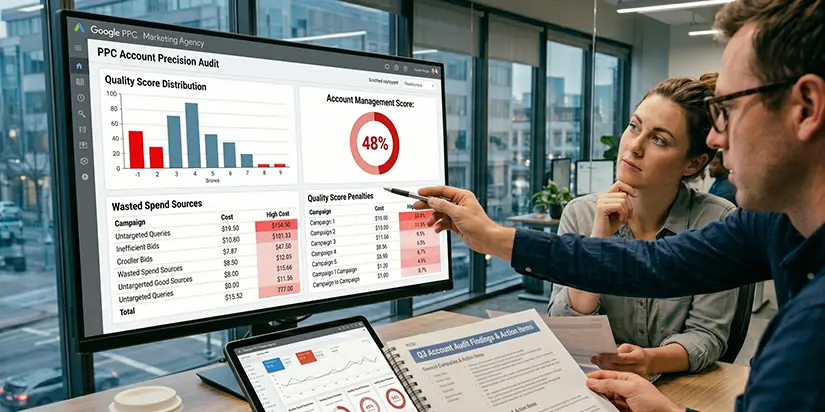
How do you determine with absolute certainty if your Google PPC Agency is maximizing your budget or simply coasting?
You should use AI PPC agency audit tools to get an objective third-party view of your account.
These tools scan for common mistakes, wasted spend, and missed opportunities. They provide a score for your account management.
If the score is low, you have hard evidence to take back to your account manager. An audit should look at your Quality Scores. Quality Score is Google’s way of telling you how relevant your ads and landing pages are.
If your scores are below 5, you are being penalized with higher costs. Improving these scores is a core task for your Google PPC Agency.
If they are not talking about Quality Score, they are not doing their job properly.
Performance Audit: Determining Responsibility for ROAS
| Symptom | Who to Blame? | Technical Indicator |
| Low Click-Through Rate (CTR) | Agency | Poor keyword intent or stagnant ad creative testing. |
| High CTR, Zero Conversions | Business | Landing page friction, high pricing, or slow site speed. |
| Wasted Spend on Junk Terms | Agency | Failure to maintain and update negative keyword lists. |
| Inaccurate Performance Data | Both | Broken conversion tracking or failed attribution setups. |
Comparing PPC Advertising Companies
If you decide to look for a new partner, you will find many PPC advertising companies claiming they are the best. Do not fall for generic promises of guaranteed results. Instead, ask about their specific process for scaling ROAS.
Ask how they handle attribution and how they stay ahead of Google’s frequent algorithm changes.
Look for case studies in your specific niche. A team that excels at Lead Generation for lawyers might struggle with E-commerce for fashion brands. Different industries require different strategies.
The best PPC advertising companies will be transparent about their successes and their failures.
They should be able to explain exactly why a campaign failed and what they learned from it.
Transitioning to a New PPC Digital Marketing Agency
Moving your account is a big decision. If your current results are consistently poor and the communication has broken down, it might be time to find a new digital marketing agency.
A fresh set of eyes can often find obvious mistakes that the previous team overlooked. Sometimes a reset is exactly what an account needs to start growing again.
During the transition, ensure you keep ownership of your Google Ads account. Never let an agency run your ads out of their own master account. You need to keep your historical data, even if you change partners.
A professional PPC digital marketing agency will have no problem working in your existing account. This ensures a smoother handoff and prevents you from having to start from zero.
The Importance of Communication
Many ROAS problems are actually communication problems. If your Google PPC Agency sends you a monthly PDF with no context, that is a bad sign. You should have regular meetings to discuss strategy, not just metrics.
You need to tell them about your business goals, and they need to tell you how they are reaching them. Ask for a roadmap. What are they testing next month? What did they learn from last month’s losers?
If they can’t answer these questions, they are likely just coasting. A high-performing Google PPC Agency acts as an extension of your team.
They should be as invested in your profitability as you are. If they don’t seem to care about your bottom line, it’s time to move on.
Final Checklist for ROAS Recovery
Before you make any drastic changes, run through this checklist. Is my tracking accurate? Is my landing page fast? Are my prices competitive?
Is my Google PPC Agency active in the account every week?
If the answer to any of these is No, you have found your starting point for improvement.
Do not expect an overnight miracle. Google Ads is an iterative process. It takes time for the algorithms to learn and for creative tests to show winners. However, you should see a trend toward improvement.
If the line on the graph has been going down for six months, you don’t need more time, you need a change in strategy or a change in personnel.
Conclusion
You should not feel like a victim of your ad account. Whether you stay with your current Google PPC Agency or hire a new PPC digital marketing agency, the goal is the same i.e. profitable growth.
Use the data to guide your decisions, not your emotions. Audit your site, audit your ads, and use the latest technology to stay ahead of the competition.
The road to a high ROAS is paved with constant testing and clear communication. By understanding the roles that both you and your agency play, you can stop the blame game and start making money.
The digital landscape is always changing, but the fundamentals of a good offer and a well-managed account remain the same. Take the first step today by reviewing your search terms and your site speed.
Ready to stop the guesswork and start scaling? Let the experts at Ingenious Netsoft audit your campaigns and build a technical SEO and PPC strategy to fetch maximum ROI.


