
Why Is My Website Getting No Traffic After Paying for SEO?
In 2026, the SEO landscape hasn’t just shifted, it has been completely reconstructed. For any business working with a seo service company, it can be frustrating to invest a significant budget only to see your traffic flatline. However, you aren’t alone: Gartner predicts a 25% drop in traditional search volume by the end of 2026 as users migrate toward AI chatbots and virtual assistants for their answers.
The data is even more stark for mobile: over 80% of mobile searches now end without a single click to an external website (Similarweb, 2026). This is not because search is “dying,” but because Google has transitioned from a search engine (finding a path to an answer) to an answer engine (providing the answer itself).
Table of Contents
- Reasons Why Your SEO Isn’t Delivering Results
- 1. Poor Keyword Targeting
- 2. Thin or Low-Quality Content
- 3. Technical SEO Problems
- 4. Weak Backlink Profile
- 5. Poor On-Page Optimization
- 6. Lack of a Clear SEO Strategy
- 7. High Competition
- 8. Insufficient Content Volume
- 9. Poor User Experience (UX)
- 10. SEO Takes Time to Show Results
- Summary Table of Key Issues and Solutions
- Final Thoughts
- FAQs
If your SEO ranking is not moving, your strategy is likely optimized for a 2022 web, fighting against AI-driven algorithms rather than feeding them.
Reasons Why Your SEO Isn’t Delivering Results
1. Poor Keyword Targeting
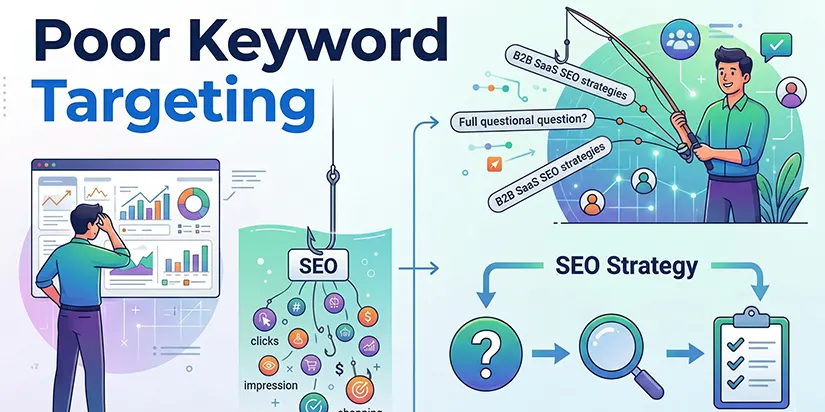
In 2026, broad keywords fail because search engines now prioritize Entity Recognition and User Intent over simple word matching. If your strategy focuses on generic terms like “SEO” instead of “B2B SaaS SEO strategies,” you will attract irrelevant impressions rather than conversions.
Solution: Focus on long-tail and intent-driven keywords to capture users further in the buying cycle.
Brief Strategy
- Target Long-Tail Phrases: Terms with 3+ words now account for 91% of searches, offering lower competition and higher conversion potential.
- Map Search Intent: Align content with the four stages Informational (guides), Navigational (brand), Commercial (comparisons), and Transactional (sales pages).
- Conversational Optimization: Target full questions to trigger AI Overview (AIO) citations, which now dominate 88% of informational queries.
Build Topic Clusters: Create a “Pillar Page” linked to specific “Spoke Pages” to prove topical authority to Google’s NLP algorithms.
2. Thin or Low-Quality Content
Google’s March 2026 Core Update has significantly raised the threshold for “Helpful Content.” Sites relying on shallow, AI-generated “slop” or unoriginal summaries are now being systematically de-indexed or suppressed by 45% more than in previous years.
Solution: Collaborate with a professional ai-powered seo services team to replace “filler” with high-impact, research-backed assets that satisfy both users and AI scrapers.
Brief Strategy
- Information Gain: Google now prioritizes content that provides new information. If your page repeats what is already in the top 10 results, it is flagged as “low value.”
- Proof of Experience (E-E-A-T): Include first-hand insights, case studies, and original imagery. Content must prove you have actually “done the work” to rank in high-trust niches.
- Modular Density: Use tight sections with clear headings and concise answer blocks. This makes your content “ingestable” for AI Overviews, increasing your citation rate.
- Utility-Driven Content: Beyond text, integrate calculators, checklists, or templates. In 2026, “depth” is defined by how much a user can interact with the page.
- Strategic Pruning: Regularly audit and delete underperforming “thin” pages. Data shows that removing low-quality archives can boost the rankings of your “Money Pages” by 20% within 60 days.

3. Technical SEO Problems
Technical debt is the “silent killer” of search rankings. In 2026, Google’s Interaction to Next Paint (INP) metric is a critical ranking factor. If your site suffers from slow speeds or indexing errors, search bots will deprioritize your content, regardless of its quality.
Solution: Professional SEO Services company performs recurring audits to eliminate crawl blockers and optimize for Core Web Vitals (CWV), ensuring your site is machine-readable for both Google and AI engines.
Brief Strategy
- Optimize Core Web Vitals: Maintain an LCP under 2.5s and an INP under 200ms. Sites exceeding a 3-second load time lose 53% of mobile visitors.
- Fix Indexing Bloat: Use Google Search Console to identify “Discovered currently not indexed” pages. Pruning thin content increases your “crawl budget” for high-priority pages.
- Prioritize Mobile-First Rendering: With mobile driving over 60% of web traffic, ensure your JavaScript renders correctly so the Googlebot doesn’t see a blank screen.
- Advanced Schema Implementation: Use Schema 3.0 to provide structured data. This helps AI search engines understand your “Entities” for AI Overviews (AIO).
Sources: Search Engine Land, W3era, Colorlib.
4. Weak Backlink Profile
Backlinks are no longer just “votes of confidence”; they are trust signals that distinguish human-led authority from AI-generated noise. Following the March 2026 Spam Update, Google’s SpamBrain AI now identifies and neutralizes low-quality link farms in real-time. If your profile consists of generic guest posts without genuine referral traffic, your rankings will remain stagnant.
Solution: Partner with an SEO company to shift from “link building” to “link earning” through high-authority digital PR and editorial mentions that Google cannot ignore.
Brief Strategy
- Digital PR Dominance: 34% of SEOs now rank digital PR as the #1 link-building method. It earns editorial links (DR 60+) that provide massive ranking power.
- Focus on “Information Gain”: Create proprietary data studies. Original research can generate 40 to 80 natural mentions as other sites cite your findings.
- Target Entity Relevance: Google prioritizes Topical Authority over raw Domain Rating. One link from a niche-specific site is more valuable than ten from unrelated “general” blogs.
- Audit and Disavow: Use March 2026 guidelines to prune toxic debt. Disavowing legacy PBN (Private Blog Network) links can trigger a recovery within 24 hours.
Sources: Techpullers, Reporter Outreach, Levitate AI.
5. Poor On-Page Optimization
In 2026, on-page SEO has evolved from “keyword placement” to Semantic Clustering. Improper meta tags and broken header hierarchies don’t just hurt rankings; they confuse Google’s Knowledge Graph, preventing your site from being recognized as an authority. According to 2026 Search Engine Land data, inconsistent headers can lower crawl efficiency by 30%.
Solution: Standardize your site’s structure with title tags, meta descriptions, and headers. Modern SEO service companies ensure these elements are machine-readable for both traditional bots and AI Overviews (AIO).
Brief Strategy
- Benefit-Driven Title Tags: Move beyond raw keywords. Including a specific “year” or “stat” in your title increases CTR by 18%.
- The “Answer Box” H2: Use H2 tags as questions (e.g., “How much does SEO cost in 2026?”). Following these with a 50-word answer increases AI citation chances by 41%.
- Entity-Based Internal Linking: Link pages based on Topical Clusters, not random keywords. This helps Google map your “Entities” and boosts your “Money Pages.”
- Schema 3.0 Integration: SEO requires JSON-LD Schema on every page. This acts as a “translator” for AI engines to understand your content’s context.
Sources: Search Engine Land, W3era, Backlinko.
6. Lack of a Clear SEO Strategy
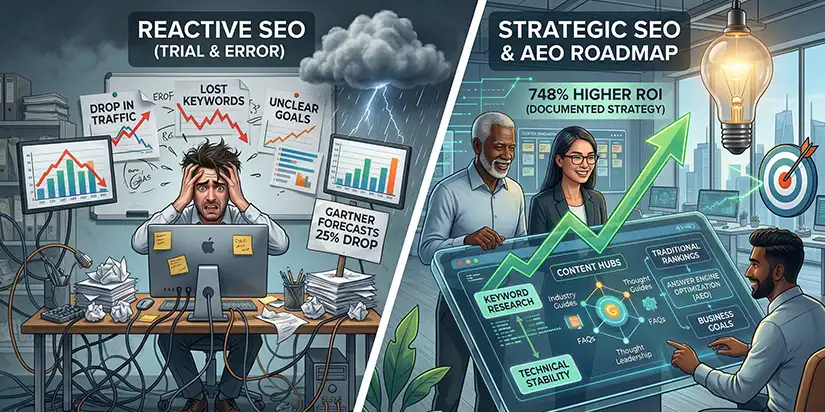
Without a documented roadmap, SEO efforts are often reactive and inconsistent. In 2026, a “trial and error” approach is costly; Gartner forecasts a 25% drop in traditional search volume by year-end as AI chatbots resolve queries directly. Success now requires a strategy that balances traditional rankings with Answer Engine Optimization (AEO).
Solution: Partner with an SEO team to develop a framework aligning keyword research, content hubs, and technical stability with your business goals.
Brief Strategy
- Documented Planning: Marketers with documented strategies see 748% higher ROI. A clear plan ensures every piece of content serves a specific stage of the funnel.
- Topic Cluster Architecture: Move from individual keywords to “Pillar and Spoke” models. This builds the Topical Authority necessary to be cited by AI search engines like Gemini.
- New KPIs (Share of Model): Track how often AI assistants mention your brand. This “Share of Model” is now as vital as traditional keyword rankings.
- Agile Auditing: Monthly strategy reviews are essential to adapt to the 200+ algorithm changes and real-time AI updates that define today’s search landscape.
Sources: Gartner, First Page Sage, Marketing Aid.
7. High Competition
In 2026, ranking for “head terms” is a massive challenge as AI search traffic has surged by over 500% in a single year. For competitive queries, AI Overviews (AIO) now occupy the top 83% of the screen, effectively pushing standard organic results out of sight. Competing directly against established giants for broad keywords often results in a “click-dead” zone with stagnant ROI.
Solution: Target niche topics and long-tail keywords to bypass the “authority wall.” This builds a foundation of specific wins before you attempt to rank for broader, high-competition industry terms.
Brief Strategy
- Own the Long-Tail: Phrases with 3+ words account for 70% of all search traffic. These specific queries have lower competition and typically convert at 2.5x the rate of broad terms.
- The “GEO” Advantage: Use Generative Engine Optimization. Including unique statistics and proprietary data can boost your visibility in AI-generated responses by 40%, helping you leapfrog larger competitors.
- Micro-Niche Authority: Mastering a specialized sub-topic signals high E-E-A-T (Experience, Expertise, Authoritativeness, Trustworthiness) to Google, often accelerating your ranking timeline by 3 to 6 months.
- Target “Zero-Volume” Intent: Focus on specific customer pain points that traditional tools haven’t indexed yet. This allows you to capture high-value leads with zero competition.
Sources: Averi AI: 2026 SEO Trends, Gartner, Similarweb/ClickVision.
8. Insufficient Content Volume
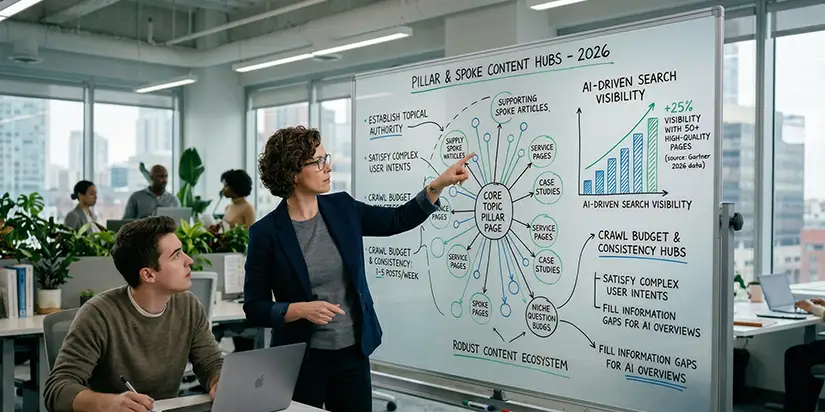
In 2026, content volume is no longer about “quantity for quantity’s sake.” A limited number of pages restricts your Topical Authority, making it difficult for Google’s Knowledge Graph to categorize your brand as a definitive expert. According to 2026 Gartner data, businesses with fewer than 50 high-quality “spoke” pages in their niche see 25% less visibility in AI-driven search results compared to those with robust content hubs.
Solution: Expand your website with a “Pillar and Spoke” strategy. Consistently publishing service pages, blogs, and case studies signals to search engines that you have the depth required to satisfy complex user intents.
Brief Strategy
- Develop Topic Clusters: Instead of random posts, create one comprehensive “Pillar” page linked to multiple “Supporting” articles. This structure improves crawlability and establishes authority faster than isolated posts.
- Maintain Strategic Consistency: Experts recommend 1–3 high-quality posts per week for accelerated growth. Regular updates keep your “Crawl Budget” active and ensure your information remains fresh for AI scrapers.
- Fill “Information Gaps”: Use content to answer specific, niche questions. AI Overviews trigger at rates of 80–88% for informational queries, so more pages mean more chances to be cited as the primary source.
- Audit and Repurpose: Volume isn’t just about “new” pages. Refreshing old content with updated stats can provide the same ranking boost as a new post while requiring less effort.
Sources: Circles Studio, Averi AI, Design Sphere.
9. Poor User Experience (UX)
In 2026, Google ranks experiences, not just pages. “Poor UX” is now a direct ranking killer; if users struggle with navigation or slow loads, Google’s Interaction to Next Paint (INP) metric will flag your site as “unhelpful.” Research shows that pages meeting Core Web Vitals standards see 20–30% stronger engagement, which directly translates to higher search stability.
Solution: Collaborate with a conversion-focused SEO team to audit your site’s architecture. Fixing friction points like cluttered layouts or slow mobile speeds ensures that once traffic arrives, it stays and converts.
Brief Strategy
- Mobile-First Accessibility: With mobile driving over 77% of zero-click searches, your site must be flawless on small screens. Large “tap targets” and responsive spacing are now mandatory for ranking.
- Visual Stability (CLS): Minimize layout shifts. If text or buttons jump while a page is loading, users bounce, sending a “dissatisfaction signal” to Google that drops your rankings.
- Scannable Content Design: Use short paragraphs (2–3 lines) and clear H2/H3 hierarchies. Modern searchers and AI agents both prioritize content that is easy to parse and “digest” quickly.
- Direct Value Above the Fold: Ensure the user’s answer or your primary Call-to-Action (CTA) is visible without scrolling. Reducing “cognitive load” leads to higher dwell times and better SEO performance.
10. SEO Takes Time to Show Results
In 2026, SEO is no longer a “sprint” but a long-term digital flywheel. Unlike paid ads that stop the moment the budget ends, SEO builds compounding value. However, Google’s systems now take longer to verify E-E-A-T (Experience, Expertise, Authoritativeness, Trustworthiness) signals.
According to recent Ahrefs and 2026 industry data, only 1.74% of newly published pages reach the Top 10 within their first year, highlighting the need for strategic patience.
Solution: Maintain consistency and focus on “Search Velocity.” A trusted SEO management company prioritizes sustainable authority growth over short-term hacks, adapting your roadmap as search engines learn to trust your brand.
Brief Strategy
- Months 1–3 (The Foundation): Focus is on technical audits, fixing crawl errors, and indexing. You may see early signals like increased impressions in Google Search Console, even if clicks remain low.
- Months 3–6 (Traction Phase): This is when long-tail keywords begin to rank. Sites often see their first AI Overview (AIO) citations during this period as topical authority builds.
- Months 6–12 (The Breakthrough): Meaningful traffic growth usually triggers here. Competitive terms start climbing, and the compounding effect begins to lower your overall cost-per-acquisition.
- 12+ Months (Category Authority): Your site becomes a dominant “Entity” in its niche. At this stage, new content ranks significantly faster because baseline trust is already established.
Sources:
- Lasso Up: How Long Does SEO Take in 2026?
- Whitehat SEO: 2025–2026 Ranking Study
- Ahrefs: How Long Does SEO Take to Show Results?
Summary Table of Key Issues and Solutions
| Reason | What It Means | Solution |
|---|---|---|
| Poor Keyword Targeting | Targeting irrelevant or overly competitive keywords | Use intent-based, long-tail keyword research |
| Thin Content | Low-value or insufficient content | Create in-depth, informative, and structured content |
| Technical SEO Issues | Crawl errors, slow speed, mobile issues | Perform technical audits and fix site errors |
| Weak Backlinks | Lack of authority signals | Build high-quality, relevant backlinks |
| Poor On-Page SEO | Missing or poorly optimized meta tags | Optimize titles, headers, and internal links |
| No SEO Strategy | Random or inconsistent efforts | Follow a structured SEO roadmap |
| High Competition | Competitive niche keywords | Target niche and long-tail keywords |
| Low Content Volume | Limited pages to rank | Publish blogs, landing pages, and FAQs regularly |
| Poor User Experience | High bounce rates due to design/navigation issues | Improve UX, speed, and mobile usability |
| Lack of Consistency | Irregular SEO efforts | Maintain ongoing optimization and updates |
| Outdated Content | Content loses relevance over time | Refresh and update existing pages |
| Limited Use of Modern Tools | Traditional methods only | Use AI SEO tools and AI-powered SEO services |
Pro Tip
Instead of expecting quick results, focus on building authority, consistency, and content quality. Partnering with the right seo service company that integrates strategy, execution, and modern tools ensures sustainable growth rather than temporary spikes in traffic.
Final Thoughts
If your website is not receiving traffic after investing in SEO, the issue is usually a combination of keyword strategy, technical setup, content quality, and consistency. Working with a reliable seo service company, supported by a structured approach and modern techniques, can gradually improve visibility and drive meaningful organic traffic.
For expert guidance and result-driven strategies, you can explore Ingenious Netsoft, a trusted partner offering tailored SEO solutions to help businesses achieve sustainable growth online.


