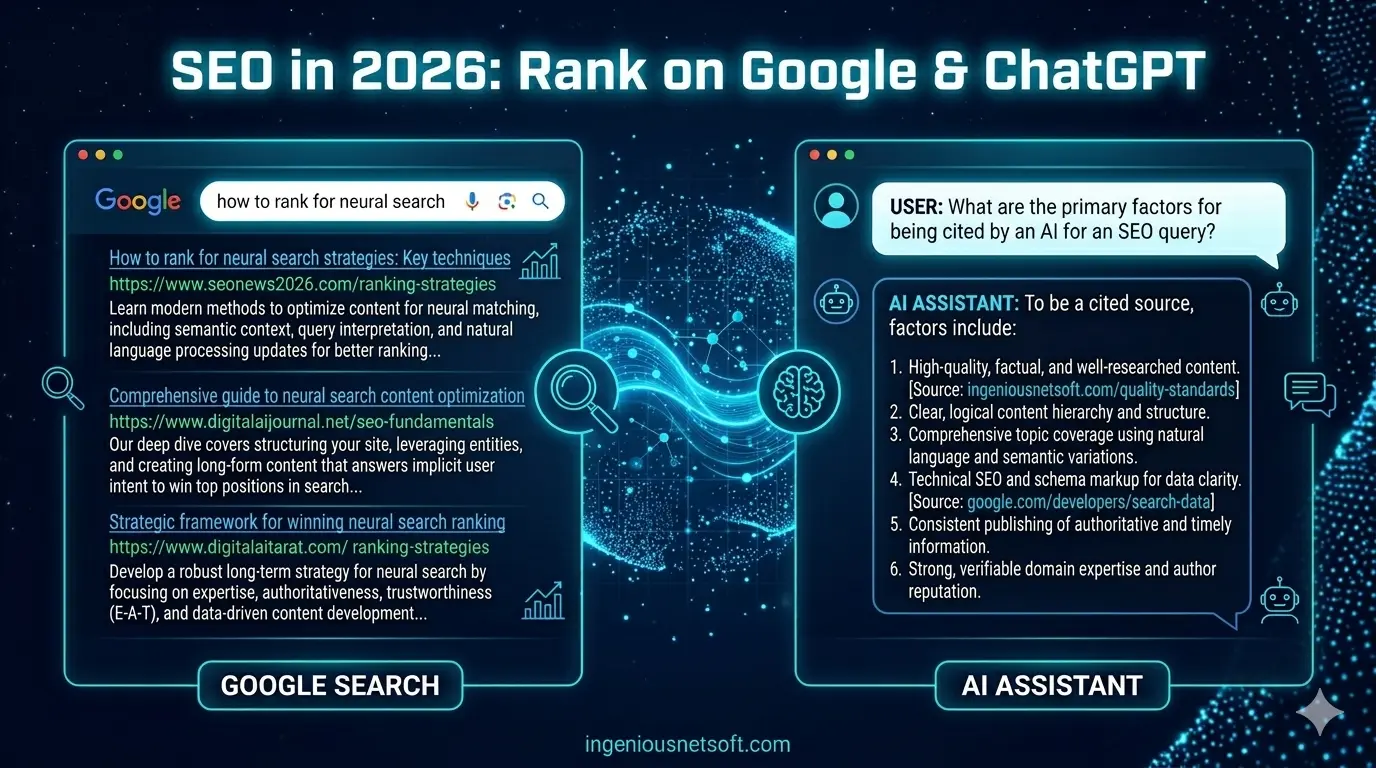
SEO Strategy 2026: How to Rank on Google and ChatGPT at the Same Time
If you’ve been doing SEO the same way for the last few years, you may have already noticed something: your traffic is shifting. Rankings that used to send hundreds of visitors per month are delivering fewer clicks. Blog posts that are ranked on page one are getting fewer impressions.
You’re not imagining it.
SEO in 2026 is fundamentally different, and the businesses that are winning right now are the ones who’ve figured out one critical thing:
There are now two search engines you need to rank on. Google. And AI.
Table of Contents
- What Changed in SEO in 2026?
- Traditional SEO vs GEO (Generative Engine Optimization)
- Why Does Ranking on ChatGPT Even Matter?
- The Complete SEO Strategy for 2026
- Step 1: Target Keywords with Search Intent and Question Format
- Step 2: Build Topical Authority, Not Just Individual Pages
- Step 3: Structure Your Content for AI Extraction
- Step 4: Add Schema Markup
- Step 5: Focus on Information Gain, Not Just Good Writing
- Step 6: Build Brand Signals Across the Web
- Should You Stop Traditional SEO?
- Recommended External Resources
- Final Thoughts: The SEO Opportunity of 2026
- Frequently Asked Questions
In this guide, we’ll break down exactly what’s changed, why traditional SEO alone is no longer enough, and how you can build a 2026 SEO strategy that gets you visible on both Google AND AI platforms like ChatGPT, Perplexity, and Google’s own AI Overviews.
TL;DR – Key Takeaways
Too busy to read the full guide? Here’s what you need to know:
-
AI is rewriting search:
Google AI Overviews and ChatGPT have fundamentally changed how people find and consume information online, and your SEO strategy must catch up. -
Clicks are dropping:
AI Overviews reduce organic click-through rates on top results by an average of 34.5%, meaning ranking #1 no longer guarantees the traffic it once did. -
New opportunities are opening up:
Brands that optimize for AI search are gaining impressions and visibility that their competitors are completely missing. -
Brand signals now protect you:
Websites with a strong brand presence across multiple platforms are far more resilient to Google algorithm updates. -
SEO in 2026 is bigger than keywords:
Winning search now combines content quality, technical structure, brand authority, and AI optimization, all working together.
What Has Actually Changed in SEO in 2026? (The Real Numbers)
Let us start with data, because the numbers tell the real story.
The click crisis is real:
- Google AI Overviews now appear on 48% of all Google searches as of March 2026, up from 31% just a year ago. (Source: Advanced Web Ranking / Digital Applied, 2026)
- For queries where AI Overviews appear, organic click-through rates have dropped by 61%, from 1.76% to 0.61%. (Source: Seer Interactive, September 2025)
- A separate Ahrefs study confirmed AI Overviews correlate with a 58% lower average CTR for the top-ranking page. (Source: Ahrefs, December 2025)
The AI traffic opportunity is also real:
- ChatGPT referral traffic to websites grew 206% year-over-year from January 2025 to January 2026. (Source: Semrush, April 2026)
- AI-referred visitors convert at 4.4x the rate of traditional organic search visitors. (Source: Semrush, 2025)
- Ahrefs found that just 0.5% of total visitors from AI drove 12.1% of signups for their own platform. (Source: Ahrefs, June 2025)
What this means is simple: the old game of ranking for keywords and getting clicks is shrinking. A new game, getting your content cited by AI systems, is growing fast, and the visitors it sends are higher-intent and more likely to convert.
The Two Types of Search You Now Need to Rank For
1. Traditional SEO (Google Blue Links)
This is what most businesses are familiar with. You optimize your pages for target keywords, build backlinks, improve site speed, and aim for page one of Google.
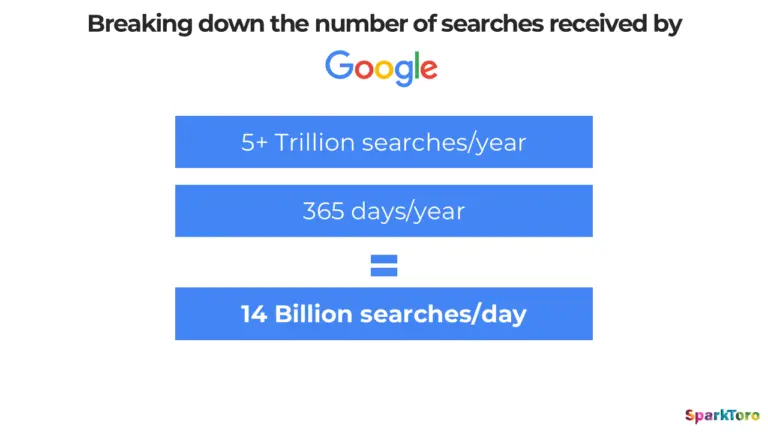
Source: SparkToro
This still matters a lot. Google still handles over 13 billion searches per day, and the majority of high-intent commercial queries still drive clicks. Traditional SEO is not dead. But it is no longer enough on its own.
2. GEO (Generative Engine Optimization)
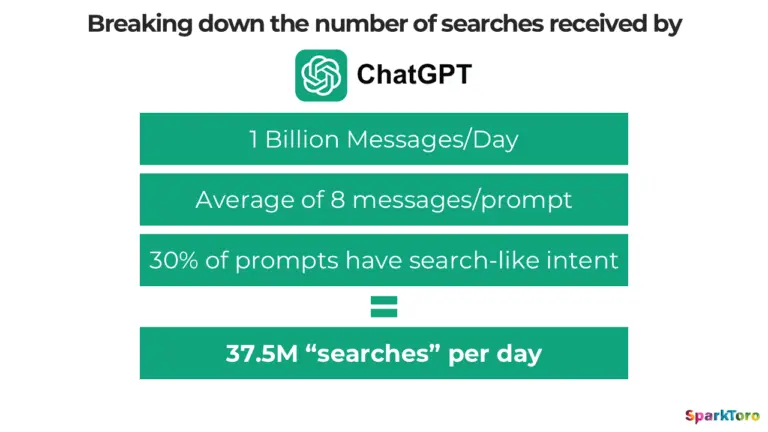
GEO (also called AEO i.e. Answer Engine Optimization, or AI SEO) is the practice of optimizing your content so that AI systems like ChatGPT, Google AI Overviews, Perplexity, and Gemini cite your website when answering user queries.
Source: SparkToro
Instead of ranking #1 on a page of blue links, the goal with GEO is to become the source that AI pulls its answer from.
Think of it this way: when someone asks ChatGPT “what is the best SEO strategy for a small business in 2026?” — whose content does it reference? That is the GEO opportunity, and most of your competitors have not started chasing it yet.
Key insight:
Research shows that 90% of ChatGPT citations come from pages that are NOT in Google’s top 20 results.
(Source: ALM Corp, 2026)
This means even smaller, specialist websites can outcompete large domains in AI search if their content is structured correctly.
Why Does Ranking on ChatGPT Even Matter?
Great question, especially because many SEOs initially dismissed AI search as a novelty.
Here’s what the data says:
- 90% of ChatGPT citations come from pages that are NOT in Google’s top 20 results. This means even smaller websites can get cited by AI if their content is structured correctly.
- AI referral traffic has grown 206% in one year (Semrush, 2026).
- Users who find you via AI citations tend to have higher intent; they’ve already been given a recommendation.
In short: AI search is no longer a future trend. It’s happening right now, and your competitors are already paying attention.
The 2026 Dual SEO Strategy: How to Rank on Both
Here is the practical, actionable framework we recommend for businesses that want to dominate both traditional Google search and AI-powered search in 2026.
Step 1: Target Keywords with Both Search Intent AND Question Format
Traditional SEO focuses on search volume and keyword difficulty. That still matters in 2026. But for AI search optimization, you also need to think about how people phrase questions to ChatGPT and Perplexity; these are conversational, full-sentence questions, not fragmented keywords.
Example:
| Traditional Keyword | AI-Optimized Version |
|---|---|
| SEO tips 2026 | What are the best SEO tips for small businesses in 2026? |
| improve Google ranking | How do I improve my Google ranking without a big budget? |
| digital marketing strategy | What digital marketing strategy works best for local businesses? |
Your content should naturally answer both types — the short keyword for Google, and the full question for AI platforms. Between 65% and 85% of ChatGPT prompts do not match any traditional search keyword
(Source: Semrush, 2026) — meaning keyword research alone will leave a massive gap in your AI visibility.
Step 2: Build Topical Authority, Not Just Individual Pages
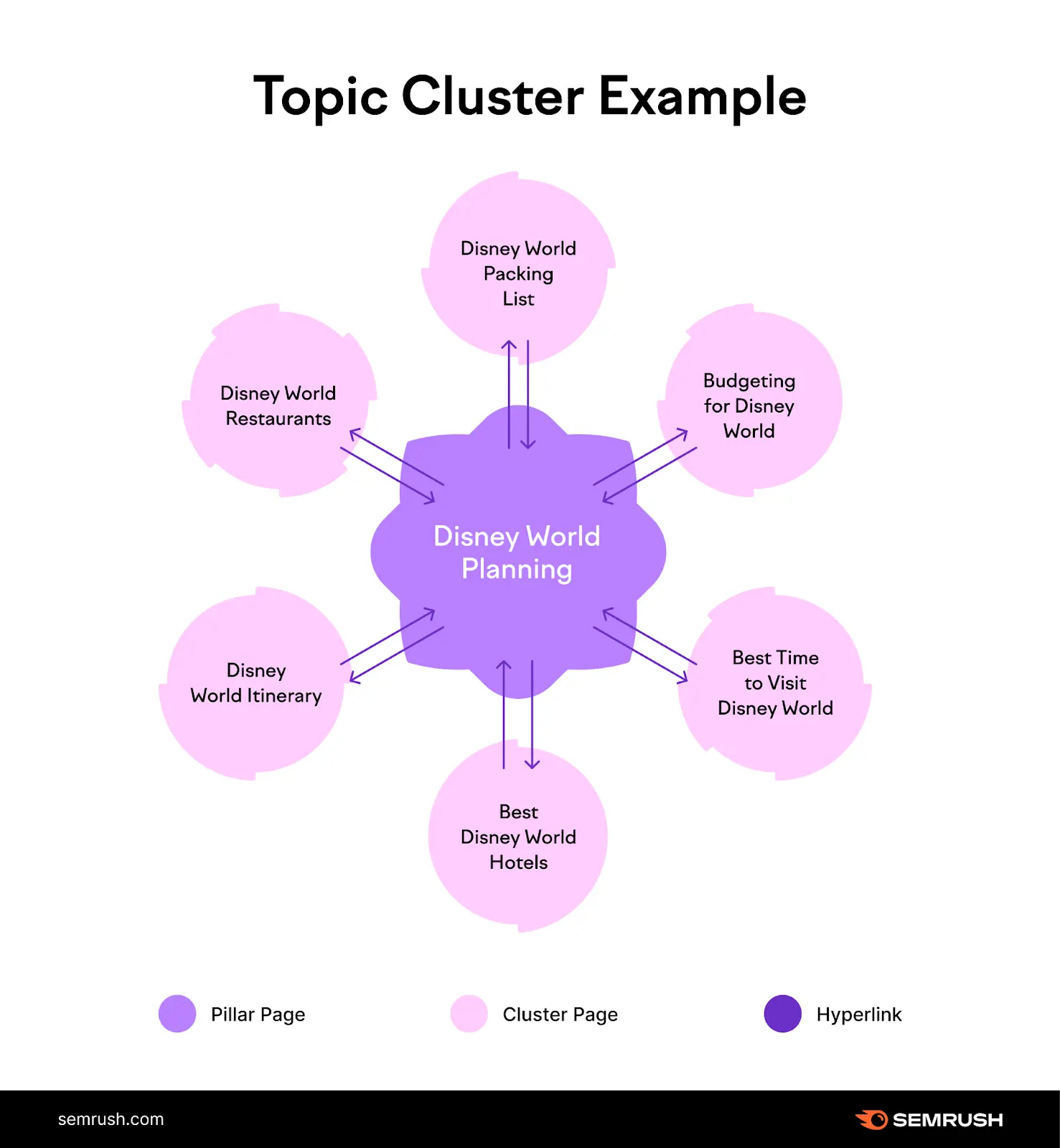
Both Google and AI platforms reward topical depth. One blog post about SEO is not enough anymore. What wins in 2026 is a network of content that covers a topic thoroughly from multiple angles — this is called a Topic Cluster strategy.
Source: Semrush
How to build a topic cluster:
- Pillar page: “Complete Guide to SEO in 2026” (2,500–5,000 words, covers everything)
- Cluster pages: Individual blogs on GEO, keyword research, technical SEO, on-page SEO, local SEO, schema markup
- Internal linking: Every cluster page links back to the pillar, and vice versa
When AI systems see that your website has deep, interconnected content on a topic, they treat you as a topical authority, far more likely to cite you consistently across multiple queries.
From our 15 years of experience: Clients who invest in topic clusters consistently outperform competitors relying on isolated, one-off blog posts, even when those competitors have higher domain authority.
Step 3: Structure Your Content for AI Extraction
This is the single most important — and most overlooked — step in AI search optimization. AI systems do not read content the way humans do. They scan for clear, well-structured answers they can extract and use. Vague introductions and long-winded paragraphs get skipped entirely.
How to structure content for AI citation in 2026:
Answer the main question in the first 2–3 sentences. Do not bury your answer at the bottom. AI interfaces are designed to summarize quickly — give them what they need immediately.
Use clear H2 and H3 headings that mirror how people phrase questions. “What is Generative Engine Optimization?” beats “Our Approach to Modern SEO.”
Use definition boxes for key terms:
Generative Engine Optimization (GEO) is the practice of structuring and writing content so that AI systems like ChatGPT, Google AI Overviews, and Perplexity can extract, understand, and cite it in their generated answers.
Keep paragraphs to 3–4 sentences maximum. AI systems favour information density over filler.
Use numbered lists and bullet points for step-by-step content — these are the easiest format for AI to extract and reproduce accurately.
Step 4: Add Schema Markup
Schema markup (structured data) is code added to your website that tells search engines and AI systems exactly what your content means and who it is from. In 2026, schema is one of the clearest authority signals you can send.
The most important schema types for SEO strategy in 2026:
- FAQ Schema — highly effective for getting featured in AI answers and Google’s People Also Ask
- HowTo Schema — ideal for step-by-step guides like this one
- Article Schema — establishes authorship and content credibility (critical for E-E-A-T)
- Organization Schema — builds brand entity recognition with Google and AI platforms
- LocalBusiness Schema — essential for local SEO ranking
If you are on WordPress, tools like Rank Math or Yoast SEO make schema implementation straightforward without any coding knowledge.
Step 5: Focus on Information Gain, Not Just Good Writing
Google’s quality guidelines emphasise a concept called Information Gain: content that adds new, original information to the web is rewarded more than content that simply rephrases what already exists. For AI platforms, this principle is even more critical.
ChatGPT and Perplexity are specifically designed to prefer sources that offer unique data points, original insights, case studies, or first-hand expertise — things that AI itself cannot generate from training data alone.
Practical ways to add Information Gain to your content:
- Share real results from your own campaigns: “We ran this keyword clustering strategy for a client in the e-commerce space for 6 months — here is what the data showed.”
- Include original statistics from your own work or client results
- Take a clear, expert stance — not just “here are both sides”
- Reference real industry experience with specific examples
This is precisely where established agencies like Ingenious Netsoft hold a massive competitive advantage over generic AI-generated content. Fifteen years of campaign data, client results, and industry experience cannot be replicated — and search engines are increasingly rewarding it.
Step 6: Build Brand Signals Across the Web
Both Google and AI systems increasingly favour recognized brands over anonymous websites. The more your brand appears consistently across the web — in PR coverage, social media, business directories, and industry publications — the more trusted your content becomes to AI systems.
Research confirms this clearly:
- Domains with brand mentions on platforms like Quora and Reddit have roughly 4x higher chances of being cited by ChatGPT. (Source: SE Ranking, November 2025)
- Domains with profiles on Trustpilot, G2, Capterra, or Google Business have 3x higher chances of being chosen by ChatGPT as a source. (Source: SE Ranking, November 2025)
Action steps to build brand signals:
- Get featured in industry publications and relevant guest posts
- Maintain an active, consistent presence on LinkedIn
- Build up reviews on Google Business, Clutch, and Trustpilot
- Create proper author profiles for all content with real credentials and experience
- Ensure your NAP (Name, Address, Phone) is consistent across all directories
Does Traditional SEO Still Matter in 2026?
Absolutely, yes. Here’s why you shouldn’t abandon it:
Google still drives the majority of search traffic for commercial queries. When someone types “digital marketing agency in [city]” into Google, they still click on results. Traditional SEO captures this traffic.
The smart approach is not to choose between traditional SEO and GEO; it’s to do both. And the good news? Many of the same practices that help you rank on Google (quality content, backlinks, structured data, fast load times) also help you get cited by AI.
The difference is in the details of how you write and structure your content.
Quick Summary: SEO vs GEO in 2026
| Factor | Traditional SEO (Google) | GEO (AI Search) |
|---|---|---|
| Goal | Rank in blue links | Get cited in AI-generated answers |
| Success metric | Rankings and organic clicks | Citations, mentions, share of voice |
| Content format | Keyword-optimised pages | Question-answering, structured content |
| Key signals | Backlinks, domain authority, keywords | Information density, entity clarity, structure |
| Who benefits most | Commercial/local intent queries | Research and informational queries |
| Tracking tools | Google Search Console, Ahrefs, Semrush | Semrush Brand Monitoring, OtterlyAI |
Recommended External Resources
For deeper reading on these topics from authoritative sources:
- Google Search Central — How Google Search Works
- Semrush — ChatGPT Traffic Study, April 2026
- Seer Interactive — AI Overviews CTR Impact Study
- Search Engine Journal — 2026 SEO Trends
- Ahrefs — ChatGPT Traffic Guide
Final Thoughts: The SEO Opportunity of 2026
Here is the honest truth after 15 years in this industry: most businesses are still only doing traditional SEO. The vast majority have not adapted their content strategy to target AI search at all.
That means right now in mid-2026 there is a significant first-mover advantage for businesses willing to adapt early. The companies building GEO-optimised content today will establish AI citation authority before their competitors even realise the game has changed.
Combined with a solid traditional SEO foundation, this dual-search approach is the most powerful SEO strategy available in 2026, and the gap between those who implement it and those who do not is widening every month.
Need help implementing this for your business? Whether it is a full SEO audit, a topic cluster content plan, technical schema implementation, or a complete AI search strategy, the team at Ingenious Netsoft has been helping businesses grow their online visibility for over 15 years.
Contact our team today, and let us build a search strategy that works for both Google and AI.
Want to go deeper? Take a course related to this topic.