
Is Paid Search Worth It When My Marketing Budget Is Small?
Running a small business means every rupee, dollar, or pound counts. So before you invest in paid search, you want to know one thing: will it actually work for me?
The short answer? It depends. Paid search can be a game-changer for some businesses. For others, it can quietly drain a budget with little to show for it.
Table of Contents
- What Is the Real Cost of Paid Search for Small Businesses?
- Signs Paid Search Makes Sense for Your Small Business
- Signs You Should Hold Off on Paid Search
- How to Test Paid Search Without Wasting Your Small Budget
- When to Hire a Paid Search Advertising Agency
- 6 Common Small Budget Mistakes That Kill ROI
- Our Approach
- What We Can Do
- Frequently Asked Questions
This guide breaks down everything you need to know about working with a paid search advertising agency or going it alone, clearly, honestly, and without the jargon.
TL;DR
- Paid search fails when poorly structured.
- Tracking, targeting, and optimisation are essential.
- Small budgets can work with focused strategy.
- A skilled paid search advertising agency improves ROI and consistency.
- Success depends more on setup than spend
What Is the Real Cost of Paid Search for Small Businesses?
Paid search offers quick visibility, but small businesses must balance every click against real returns. The right strategy can drive leads, while the wrong one can waste valuable budgets.
What You Actually Pay For
When you run a paid search campaign, you pay each time someone clicks your ad. This is called pay-per-click, or PPC. You set a daily budget, choose keywords, and your ads appear when people search for those terms.
But clicks alone don’t make money. Conversions do. So the number that really matters is your cost per lead (CPL), what you pay to get one enquiry, sign-up, or sale.
Why Costs Have Gone Up
Search advertising has become more competitive. More businesses are bidding on the same keywords. As a result, average cost-per-click rose 12.88% year over year in 2025, according to data compiled across thousands of Google Ads accounts.
Additionally, AI Overviews on Google are taking up more screen space. This reduces the pool of clicks available for paid ads, pushing costs up further for everyone.
The Good News — CPL Finally Dropped in 2026
Here is something worth knowing before you give up on paid search entirely.
In 2026, the average cost per lead across all industries on Google Ads dropped to $66.69, the first time in several years that CPL has actually declined. This happened because AI-powered bidding and better landing page matching have improved conversion efficiency.
In plain terms: more clicks are turning into actual leads.
The average conversion rate for Google Ads Search campaigns in 2026 sits between 4.40% and 7.04%, a notable improvement from prior years, driven in part by better AI-matched landing page experiences.
Source: https://www.dollarpocket.com/google-ads-benchmarks-2026-cpc-ctr-cvr-cpl-by-industry/?utm_source
This makes 2026 a practical time to test paid search, especially if you are considering working with a paid search advertising agency for the first time.
Signs Paid Search Makes Sense for Your Small Business
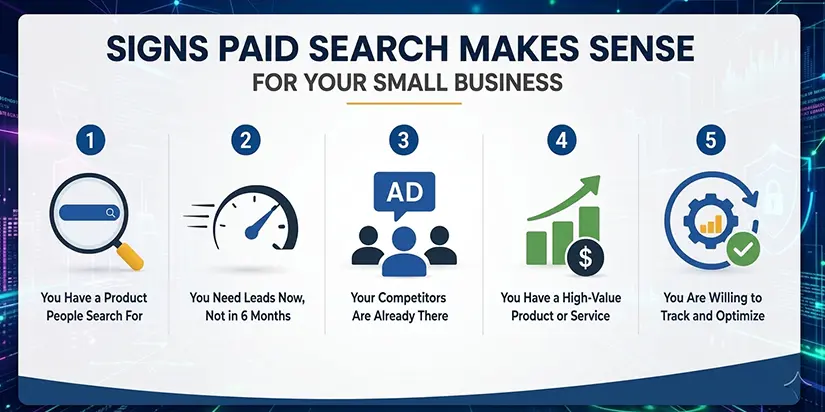
Paid search makes sense when you need quick visibility and already have a website that can convert visitors into leads or sales.
1. You Have a Product People Search For
Paid search only works when people are actively looking for what you sell. If someone types “emergency plumber London” or “custom wedding cake Nairobi,” they already want to buy. Your ad simply needs to appear at the right moment.
However, if your product is new or niche, people may not yet know how to search for it. In that case, paid search is not your best starting point.
2. You Need Leads Now, Not in 6 Months
SEO is powerful, but it takes time, often six to twelve months to show results. Paid search, on the other hand, can generate leads within days of launching. A skilled paid search advertising agency can have your first campaign live within a week.
If you have a short sales window, a new product launch, or a seasonal offer, paid search marketing services give you speed that organic channels simply cannot match.
3. Your Competitors Are Already There
Do a quick search for your main service. Are your competitors showing up in ads at the top? If yes, and you are not there, you are handing them your potential customers for free.
A basic rule: if your competitors are investing in a paid search advertising agency, it is worth at least testing whether you should too.
4. You Have a High-Value Product or Service
Paid search works best when there is a strong return on a converted lead. On average, businesses make $2 for every $1 spent on PPC campaigns. But that average rises significantly when your product has a higher price point.
If a single customer is worth $500 or more to your business, even a $70 cost per lead can make strong financial sense. The maths matters here.
5. You Are Willing to Track and Optimize
Paid advertising services are not a “set and forget” tool. The businesses that win are the ones that review their data, remove wasted spend, and continuously improve. If you are willing to put in that time, or hire someone to do it, paid search can deliver strong results.
Signs You Should Hold Off on Paid Search
Hold off on paid search if your website isn’t ready to convert traffic or your targeting and tracking aren’t clearly defined yet. It can end up wasting the budget without delivering meaningful results.
1. Your Margins Are Too Thin
If you sell a $30 product with a 20% margin, spending $50 to acquire a customer is a losing equation. Before investing in paid advertising services, calculate your break-even cost per lead. If the numbers do not work, they do not work.
2. You Have No Conversion Tracking Set Up
This is non-negotiable. Without conversion tracking, you are flying blind. You will not know which keywords bring leads and which ones burn budget. Consequently, you will keep spending on things that do not work.
3. Your Website Does Not Convert
Sending traffic to a slow, confusing, or outdated website is like pouring water into a leaking bucket. Furthermore, if your landing page does not match your ad’s promise, visitors will leave immediately. Fix your website first, then run ads.
4. You Have No Time to Manage Campaigns
72% of companies have not looked at their ad campaigns in over a month. This is one of the biggest reasons small budgets get wasted. Paid search needs regular attention, weekly at minimum. If you do not have that time, consider hiring a paid search advertising agency before you start.
How to Test Paid Search Without Wasting Your Small Budget
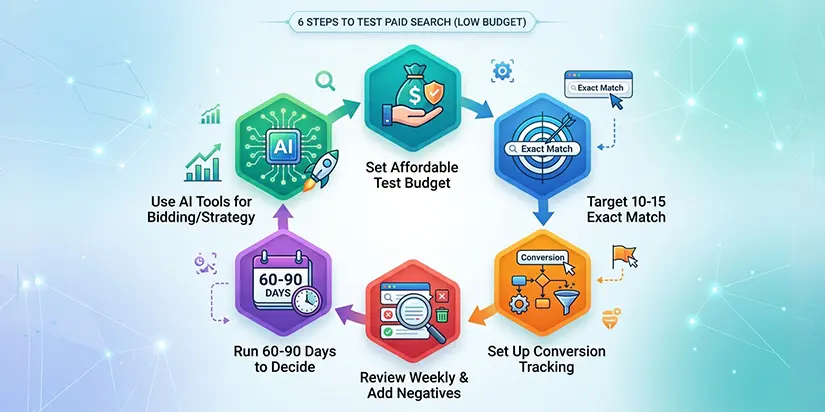
Testing is how you find out if paid search works for your specific business. Here is a step-by-step approach that limits risk.
Step 1: Start with a Test Budget You Can Afford to Lose
Do not put your emergency fund into Google Ads. Start with a budget you are genuinely comfortable losing, even if you learn nothing else, you will understand the platform better.
A reasonable starting point for most small businesses is $500–$1,000 per month for a 60-90 day test.
Step 2: Target Only 10–15 Exact Match Keywords
Broad match keywords will spend your budget on irrelevant searches. Instead, start with exact match keywords. These are specific, high-intent phrases that closely match what your best customers are searching for.
For example, affordable web design for startups is far more targeted than just web design.
Step 3: Set Up Conversion Tracking First
Before you spend a single dollar, make sure conversion tracking is live. Set up Google Tag Manager, configure your goals, and test them. This is the foundation of everything that follows.
Step 4: Review Search Terms Every Week
Your search term report shows the actual phrases people typed before clicking your ad. Review it every week without fail. Add irrelevant terms as negative keywords. This alone can save 20–30% of your budget from being wasted.
Step 5: Run for 60–90 Days Before Deciding
Do not judge a campaign after two weeks. Paid search needs data to optimize. Give your campaigns at least 60 days before drawing conclusions. Ad scheduling also plays a role here, over time, you will notice which hours and days perform best.
Step 6: Use AI-Powered Tools to Stretch Your Budget
An AI PPC budget optimizer or AI small business PPC strategy tool can help you make smarter bidding decisions without a full-time analyst. Many platforms now offer AI-powered recommendations for bidding strategy, ad scheduling, and audience targeting. Use them, especially when the budget is limited.
When to Hire a Paid Search Advertising Agency
Hire a paid search agency when campaigns get complex or results stop improving, and you need expert help to scale and optimize performance.
You Can Do It Yourself If:
- You have time to learn the platform properly.
- Your monthly budget is under $1,000.
- You are comfortable reviewing data weekly.
- Your campaigns are simple (one service, one location).
Hire a Paid Search Advertising Agency If:
- You are spending over $1,500 per month and want every dollar to work harder.
- You have tried running ads but saw little return.
- You want geo-targeting, advanced bidding strategy, or multi-campaign structures.
- You simply do not have the time to manage it consistently.
What to Look for in an Agency
Not all agencies are equal. Look for a paid search advertising agency that provides transparent reporting, clear ownership of your ad account, and regular communication. Ask how they measure success. If they cannot explain it simply, that is a red flag.
A good agency offering paid search marketing services will tell you honestly if paid search is not right for your business, and suggest what to do instead.
6 Common Small Budget Mistakes That Kill ROI
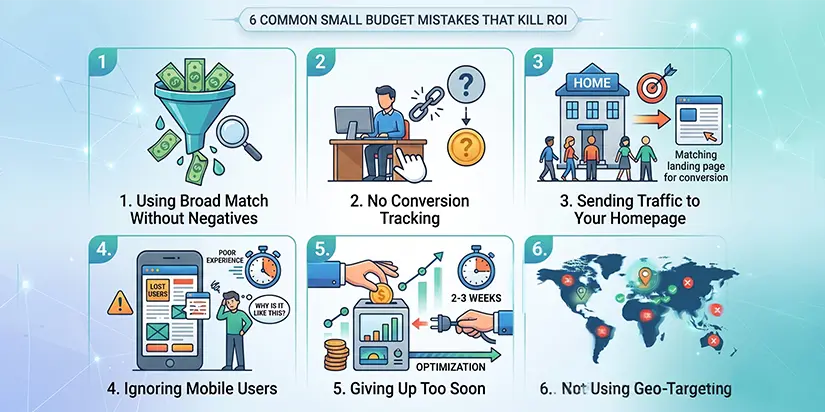
Small budgets lose ROI when targeting is too broad, tracking is missing, or spend is spread across too many keywords instead of focusing on high-intent ones.
1. Using Broad Match Without Negatives
Broad match keywords trigger your ads for all kinds of loosely related searches. Without a negative keyword list, you will pay for clicks that have no chance of converting. Always combine broad matches with a strong negative keyword strategy.
2. No Conversion Tracking
Already mentioned, but worth repeating. Without conversion tracking, you cannot improve what you cannot measure.
3. Sending Traffic to Your Homepage
Your homepage serves everyone. Your ad targets a specific searcher with a specific need. Therefore, always send paid traffic to a dedicated landing page that mirrors your ad’s message exactly.
4. Ignoring Mobile Users
Most searches now happen on mobile. If your landing page is not mobile-friendly, you are losing a significant chunk of potential leads before they even read your offer. Review your mobile experience regularly.
5. Giving Up Too Soon
Many small business owners run ads for two or three weeks, see no results, and quit.
Meanwhile, the data needed to optimize simply has not had time to accumulate. Give campaigns time. Patience is a genuine competitive advantage in paid search, and one reason working with a paid search advertising agency often outperforms solo efforts over time.
6. Not Using Geo-Targeting
If you serve a local area, national or global targeting will burn your budget fast. Use geo-targeting to show ads only where your customers actually are. Local search ads are often far more cost-effective than broad targeting, especially for service-area businesses.
Ingenious Netsoft Helps You Scale Your Paid Search Performance
The Problem
Small businesses often struggle with paid search because campaigns are launched without proper structure. Budgets get wasted on broad keywords, tracking is missing, and traffic is sent to weak landing pages. As a result, costs go up while leads stay low, creating the impression that paid search does not work.
Our Approach
At Ingenious Netsoft, paid search is built on clarity and performance. We focus on precise keyword targeting, geo-targeting, and strong conversion tracking from day one.
AI-supported insights, including tools like an AI PPC budget optimizer, help improve bidding decisions and reduce wasted spend. Campaigns are continuously refined using search term data, ad performance, and user behavior.
What We Can Do
- Build and manage end-to-end paid search campaigns.
- Handle keyword research, ads, tracking, and optimisation.
- Improve cost per lead through ongoing performance tuning.
- Focus on high-intent traffic for small budgets.
- Scale campaigns with structured paid search marketing services for growth.


