Spending on Social Ads Every Month and Getting Nothing Back
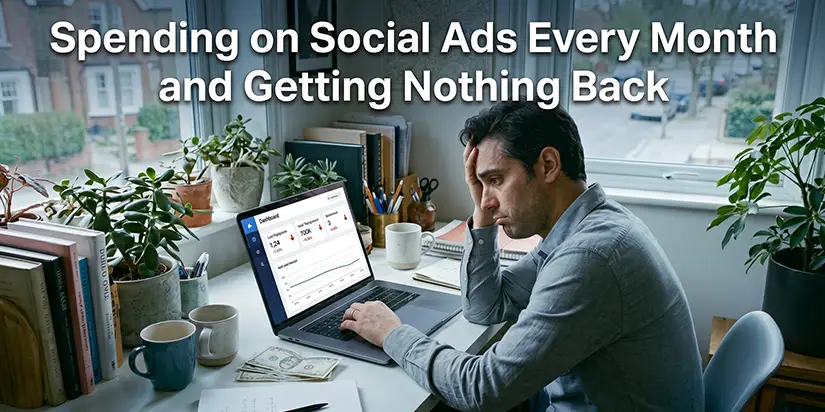
You wait for the sales to roll in, but all you see is your bank account balance going down. You are spending money every month and getting absolutely nothing back!
If this sounds like your business, there is no need to panic. It does not mean your marketing is in-effective or that something is wrong with your approach.
Table of Contents
The reality is that paid social media advertising has simply evolved, and the rules that once worked no longer deliver the same results. In fact, the old habit of just “boosting a post” without strategy or structure is now one of the fastest ways to lose money.
In this guide, we will break down the invisible mistakes that are killing your ROI and show you how to turn your ads into a profit-making machine.
Why Most Ad Budgets Stop Delivering Returns
Most advertising budgets fail not because of spending levels, but because the underlying strategy no longer matches how platforms and users behave today.
- Clicks Without Conversions: The “Invisible Traffic” Problem
A large share of advertising budgets today is consumed by traffic that never converts. Users scroll faster, make decisions quicker, and ignore anything that feels repetitive or overly promotional.
Social platforms have also changed how discovery works. Instead of passive scrolling alone, users now search, compare, and validate within the same ecosystem. Ads that interrupt this behavior rather than support it tend to get ignored.
Even when impressions and clicks look healthy, the underlying intent is often missing.
- Targeting Is No Longer Just About Filters
Manual audience selection has lost much of its former precision. Age, gender, and interest-based settings still exist, but they are no longer the primary drivers of performance.
Modern systems rely more on content interpretation. The platforms analyze visuals, captions, and even tone to decide who should see an ad. In simple terms, the creative itself now defines the audience more than the settings do.
If the message is unclear, the targeting becomes diluted as well.
- Incomplete Tracking Leads to Wrong Decisions
Another major issue sits behind the scenes: data loss. With changes in privacy policies and the decline of third-party cookies, many conversion journeys are only partially visible. A significant portion of actual purchases may never be correctly attributed to the original ad.
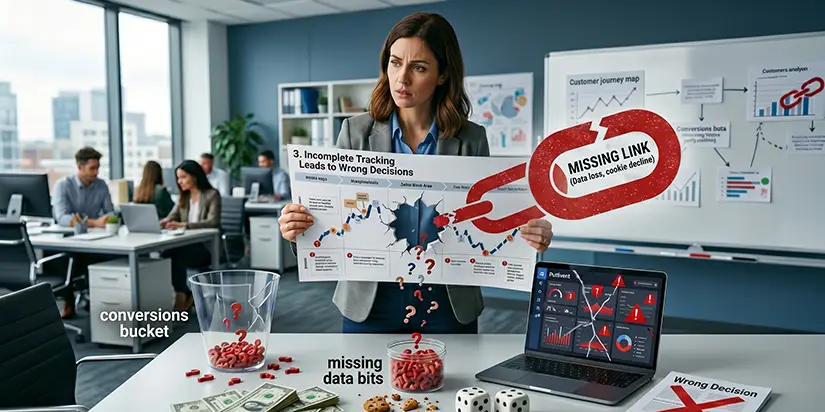
Without accurate tracking, optimization becomes guesswork. Campaigns may look underperforming simply because the system cannot see the full picture of what is working.
- Polished Ads Are Not Always the Best Performers
High-production advertisements are no longer guaranteed to outperform simpler content. In many cases, the opposite is true.
Content that feels natural, direct, and unfiltered often performs better because it resembles how real users communicate online. People respond more to clarity and relatability than to polished production value.
A straightforward message delivered by a real voice can often outperform a heavily produced campaign.
5. Automation Has Become Central to Performance
Campaign management today is heavily influenced by automation systems that continuously adjust bids, placements, and budgets in real time.
This reduces manual control but increases speed and responsiveness. The challenge is no longer just launching ads, but guiding the system with the right inputs—creative, data, and structure.
Without proper setup, automation can just as easily scale inefficiencies as it can scale success.
- Ads No Longer Work in Isolation
A user rarely converts immediately after seeing an ad. Most will look for additional validation before making a decision.
That means advertising performance is now tied closely to overall brand presence. If supporting information is weak or inconsistent, even strong ads struggle to convert attention into action.
The journey does not end at the click anymore; it continues across search, reviews, and reputation.
- Pushing for Sales Too Early Reduces Efficiency
Many campaigns fail because they attempt to convert users too quickly. Cold audiences often need time before they are ready to purchase.
A more effective structure typically follows a gradual path: introducing the problem, presenting the solution, and only then offering the product.
This layered approach allows interest to develop naturally rather than forcing immediate decisions.
- Technical Setup Now Matters as Much as Creativity
Success in paid social campaigns is no longer driven by creativity alone. The technical foundation behind the ads has become equally important.
Accurate tracking, proper event setup, and clean data signals all influence how platforms optimize delivery. Without these elements, even strong creative work can underperform.
Case Study: Instagram Ads Driving 8.7X ROAS (Clinique Australia)
A documented industry case shows how a global skincare brand significantly improved advertising performance using authentic, creator-led social media ads instead of traditional polished creatives.
Clinique Australia ran an Instagram branded content campaign featuring real creators reviewing and demonstrating the product. The goal was to increase both awareness and online sales through more “native-feeling” content.
Results of the Campaign
- 8.7X return on ad spend (ROAS).
- 54% lower cost per purchase.
- 1.8X higher ROAS compared to standard photo ads.
The key reason for success was not increased budget, but the shift toward authentic, user-style content that blended into social feeds rather than looking like traditional advertising.
Source
Meta Case Study (Clinique Australia – Instagram Branded Content Ads)
https://www.casestudies.com/company/instagram/case-study/clinique-customer-case-study
The Next Wave: What to Expect in Late 2026
As we move forward, the integration of Augmented Reality (AR) and even more advanced ai paid social optimization will become standard. The brands that survive are those that treat their ad budget as an investment in data, not just a gamble for sales. Every dollar you spend should teach the AI more about your customer.
Conclusion
The frustration of spending on paid social media advertising and getting nothing back is a signal that your strategy is out of sync with the modern market. By fixing your data signals, embracing authentic creative, and utilizing ai paid social optimization, you can turn the tide. Stop chasing clicks and start building a machine that understands your audience better than they understand themselves. When you align human creativity with AI precision, the ROI will finally follow.